Center for Reproductive Medicine, Department of Gynecology and Obstetrics, Nanfang Hospital, Southern Medical University, No 1838 Guangzhou Northern Road, Guangzhou, 510515, People's Republic of China.
J Ovarian Res. 2023 Jan 5;16(1):2. doi: 10.1186/s13048-022-01085-y.
Premature ovarian insufficiency (POI) patients are predisposed to metabolic disturbances, including in lipid metabolism and glucose metabolism, and metabolic disorders appear to be a prerequisite of the typical long-term complications of POI, such as cardiovascular diseases or osteoporosis. However, the metabolic changes underlying the development of POI and its subsequent complications are incompletely understood, and there are few studies characterizing the disturbed metabolome in POI patients. The aim of this study was to characterize the plasma metabolome in POI by using ultrahigh-performance liquid chromatography-mass spectrometry (UHPLC-MS/MS) metabolomics and to evaluate whether these disturbances identified in the plasma metabolome relate to ovarian reserve and have diagnostic value in POI.
This observational study recruited 30 POI patients and 30 age- and body mass index (BMI)-matched controls in the Center for Reproductive Medicine, Department of Gynecology and Obstetrics, Nanfang Hospital, Southern Medical University, from January 2018 to October 2020. Fasting venous blood was collected at 9:00 am on days 2-4 of the menstrual cycle and centrifuged for analysis. An untargeted quantitative metabolomic analysis was performed using UHPLC-MS/MS.
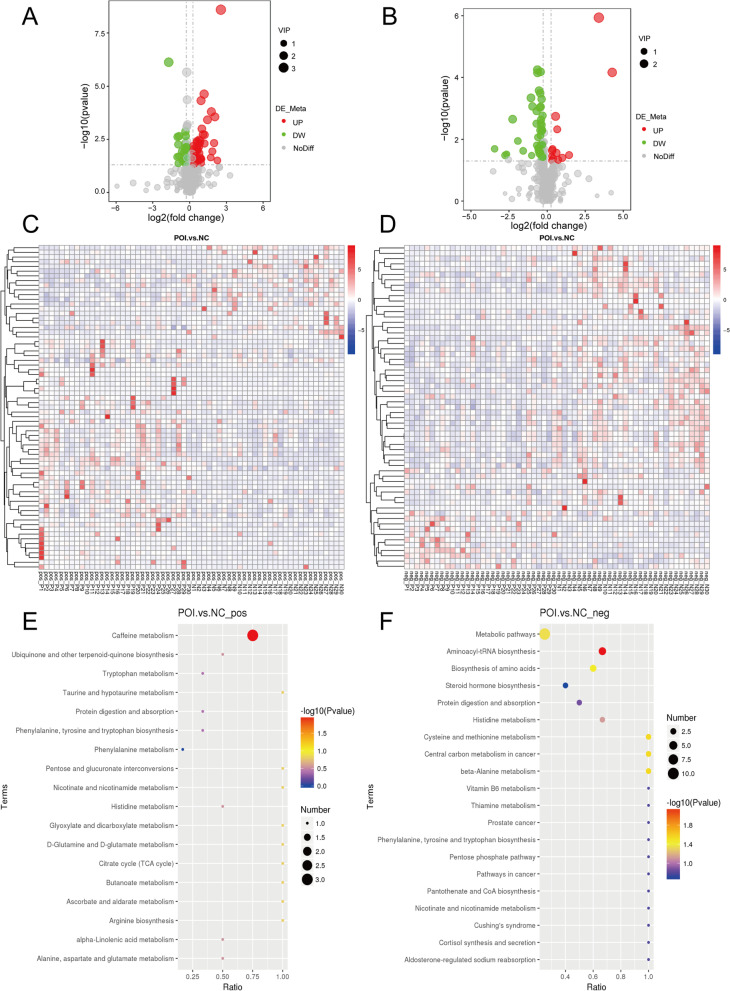
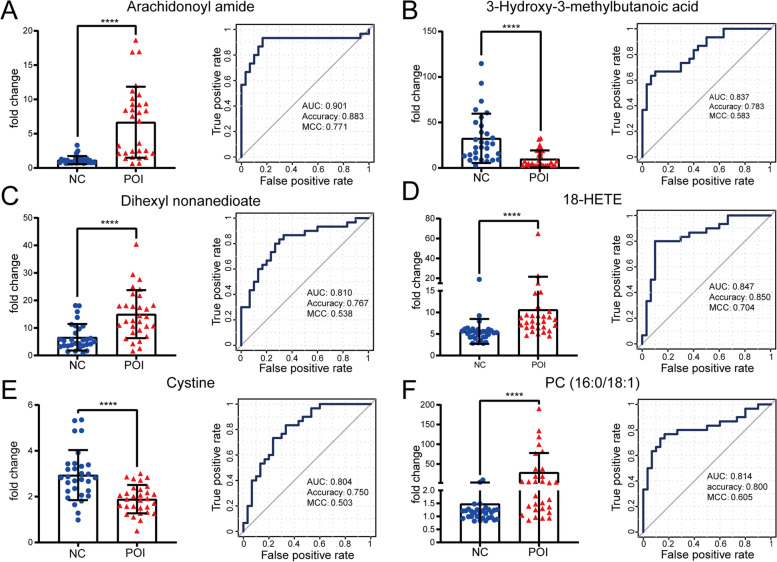
Our study identified 48 upregulated and 21 downregulated positive metabolites, and 13 upregulated and 48 downregulated negative metabolites in the plasma of POI patients. The differentially regulated metabolites were involved in pathways such as caffeine metabolism and ubiquinone and other terpenoid-quinone biosynthesis. Six metabolites with an AUC value > 0.8, including arachidonoyl amide, 3-hydroxy-3-methylbutanoic acid, dihexyl nonanedioate, 18-HETE, cystine, and PG (16:0/18:1), were correlated with ovarian reserve and thus have the potential to be diagnostic biomarkers of POI.
This UHPLC-MS/MS untargeted metabolomics study revealed differentially expressed metabolites in the plasma of patients with POI. The differential metabolites may not only be involved in the aetiology of POI but also contribute to its major complications. These findings offer a panoramic view of the plasma metabolite changes caused by POI, which may provide useful diagnostic and therapeutic clues for POI disease.
卵巢早衰(POI)患者易发生代谢紊乱,包括脂质代谢和糖代谢紊乱,而代谢紊乱似乎是 POI 典型的长期并发症(如心血管疾病或骨质疏松症)的前提。然而,导致 POI 及其随后并发症发展的代谢变化尚不完全清楚,并且很少有研究描述 POI 患者中失调的代谢组。本研究旨在使用超高效液相色谱-质谱联用(UHPLC-MS/MS)代谢组学来描述 POI 患者的血浆代谢组,并评估这些在血浆代谢组中发现的紊乱是否与卵巢储备有关,以及在 POI 中是否具有诊断价值。
本观察性研究于 2018 年 1 月至 2020 年 10 月在南方医科大学南方医院妇产科生殖医学中心招募了 30 名 POI 患者和 30 名年龄和体重指数(BMI)匹配的对照者。在月经周期第 2-4 天的上午 9:00 采集空腹静脉血并离心进行分析。使用 UHPLC-MS/MS 进行非靶向定量代谢组学分析。
本研究在 POI 患者的血浆中发现了 48 个上调和 21 个下调的阳性代谢物,以及 13 个上调和 48 个下调的阴性代谢物。差异调节的代谢物参与了咖啡因代谢和泛醌以及其他萜烯醌生物合成等途径。AUC 值>0.8 的 6 种代谢物,包括花生四烯酰胺、3-羟基-3-甲基丁酸、二己基壬二酸酯、18-HETE、胱氨酸和 PG(16:0/18:1),与卵巢储备相关,因此具有成为 POI 的诊断生物标志物的潜力。
本 UHPLC-MS/MS 非靶向代谢组学研究揭示了 POI 患者血浆中差异表达的代谢物。差异代谢物不仅可能参与 POI 的发病机制,而且可能导致其主要并发症。这些发现提供了 POI 引起的血浆代谢物变化的全景图,可能为 POI 疾病提供有用的诊断和治疗线索。