Campolo Allison, Pifer Reed, Walters Rhonda, Thomas Megan, Miller Elise, Harris Valerie, King Jamie, Rice Christopher A, Shannon Paul, Patterson Brian, Crary Monica
Alcon Research, LLC, Fort Worth, TX, United States.
Department of Comparative Pathobiology, College of Veterinary Medicine, Purdue University, West Lafayette, IN, United States.
Front Microbiol. 2022 Dec 19;13:1089092. doi: 10.3389/fmicb.2022.1089092. eCollection 2022.
keratitis is often caused when contaminate contact lenses and infect the cornea. is pervasive in the environment as a motile, foraging trophozoite or biocide-resistant and persistent cyst. As contact lens contamination is a potential first step in infection, we studied behavior and interactions on different contact lens materials. We hypothesized that contact lenses may induce aggregation, which is a precursor to encystment, and that aggregated encystment would be more difficult to disinfect than motile trophozoites.
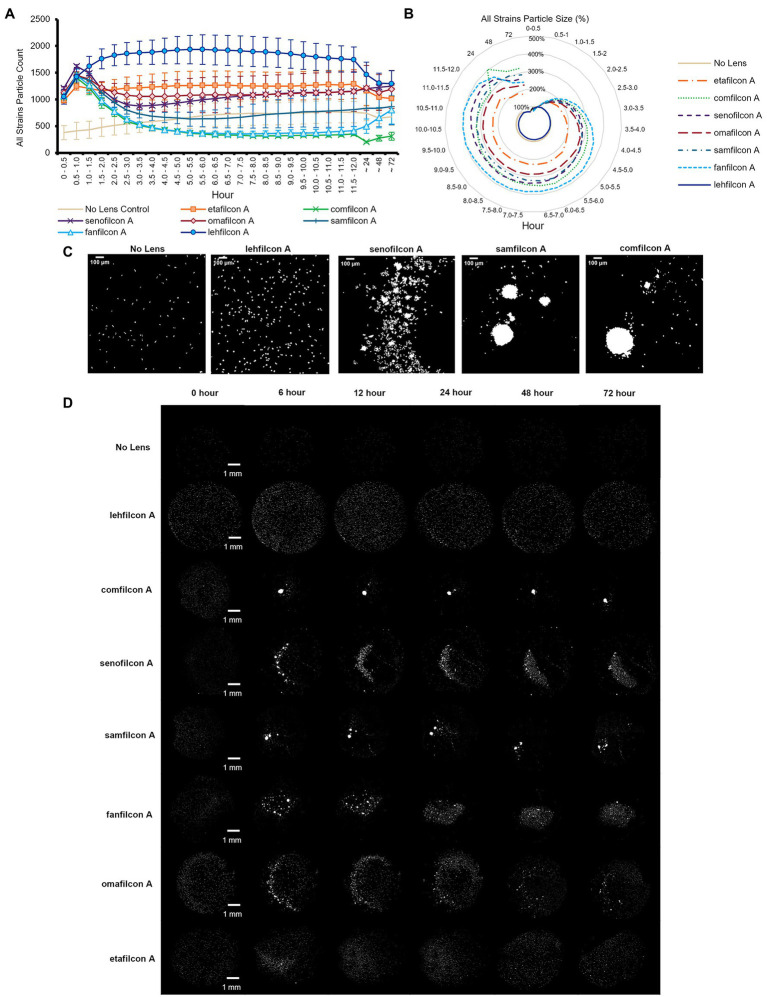
Six clinically and/or scientifically relevant strains of (ATCC 30010, ATCC 30461, ATCC 50370, ATCC 50702, ATCC 50703, and ATCC PRA-115) were investigated on seven different common silicone hydrogel contact lenses, and a no-lens control, for aggregation and encystment for 72 h. Cell count and size were used to determine aggregation, and fluorescent staining was used to understand encystment. RNA seq was performed to describe the genome of which was individually motile or aggregated on different lens materials. Disinfection efficacy using three common multi-purpose solutions was calculated to describe the potential disinfection resistance of trophozoites, individual cysts, or spheroids.
trophozoites of all strains examined demonstrated significantly more aggregation on specific contact lens materials than others, or the no-lens control. Fluorescent staining demonstrated encystment in as little as 4 hours on contact lens materials, which is substantially faster than previously reported in natural or laboratory settings. Gene expression profiles corroborated encystment, with significantly differentially expressed pathways involving actin arrangement and membrane complexes. High disinfection resistance of cysts and spheroids with multi-purpose solutions was observed.
Aggregation/encystment is a protective mechanism which may enable to be more disinfection resistant than individual trophozoites. This study demonstrates that some contact lens materials promote aggregation and encystment, and spheroids obstruct multi-purpose solutions from disinfecting .
隐形眼镜受污染并感染角膜时常常会引发角膜炎。在环境中,它以活动的觅食滋养体或具有抗杀菌剂能力且持久的包囊形式普遍存在。由于隐形眼镜污染是感染的潜在第一步,我们研究了它在不同隐形眼镜材料上的行为和相互作用。我们假设隐形眼镜可能会诱导聚集,而聚集是包囊形成的前奏,并且聚集形成的包囊比活动的滋养体更难消毒。
对六种临床和/或科学相关的菌株(美国典型培养物保藏中心30010、30461、50370、50702、50703和PRA - 115)在七种不同的常见硅水凝胶隐形眼镜以及无镜片对照上进行了72小时的聚集和包囊形成研究。通过细胞计数和大小来确定聚集情况,使用荧光染色来了解包囊形成情况。进行RNA测序以描述在不同镜片材料上单独活动或聚集的该菌株的基因组。计算使用三种常见多功能护理液的消毒效果,以描述滋养体、单个包囊或球体的潜在消毒抗性。
所有检测菌株的滋养体在特定隐形眼镜材料上的聚集明显多于其他材料或无镜片对照。荧光染色显示在隐形眼镜材料上仅4小时就出现了包囊形成,这比之前在自然或实验室环境中报道的速度要快得多。基因表达谱证实了包囊形成,涉及肌动蛋白排列和膜复合物的通路有显著差异表达。观察到多功能护理液对包囊和球体具有高消毒抗性。
聚集/包囊形成是一种保护机制,这可能使该菌株比单个滋养体更具消毒抗性。本研究表明,一些隐形眼镜材料会促进该菌株的聚集和包囊形成,并且该菌株的球体阻碍了多功能护理液对其进行消毒。