
休闲大麻合法化对一系列成人精神和社会心理结果的影响有限。
Recreational cannabis legalization has had limited effects on a wide range of adult psychiatric and psychosocial outcomes.
作者信息
Zellers Stephanie M, Ross J Megan, Saunders Gretchen R B, Ellingson Jarrod M, Walvig Tasha, Anderson Jacob E, Corley Robin P, Iacono William, Hewitt John K, Hopfer Christian J, McGue Matt K, Vrieze Scott
机构信息
Department of Psychology, University of Minnesota, Minneapolis, Minnesota, USA.
Institute for Molecular Medicine Finland, University of Helsinki, Helsinki, Finland.
出版信息
Psychol Med. 2023 Oct;53(14):6481-6490. doi: 10.1017/S0033291722003762. Epub 2023 Jan 5.
BACKGROUND
The causal impacts of recreational cannabis legalization are not well understood due to the number of potential confounds. We sought to quantify possible causal effects of recreational cannabis legalization on substance use, substance use disorder, and psychosocial functioning, and whether vulnerable individuals are more susceptible to the effects of cannabis legalization than others.
METHODS
We used a longitudinal, co-twin control design in 4043 twins ( = 240 pairs discordant on residence), first assessed in adolescence and now age 24-49, currently residing in states with different cannabis policies (40% resided in a recreationally legal state). We tested the effect of legalization on outcomes of interest and whether legalization interacts with established vulnerability factors (age, sex, or externalizing psychopathology).
RESULTS
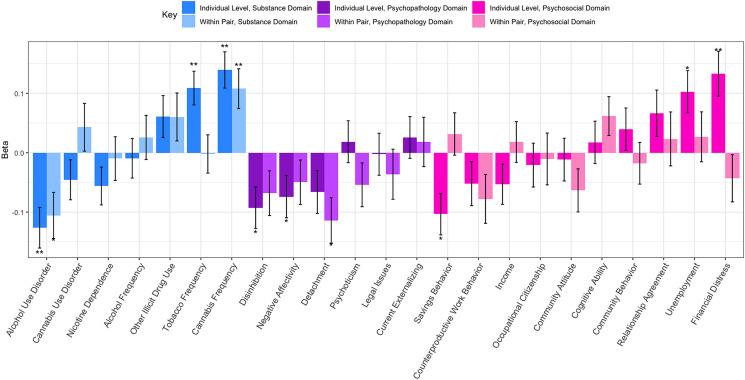
In the co-twin control design accounting for earlier cannabis frequency and alcohol use disorder (AUD) symptoms respectively, the twin living in a recreational state used cannabis on average more often ( = 0.11, = 1.3 × 10), and had fewer AUD symptoms ( = -0.11, = 6.7 × 10) than their co-twin living in an non-recreational state. Cannabis legalization was associated with no other adverse outcome in the co-twin design, including cannabis use disorder. No risk factor significantly interacted with legalization status to predict any outcome.
CONCLUSIONS
Recreational legalization was associated with increased cannabis use and decreased AUD symptoms but was not associated with other maladaptations. These effects were maintained within twin pairs discordant for residence. Moreover, vulnerabilities to cannabis use were not exacerbated by the legal cannabis environment. Future research may investigate causal links between cannabis consumption and outcomes.
背景
由于存在多种潜在的混杂因素,娱乐用大麻合法化的因果影响尚未得到充分理解。我们试图量化娱乐用大麻合法化对物质使用、物质使用障碍和心理社会功能的可能因果效应,以及弱势群体是否比其他人更容易受到大麻合法化的影响。
方法
我们对4043对双胞胎(n = 240对居住情况不一致)采用了纵向同卵双胞胎对照设计,这些双胞胎在青春期首次接受评估,现在年龄在24 - 49岁,目前居住在大麻政策不同的州(40%居住在娱乐用大麻合法的州)。我们测试了合法化对感兴趣的结果的影响,以及合法化是否与既定的脆弱因素(年龄、性别或外化精神病理学)相互作用。
结果
在分别考虑早期大麻使用频率和酒精使用障碍(AUD)症状的同卵双胞胎对照设计中,与居住在非娱乐用大麻合法州的同卵双胞胎相比,居住在娱乐用大麻合法州的双胞胎平均使用大麻更频繁(β = 0.11,p = 1.3 × 10⁻⁴),且AUD症状更少(β = -0.11,p = 6.7 × 10⁻⁴)。在同卵双胞胎设计中,大麻合法化与其他不良后果无关,包括大麻使用障碍。没有风险因素与合法化状态有显著的相互作用来预测任何结果。
结论
娱乐用大麻合法化与大麻使用增加和AUD症状减少有关,但与其他适应不良无关。这些影响在居住情况不一致的双胞胎对中持续存在。此外,合法的大麻环境并未加剧对大麻使用的易感性。未来的研究可以调查大麻消费与结果之间的因果联系。

 Zotero 插件