Lin Tai-You, Chen Jia-Jin J, Lin Linda L, Ou Yang Wei-Tsun, Chen Meng-Yu, Tsai Yueh-Chang
National Sport Training Center, Kaohsiung, Taiwan.
Department of Biomedical Engineering, National Cheng Kung University, Tainan, Taiwan.
J Exerc Sci Fit. 2023 Jan;21(1):138-146. doi: 10.1016/j.jesf.2022.12.002. Epub 2022 Dec 8.
Though multicomponent exercise training was found beneficial in improving the physical functionality, the effects of multicomponent exercise training on muscle oxygenation are still unclear. The purpose of this study was to investigate the effects of multicomponent exercise training on muscle oxygenation in young and older participants.
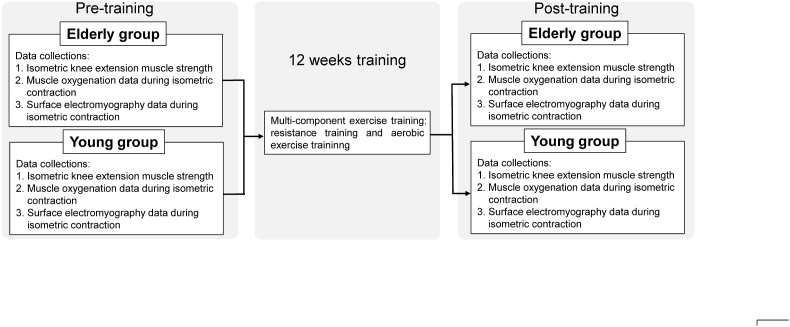
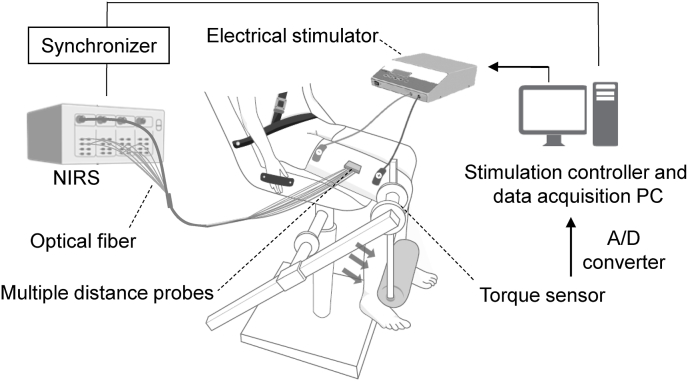
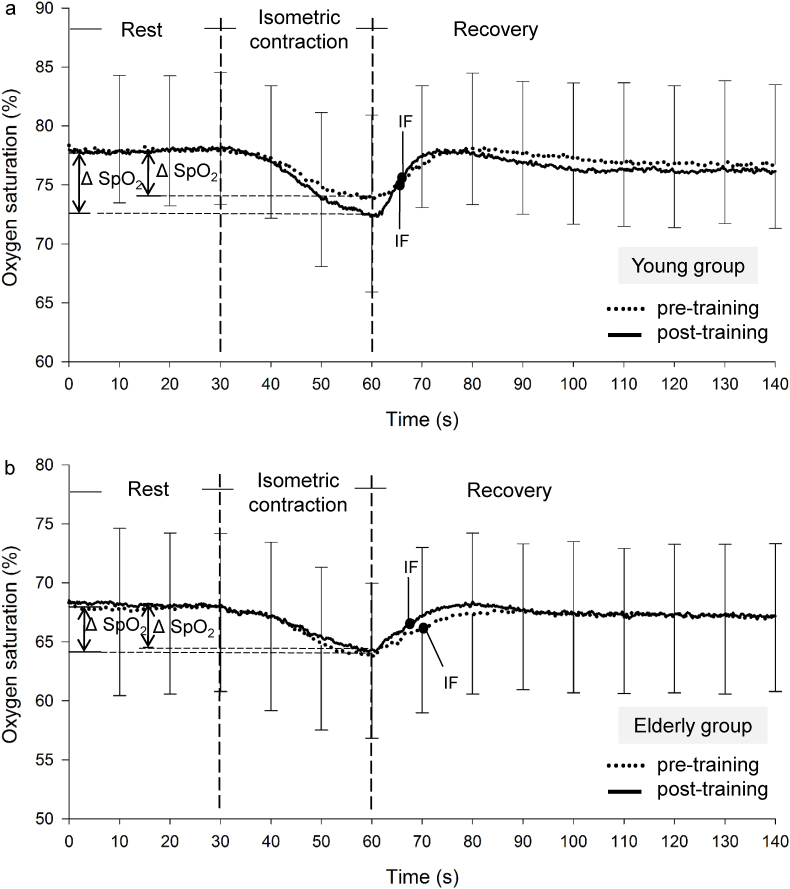
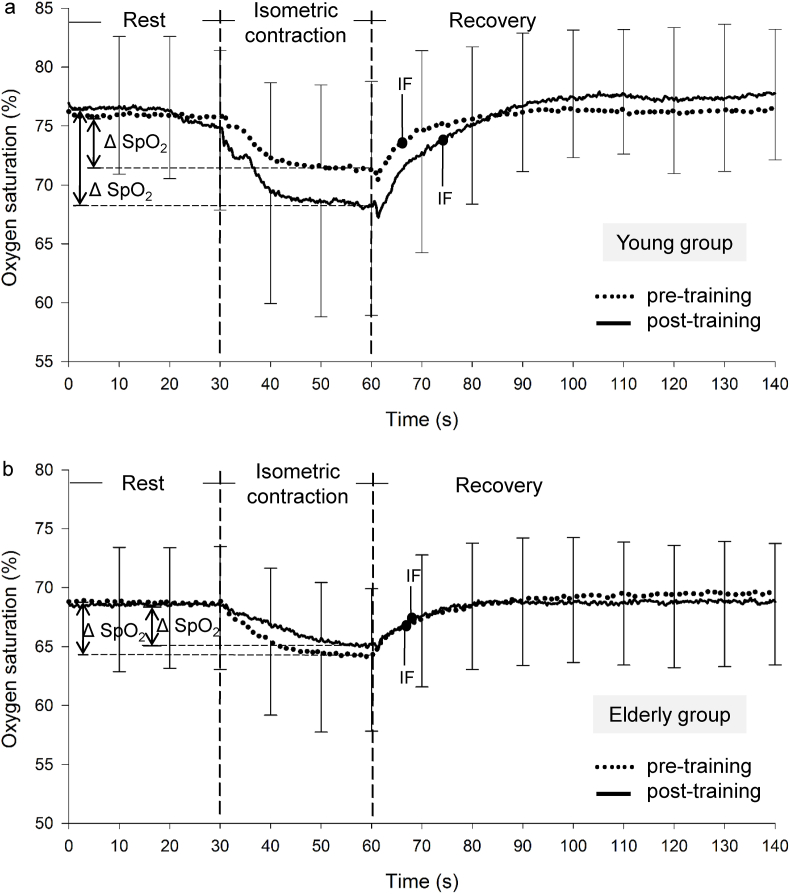
In this study, 17 young adults (Y) and 18 healthy older adults (E) were recruited to receive a multicomponent exercise training for 12 weeks, 2-3 sessions per week. Muscle oxygenation, muscle strength, and electromyography data were collected and compared pre- and post-training. Muscle oxygen saturation (SpO) during isometric knee extension tests involving voluntary contraction (VOL) and electrical stimulation (ES) was measured by near-infrared spectroscopy. The SpO kinetics in the contraction and recovery phases were calculated using a tangential model to extract ΔSpO and inflection time (IF).
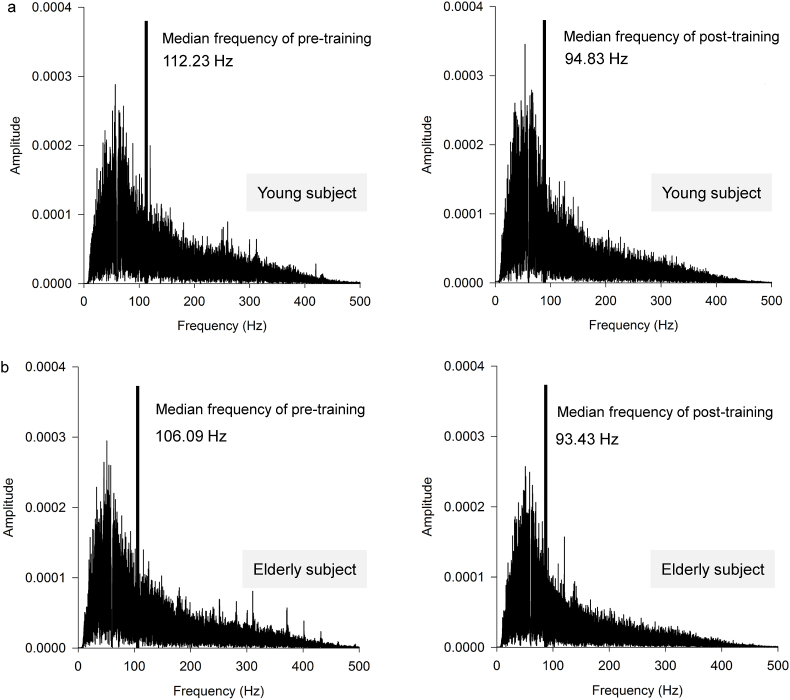
Muscle strength significantly increased in the post-training (234.31 ± 83.2 N·m, p < 0.05). The post-training ΔSpO of the ES in the Y (8.43 ± 5.35%) significantly increased and was higher than that in the E (2.78 ± 3.03%, p < 0.05). In the recovery phase, the post-training IF of VOL (7.07 ± 3.31s) was significantly shorter than that of the pre-training period (8.73 ± 4.46s, p < 0.05). Additionally, the median frequency of electromyography significantly decreased in the post-training period (103.84 ± 21.75 Hz, p < 0.05).
The multicomponent exercise training improved the muscle strength, neuromuscular performance, and muscle aerobic function irrespective of age. The primary adaptation of the muscles to the multicomponent exercise training between the two groups varied.
尽管多组分运动训练被发现对改善身体功能有益,但多组分运动训练对肌肉氧合的影响仍不明确。本研究的目的是调查多组分运动训练对年轻和年长参与者肌肉氧合的影响。
在本研究中,招募了17名年轻成年人(Y组)和18名健康的年长成年人(E组),接受为期12周的多组分运动训练,每周2 - 3次。收集训练前后的肌肉氧合、肌肉力量和肌电图数据并进行比较。通过近红外光谱法测量等长膝关节伸展测试中涉及自主收缩(VOL)和电刺激(ES)时的肌肉氧饱和度(SpO)。使用切线模型计算收缩和恢复阶段的SpO动力学,以提取ΔSpO和拐点时间(IF)。
训练后肌肉力量显著增加(234.31 ± 83.2 N·m,p < 0.05)。Y组训练后ES的ΔSpO(8.43 ± 5.35%)显著增加,且高于E组(2.78 ± 3.03%,p < 0.05)。在恢复阶段,训练后VOL的IF(7.07 ± 3.31秒)显著短于训练前期(8.73 ± 4.46秒,p < 0.05)。此外,训练后肌电图的中位频率显著降低(103.84 ± 21.75 Hz,p < 0.05)。
多组分运动训练无论年龄大小均能改善肌肉力量、神经肌肉性能和肌肉有氧功能。两组肌肉对多组分运动训练的主要适应性有所不同。