Clinical Pharmacy Course and Research Team, School of Pharmacy, Institute of Health Sciences, Jimma University, P.O.Box: 378, Jimma, Oromia, Ethiopia.
Institute of Health Sciences, Adama Comprehensive Specialized Medical College, P.O.Box: 84, Adama, Oromia, Ethiopia.
BMC Cardiovasc Disord. 2023 Jan 6;23(1):4. doi: 10.1186/s12872-022-03008-7.
Heart failure is a global pandemic, as it affects approximately 64.34 million people worldwide with a $346.17 billion global economic burden. The prevalence of heart failure has increased from 43.4 to 46.5% in the last 10 years in lower and middle-income countries. Most of the studies conducted in Ethiopia were retrospective cross-sectional, with limited study participants, and conducted in a single setting that commonly addresses the prevalence and pattern of heart failure rather than clinical outcome, associated factors, and specific management in different areas. Hence, this study aimed to assess management, clinical outcomes and their predictors among heart failure patients admitted to tertiary care hospitals in Ethiopia.
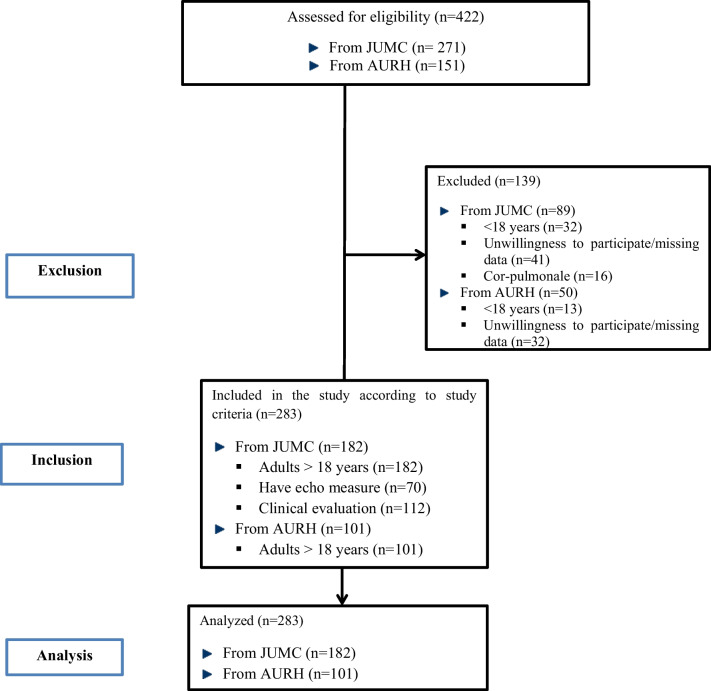
A prospective observational study design was conducted on heart failure patients admitted at two tertiary care hospitals in Ethiopia from September 2020 to May 2021. Using semi-structured questionnaires relevant data were collected from patients' medical records and face-to-face interviewing. Data were analyzed using SPSS version 23.0. A multivariate Cox regression model was performed to identify independent predictors of 90-day all-cause mortality. Variables with P values < 0.05 were considered statistically significant.
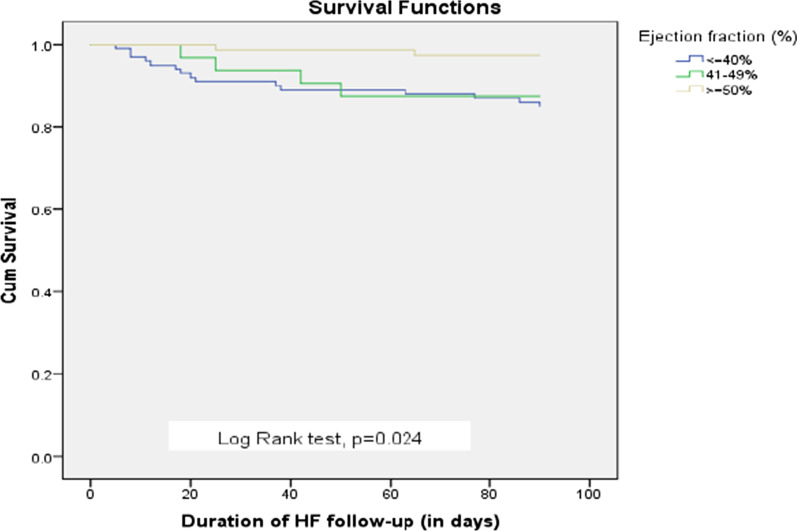
Out of 283 patients enrolled in this study, 52.3% were male and the mean (± SD) age was 52.4 ± 17.9 years. The most common medications prescribed during hospitalization and discharge were diuretics (98.9% vs 95.6%), angiotensin I converting enzyme inhibitors/angiotensin II receptor blockers (48.8% vs 67.3%), and beta-blockers (46.6% vs 64.7%), respectively. In the present study, the 90-day all-cause mortality was 10.2%. Hypertension (HR = 3.7, 95% CI 1.2-11.6), cardiogenic shock (HR = 8.7, 95% CI 3.2-20.8), alcohol drinking (HR = 2.8, 95% CI 1.1-7.8), absence of angiotensin I converting enzyme inhibitors/angiotensin II receptor blockers (HR = 0.02, 95% CI 0.0-0.2), and reduced ejection fraction (HR = 1.5, 95% CI 1.1-3.8) were predictors of 90-day all-cause mortality.
High 90-day all-cause mortality was observed among heart failure patients in the present study. In the current study, the majority of heart failure patients were treated with diuretics. Alcohol drinking, hypertension, cardiogenic shock, reduced ejection fraction, and absence of angiotensin I converting enzyme inhibitors/angiotensin II receptor blockers drugs were predictors of poor treatment outcomes for whom restriction of alcohol consumption, early management of hypertension, reduced ejection fraction, cardiogenic shock, and providing angiotensin I converting enzyme inhibitors/angiotensin II receptor blockers drugs for all heart failure patients would be recommended to improve these poor treatment outcomes.
心力衰竭是一种全球性的大流行病,因为它影响了全球约 6434 万人,给全球经济带来了 3461.7 亿美元的负担。在过去的 10 年中,低收入和中等收入国家中心力衰竭的患病率从 43.4%上升到了 46.5%。在埃塞俄比亚进行的大多数研究都是回顾性的横断面研究,研究参与者有限,且仅在单一环境中进行,这些研究通常主要关注心力衰竭的患病率和模式,而不是不同地区的临床结果、相关因素和具体管理。因此,本研究旨在评估在埃塞俄比亚的三级保健医院中心力衰竭患者的管理、临床结果及其预测因素。
本研究采用前瞻性观察研究设计,于 2020 年 9 月至 2021 年 5 月在埃塞俄比亚的两家三级保健医院对心力衰竭患者进行研究。使用半结构式问卷,从患者的病历和面对面访谈中收集相关数据。使用 SPSS 版本 23.0 对数据进行分析。采用多变量 Cox 回归模型来确定 90 天全因死亡率的独立预测因素。P 值<0.05 的变量被认为具有统计学意义。
在纳入本研究的 283 名患者中,52.3%为男性,平均(±SD)年龄为 52.4±17.9 岁。住院期间和出院时开具的最常见药物分别是利尿剂(98.9%比 95.6%)、血管紧张素转换酶抑制剂/血管紧张素 II 受体阻滞剂(48.8%比 67.3%)和β受体阻滞剂(46.6%比 64.7%)。在本研究中,90 天全因死亡率为 10.2%。高血压(HR=3.7,95%CI 1.2-11.6)、心源性休克(HR=8.7,95%CI 3.2-20.8)、饮酒(HR=2.8,95%CI 1.1-7.8)、缺乏血管紧张素转换酶抑制剂/血管紧张素 II 受体阻滞剂(HR=0.02,95%CI 0.0-0.2)和射血分数降低(HR=1.5,95%CI 1.1-3.8)是 90 天全因死亡率的预测因素。
本研究中心力衰竭患者的 90 天全因死亡率较高。在目前的研究中,大多数心力衰竭患者接受利尿剂治疗。饮酒、高血压、心源性休克、射血分数降低和缺乏血管紧张素转换酶抑制剂/血管紧张素 II 受体阻滞剂药物是治疗效果不佳的预测因素,建议限制饮酒、早期治疗高血压、降低射血分数、心源性休克和为所有心力衰竭患者提供血管紧张素转换酶抑制剂/血管紧张素 II 受体阻滞剂药物,以改善这些不良治疗效果。