Department of Pathology, Hallym University Sacred Heart Hospital, Hallym University College of Medicine, Anyang 14068, Republic of Korea.
Department of Orthopedic Surgery, Hallym University Sacred Heart Hospital, Hallym University College of Medicine, Anyang 14068, Republic of Korea.
Nutrients. 2022 Dec 28;15(1):134. doi: 10.3390/nu15010134.
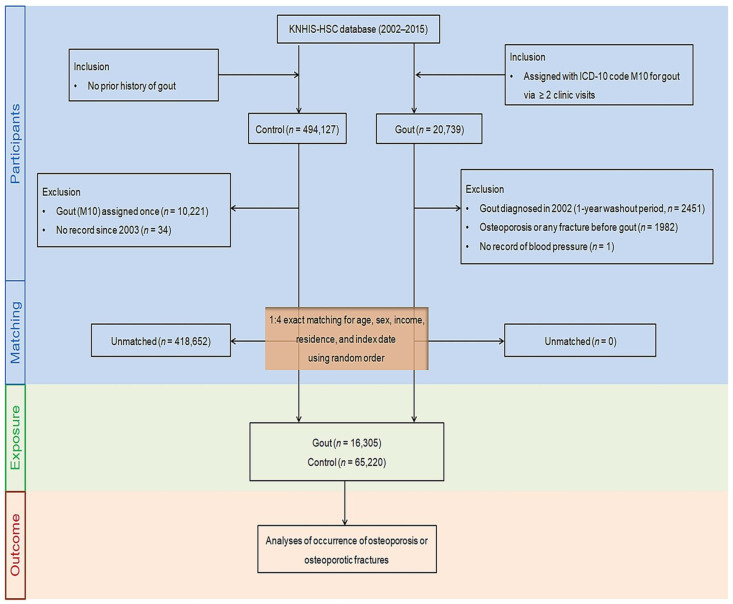
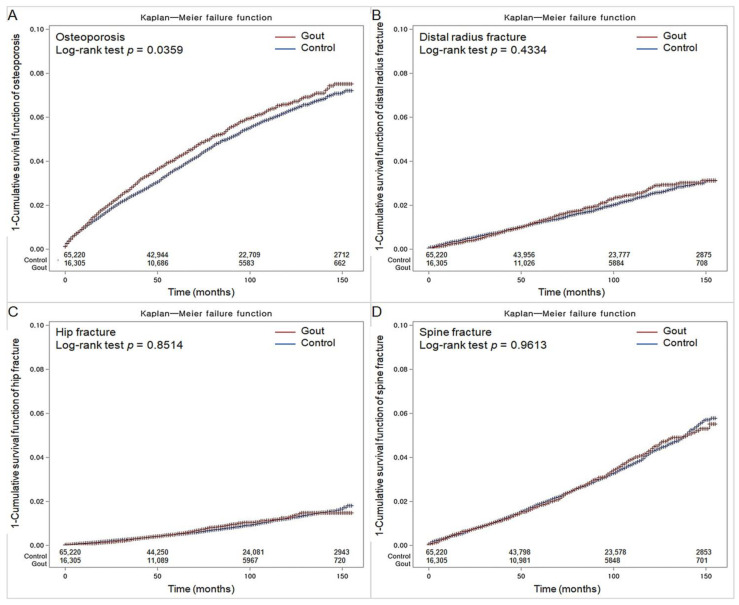
Health issues associated with gout and increased occurrence of osteoporosis or fractures have been raised; however, the results are elusive. Herein, we explored the possible link between gout and incident osteoporosis/osteoporotic fractures based on long-term follow-up nationwide data. This study enrolled 16,305 patients with gout and 65,220 controls who were matched by propensity score at a 1:4 ratio on the basis of sex, age, income, and residence from the Korean National Health Insurance Service-Health Screening Cohort database (2002−2015). A Cox proportional hazard model was employed to identify the relevance between gout and incident osteoporosis/fractures, following adjustment for various covariates. In the follow-up period, osteoporosis developed in 761 individuals with gout and 2805 controls (incidence rates: 8.0 and 7.3/1000 person-years, respectively), and each osteoporotic fracture in the distal radius (2.8 vs. 2.7/1000 person-years), hip (1.3 vs. 1.3/1000 person-years), and spine (4.5 vs. 4.5/1000 person-years) occurred in gout and control groups, respectively. After adjustment, the gout group presented an 11% higher development of osteoporosis (95% confidence interval = 1.02−1.20) than the controls (p = 0.011). Subgroup analyses maintained the augment of incident osteoporosis in sufferers with gout, particularly in either men or <60 years. However, no such relevance was identified between gout and incident osteoporotic fractures at any site. In conclusion, gout may result in a slightly elevated likelihood of developing osteoporosis, and not osteoporotic fractures, in the Korean population.
与痛风相关的健康问题,包括骨质疏松症或骨折发生率增加,已经引起了关注;然而,其结果尚不清楚。在此,我们基于全国范围内的长期随访数据,探讨了痛风与骨质疏松症/骨质疏松性骨折之间的可能联系。本研究从韩国国家健康保险服务-健康筛查队列数据库(2002-2015 年)中,按照性别、年龄、收入和居住地,以 1:4 的比例,通过倾向评分匹配,纳入了 16305 例痛风患者和 65220 例对照。采用 Cox 比例风险模型,在调整了各种混杂因素后,确定了痛风与骨质疏松症/骨折之间的相关性。在随访期间,761 例痛风患者和 2805 例对照者中发生了骨质疏松症(发生率:8.0 和 7.3/1000 人年),桡骨远端(2.8 与 2.7/1000 人年)、髋部(1.3 与 1.3/1000 人年)和脊柱(4.5 与 4.5/1000 人年)各部位的骨质疏松性骨折在痛风组和对照组中分别发生。调整后,痛风组骨质疏松症的发病风险比对照组高 11%(95%置信区间:1.02-1.20)(p = 0.011)。亚组分析显示,痛风患者的骨质疏松症发病风险增加,特别是男性或<60 岁的患者。然而,在任何部位均未发现痛风与骨质疏松性骨折之间存在相关性。综上所述,在韩国人群中,痛风可能会略微增加骨质疏松症的发病风险,但不会增加骨质疏松性骨折的发病风险。