School of Public Health, Sun Yat-sen University, Guangzhou 510080, China.
School of Public Health, Hangzhou Medical College, Hangzhou 310013, China.
Nutrients. 2023 Jan 3;15(1):239. doi: 10.3390/nu15010239.
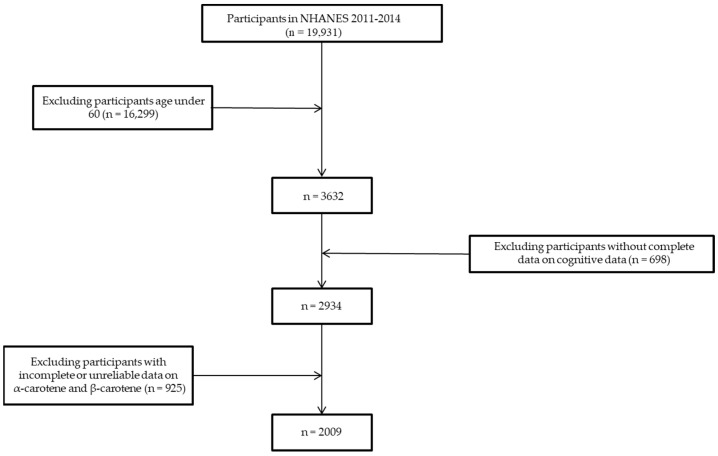
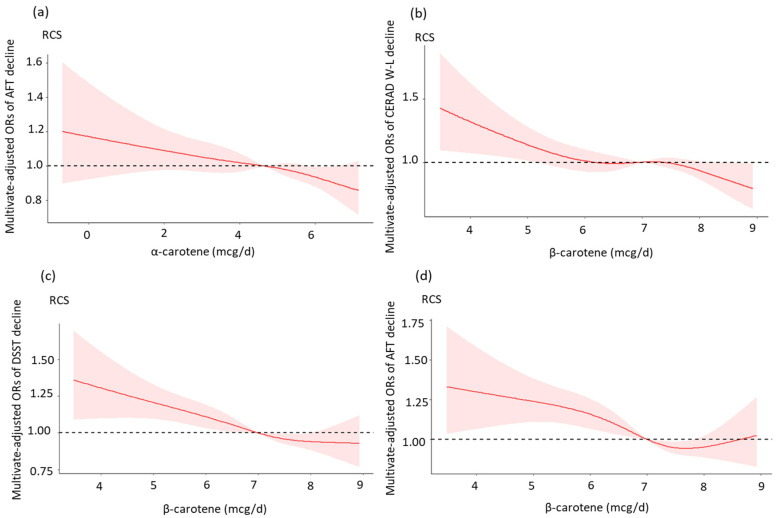
This study aims to examine the relationships of dietary α-carotene and β-carotene intake with cognitive function. The data were selected from the National Health and Nutrition Examination Survey (NHANES) 2011-2014. A total of 2009 participants were included in this analysis. Dietary α-carotene and β-carotene intake were averaged by two 24-h dietary recalls. The Consortium to Establish a Registry for Alzheimer's Disease Word Learning subset (CERAD W-L), Animal Fluency Test (AFT), and Digit Symbol Substitution Test (DSST) were used to evaluate cognitive function. Logistic regression and restricted cubic spline models were applied to explore the associations of dietary α-carotene and β-carotene intake with cognitive performance. After adjusting for all confounding factors, compared with individuals in the lowest quartile of β-carotene dietary intake, those in the highest quartile had lower risks of both CERAD W-L decline [odds ratio (OR) = 0.63, 95% confidence interval (CI): 0.44-0.90] and AFT decline (OR = 0.66, 95% CI: 0.47-0.94). In addition, the third quartile of β-carotene dietary intake had a significantly decreased risk of lower DSST (OR = 0.67, 95% CI: 0.48-0.83). Compared with the lowest quartile of α-carotene intake, the OR of AFT decline in the highest intake quartile was 0.66 (95% CI: 0.46, 0.94). For males, both dietary α-carotene and β-carotene intake were associated with a decreased risk of AFT decline (OR = 0.42, 95% CI: 0.25-0.71; OR = 0.51, 95% CI: 0.30-0.85, respectively). For females, dietary α-carotene intake was associated with a decreased risk of CERAD W-L decline (OR = 0.55, 95% CI: 0.33-0.91) and dietary β-carotene intake was associated with decreased risks of both CERAD W-L and AFT decline (OR = 0.37, 95% CI: 0.21-0.64; OR = 0.58, 95% CI: 0.37-0.91, respectively). Our results suggested that higher dietary α-carotene and β-carotene intake had inverse effects on cognitive function decline among older adults.
本研究旨在探讨饮食中 α-胡萝卜素和 β-胡萝卜素的摄入量与认知功能的关系。数据来自 2011-2014 年的国家健康和营养调查(NHANES)。共有 2009 名参与者纳入本分析。通过两次 24 小时膳食回忆来平均饮食中 α-胡萝卜素和 β-胡萝卜素的摄入量。使用阿尔茨海默病合作研究单词学习子集中的 Consortium to Establish a Registry for Alzheimer's Disease Word Learning(CERAD W-L)、动物流畅性测验(AFT)和数字符号替换测验(DSST)来评估认知功能。应用逻辑回归和限制三次样条模型探讨饮食中 α-胡萝卜素和 β-胡萝卜素摄入量与认知表现的关系。在调整所有混杂因素后,与 β-胡萝卜素饮食摄入量最低四分位数的个体相比,摄入量最高四分位数的个体发生 CERAD W-L 下降(比值比[OR] = 0.63,95%置信区间[CI]:0.44-0.90)和 AFT 下降(OR = 0.66,95% CI:0.47-0.94)的风险较低。此外,β-胡萝卜素饮食摄入量的第三四分位数与较低的 DSST 呈显著降低风险相关(OR = 0.67,95% CI:0.48-0.83)。与 α-胡萝卜素摄入量最低四分位数相比,最高摄入量四分位数的 AFT 下降的 OR 为 0.66(95% CI:0.46,0.94)。对于男性,饮食中 α-胡萝卜素和 β-胡萝卜素的摄入量均与 AFT 下降的风险降低相关(OR = 0.42,95% CI:0.25-0.71;OR = 0.51,95% CI:0.30-0.85)。对于女性,饮食中 α-胡萝卜素的摄入量与 CERAD W-L 下降的风险降低相关(OR = 0.55,95% CI:0.33-0.91),而 β-胡萝卜素的摄入量与 CERAD W-L 和 AFT 下降的风险降低相关(OR = 0.37,95% CI:0.21-0.64;OR = 0.58,95% CI:0.37-0.91)。我们的研究结果表明,较高的饮食中 α-胡萝卜素和 β-胡萝卜素摄入对老年人认知功能下降有逆效果。