Department of Prosthodontics, National Clinical Research Center for Oral Diseases, National Engineering Laboratory for Digital and Material Technology of Stomatology, Beijing Key Laboratory of Digital Stomatology, Peking University School and Hospital of Stomatology, Beijing, 100081, China.
The Central Laboratory, National Clinical Research Center for Oral Diseases, National Engineering Laboratory for Digital and Material Technology of Stomatology, Beijing Key Laboratory of Digital Stomatology, Peking University School and Hospital of Stomatology, Beijing, 100081, China.
J Transl Med. 2023 Jan 9;21(1):8. doi: 10.1186/s12967-022-03870-1.
Astronauts undergo significant microgravity-induced bone loss during space missions, which has become one of the three major medical problems hindering human's long-term space flight. A risk-free and antiresorptive drug is urgently needed to prevent bone loss during space missions. D-mannose is a natural C-2 epimer of D-glucose and is abundant in cranberries. This study aimed to investigate the protective effects and potential mechanisms of D-mannose against bone loss under weightlessness.
The hind legs of tail-suspended (TS) rats were used to mimic weightlessness on Earth. Rats were administered D-mannose intragastrically. The osteoclastogenic and osteogenic capacity of D-mannose in vitro and in vivo was analyzed by micro-computed tomography, biomechanical assessment, bone histology, serum markers of bone metabolism, cell proliferation assay, quantitative polymerase chain reaction, and western blotting. RNA-seq transcriptomic analysis was performed to detect the underlying mechanisms of D-mannose in bone protection.
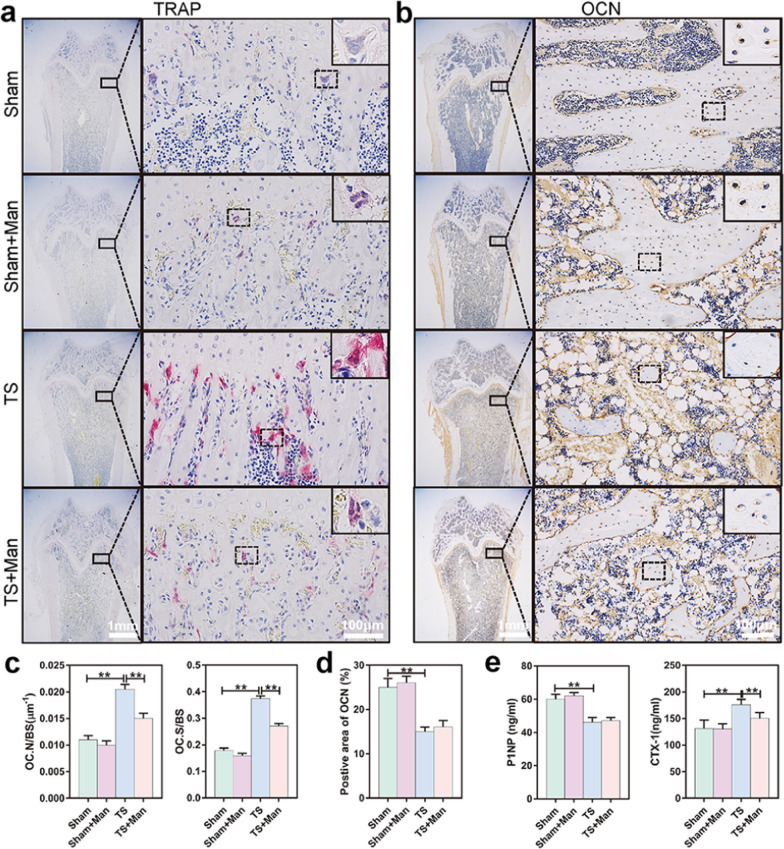
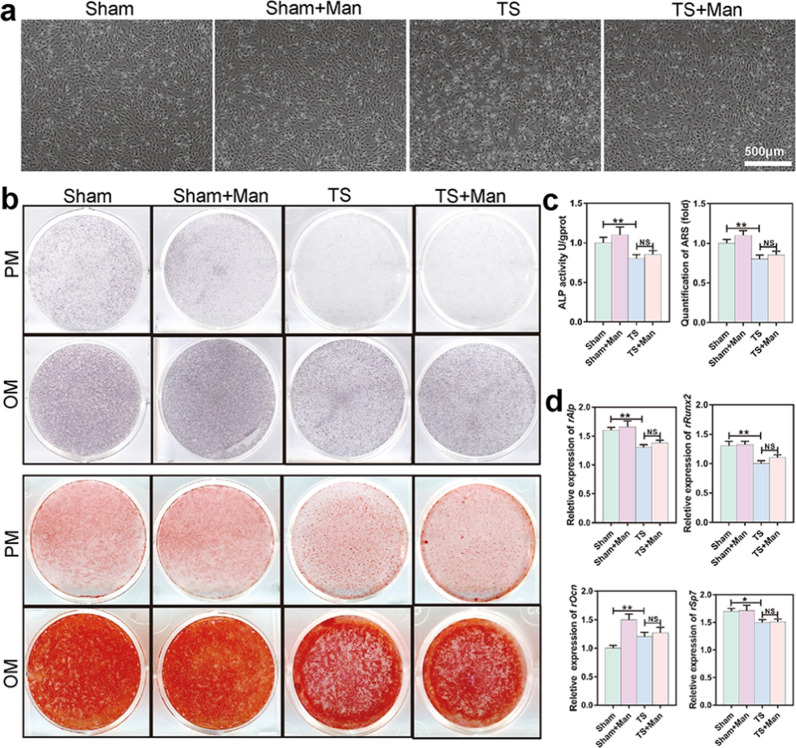
The TS rats showed lower bone mineral density (BMD) and poorer bone morphological indices. D-mannose could improve BMD in TS rats. D-mannose inhibited osteoclast proliferation and fusion in vitro, without apparent effects on osteoblasts. RNA-seq transcriptomic analysis showed that D-mannose administration significantly inhibited the cell fusion molecule dendritic cell-specific transmembrane protein (DC-STAMP) and two indispensable transcription factors for osteoclast fusion (c-Fos and nuclear factor of activated T cells 1 [NFATc1]). Finally, TS rats tended to experience dysuria-related urinary tract infections (UTIs), which were suppressed by treatment with D-mannose.
D-mannose protected against bone loss and UTIs in rats under weightlessness. The bone protective effects of D-mannose were mediated by inhibiting osteoclast cell fusion. Our findings provide a potential strategy to protect against bone loss and UTIs during space missions.
宇航员在太空任务中会经历显著的微重力诱导的骨质流失,这已成为阻碍人类长期太空飞行的三大医学问题之一。急需一种无风险且具有抗吸收作用的药物来预防太空任务中的骨质流失。D-甘露糖是 D-葡萄糖的 C-2 差向异构体,在蔓越莓中含量丰富。本研究旨在探讨 D-甘露糖在失重条件下预防骨质流失的保护作用及其潜在机制。
通过尾部悬吊(TS)大鼠的后腿模拟地球上的失重状态。大鼠经胃内给予 D-甘露糖。通过微计算机断层扫描、生物力学评估、骨组织学、骨代谢血清标志物、细胞增殖测定、定量聚合酶链反应和蛋白质印迹分析,体外和体内分析 D-甘露糖对破骨细胞生成和成骨能力的影响。进行 RNA 测序转录组分析,以检测 D-甘露糖在骨保护中的潜在机制。
TS 大鼠的骨矿物质密度(BMD)较低,骨形态指数较差。D-甘露糖可改善 TS 大鼠的 BMD。D-甘露糖在体外抑制破骨细胞增殖和融合,对成骨细胞无明显影响。RNA 测序转录组分析表明,D-甘露糖给药显著抑制破骨细胞融合分子树突状细胞特异性跨膜蛋白(DC-STAMP)和两个不可或缺的破骨细胞融合转录因子(c-Fos 和激活 T 细胞核因子 1 [NFATc1])。最后,TS 大鼠易发生与排尿困难相关的尿路感染(UTIs),而 D-甘露糖治疗可抑制其发生。
D-甘露糖可预防失重大鼠的骨质流失和 UTIs。D-甘露糖的骨保护作用是通过抑制破骨细胞融合来介导的。我们的研究结果为预防太空任务中的骨质流失和 UTIs 提供了一种潜在策略。