McCall Terika, Threats Megan, Pillai Malvika, Lakdawala Adnan, Bolton Clinton S
Division of Health Informatics, Department of Biostatistics, Yale School of Public Health, New Haven, CT, United States.
Center for Medical Informatics, Yale School of Medicine, New Haven, CT, United States.
Front Digit Health. 2022 Dec 23;4:1028408. doi: 10.3389/fdgth.2022.1028408. eCollection 2022.
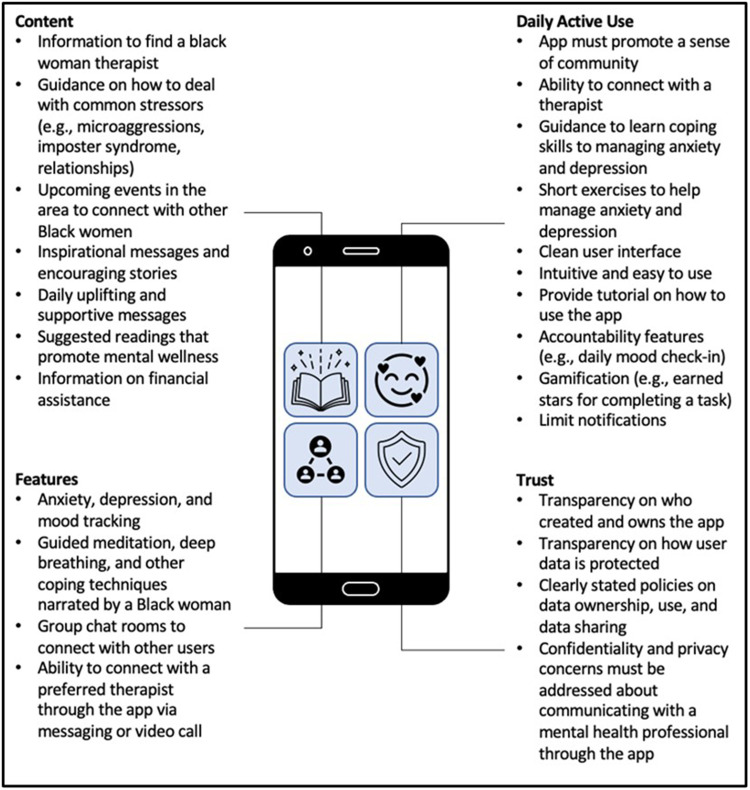
Black American women experience adverse health outcomes due to anxiety and depression. They face systemic barriers to accessing culturally appropriate mental health care leading to the underutilization of mental health services and resources. Mobile technology can be leveraged to increase access to culturally relevant resources, however, the specific needs and preferences that Black women feel are useful in an app to support management of anxiety and depression are rarely reflected in existing digital health tools. This study aims to assess what types of content, features, and important considerations should be included in the design of a mobile app tailored to support management of anxiety and depression among Black women. Focus groups were conducted with 20 women (mean age 36.6 years, SD 17.8 years), with 5 participants per group. Focus groups were led by a moderator, with notetaker present, using an interview guide to discuss topics, such as participants' attitudes and perceptions towards mental health and use of mental health services, and content, features, and concerns for design of a mobile app to support management of anxiety and depression. Descriptive qualitative content analysis was conducted. Recommendations for content were either informational (e.g., information to find a Black woman therapist) or inspirational (e.g., encouraging stories about overcoming adversity). Suggested features allow users to monitor their progress, practice healthy coping techniques, and connect with others. The importance of feeling "a sense of community" was emphasized. Transparency about who created and owns the app, and how users' data will be used and protected was recommended to establish trust. The findings from this study were consistent with previous literature which highlighted the need for educational, psychotherapy, and personal development components for mental health apps. There has been exponential growth in the digital mental health space due to the COVID-19 pandemic; however, a approach may lead to more options but continued disparity in receiving mental health care. Designing a mental health app for and with Black women may help to advance digital health equity by providing a tool that addresses their specific needs and preferences, and increase engagement.
美国黑人女性因焦虑和抑郁而面临不良健康后果。她们在获得符合文化背景的心理健康护理方面面临系统性障碍,导致心理健康服务和资源利用不足。移动技术可用于增加获取与文化相关资源的机会,然而,黑人女性认为在支持焦虑和抑郁管理的应用程序中有用的特定需求和偏好很少反映在现有的数字健康工具中。本研究旨在评估在为支持黑人女性焦虑和抑郁管理而量身定制的移动应用程序设计中应包含哪些类型的内容、功能和重要考虑因素。对20名女性(平均年龄36.6岁,标准差17.8岁)进行了焦点小组访谈,每组5名参与者。焦点小组由一名主持人主持,有记录员在场,使用访谈指南讨论话题,如参与者对心理健康和心理健康服务使用的态度和看法,以及支持焦虑和抑郁管理的移动应用程序设计的内容、功能和关注点。进行了描述性定性内容分析。内容建议要么是信息性的(例如,寻找黑人女性治疗师的信息),要么是鼓舞性的(例如,关于克服逆境的鼓舞人心的故事)。建议的功能允许用户监控自己的进展、练习健康的应对技巧并与他人建立联系。强调了感受“社区感”的重要性。建议对应用程序的创建者和所有者以及用户数据将如何使用和保护保持透明,以建立信任。本研究的结果与之前的文献一致,该文献强调了心理健康应用程序中教育、心理治疗和个人发展组件的必要性。由于COVID-19大流行,数字心理健康领域呈指数级增长;然而,一种方法可能会带来更多选择,但在接受心理健康护理方面仍存在差距。为黑人女性设计并与她们一起设计心理健康应用程序可能有助于通过提供满足她们特定需求和偏好的工具来推进数字健康公平,并提高参与度。