Division of Nephrology, Nanfang Hospital, Southern Medical University, Guangzhou, 510515, China.
National Clinical Research Center for Kidney Disease, Guangzhou, 510515, China.
Alzheimers Res Ther. 2023 Jan 9;15(1):9. doi: 10.1186/s13195-022-01158-6.
The independent and additive associations of walking pace and grip strength on dementia risk and the potential modifying effects of age, APOE phenotypes, and other dementia risk factors on the walking pace and dementia relationships demand further clarification. We aimed to investigate the independent and additive relationships of walking pace and handgrip strength on the risk of new-onset dementia and examine the potentially modifying effects of age, APOE phenotypes, lifestyle factors, and family history of dementia in the relationships.
A total of 495,700 participants from the UK Biobank, who were free of dementia at baseline, were included in this study. Walking pace was self-defined as slow, average, or brisk. Handgrip strength was assessed by dynamometer and was divided into sex-specific quartiles. The APOE genotypes were determined by a combination variant of rs429358 and rs7412. Other dementia risk factors, including education, physical activity, hypertension, depression, diabetes, and family history of dementia, were also collected. The primary outcome was new-onset all-cause dementia.
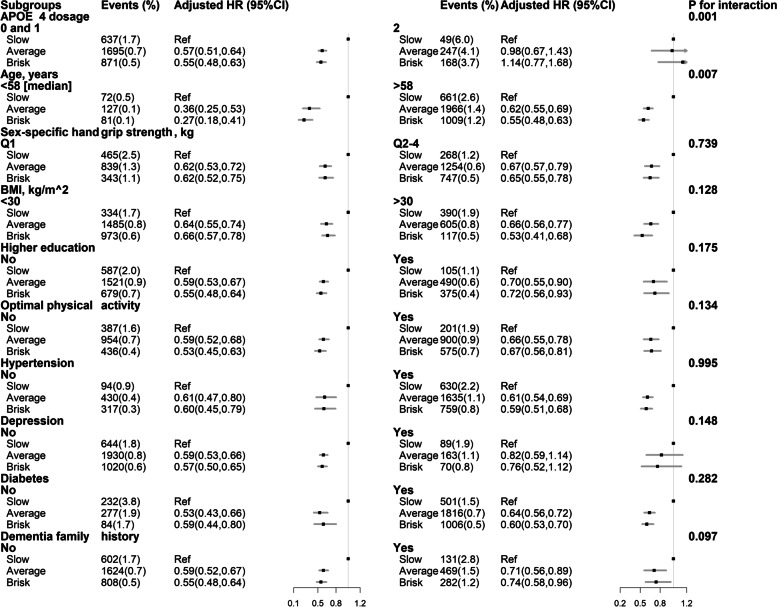
Over a median follow-up duration of 12.0 years, 3986 (0.8%) participants developed new-onset all-cause dementia. Compared with those with slow walking pace, participants with average (HR, 0.61; 95%CI: 0.55-0.68) or brisk (HR, 0.59; 95%CI: 0.52-0.67) walking pace had a significantly lower risk of new-onset all-cause dementia. Moreover, compared with those with both slow walking pace and lower handgrip strength (the first quartile), the lowest risk of new-onset all-cause dementia was observed in participants with both average or brisk walking pace and higher handgrip strength (the 2-4 quartiles) (HR, 0.45; 95%CI: 0.40-0.52). Notably, the negative relationship between walking pace and the risk of new-onset all-cause dementia was significantly reduced as APOE ε4 dosage increased (APOE ε4 dosages = 0 or 1: brisk vs. slow: HR, 0.55; 95%CI: 0.48-0.63; vs. APOE ε4 dosages = 2: brisk vs. slow: HR, 1.14; 95%CI: 0.77-1.68; P for interaction = 0.001) or age increased (< 58 [median]: brisk vs. slow: HR, 0.27; 95%CI: 0.18-0.41; vs. ≥ 58 years: brisk vs. slow: HR, 0.55; 95%CI: 0.48-0.63; P for interaction = 0.007).
Walking pace was inversely associated with new-onset dementia in the general population, especially in younger participants and those with lower APOE ε4 dosage. Participants with both faster walking pace and higher handgrip strength had the lowest risk of dementia, suggesting that maintaining both high handgrip strength and fast walking pace may be a more comprehensive strategy for preventing dementia risk.
行走速度和握力与痴呆风险的独立和附加关联,以及年龄、APOE 表型和其他痴呆风险因素对行走速度和痴呆关系的潜在调节作用,需要进一步澄清。我们旨在研究行走速度和握力与新发痴呆风险的独立和附加关系,并研究年龄、APOE 表型、生活方式因素和痴呆家族史在这些关系中的潜在调节作用。
本研究纳入了英国生物库中 495700 名基线时无痴呆的参与者。行走速度由参与者自行定义为慢、中、快。握力通过测力计评估,并分为性别特异性四分位数。APOE 基因型由 rs429358 和 rs7412 的组合变体确定。其他痴呆风险因素,包括教育程度、体力活动、高血压、抑郁、糖尿病和痴呆家族史,也被收集。主要结局是新发全因痴呆。
在中位随访 12.0 年期间,3986 名(0.8%)参与者发生新发全因痴呆。与行走速度较慢的参与者相比,行走速度中等(HR,0.61;95%CI:0.55-0.68)或较快(HR,0.59;95%CI:0.52-0.67)的参与者新发全因痴呆的风险显著降低。此外,与行走速度较慢且握力较低(第一四分位)的参与者相比,行走速度中等或较快且握力较高(第二至四分位)的参与者新发全因痴呆的风险最低(HR,0.45;95%CI:0.40-0.52)。值得注意的是,随着 APOE ε4 剂量的增加(APOE ε4 剂量=0 或 1:快 vs. 慢:HR,0.55;95%CI:0.48-0.63;vs. APOE ε4 剂量=2:快 vs. 慢:HR,1.14;95%CI:0.77-1.68;P 交互=0.001)或年龄增加(<58 岁[中位数]:快 vs. 慢:HR,0.27;95%CI:0.18-0.41;vs. ≥58 岁:快 vs. 慢:HR,0.55;95%CI:0.48-0.63;P 交互=0.007),行走速度与新发痴呆的负相关关系显著减弱。
在一般人群中,行走速度与新发痴呆呈负相关,尤其是在年轻参与者和 APOE ε4 剂量较低的参与者中。行走速度较快且握力较高的参与者痴呆风险最低,这表明保持较高的握力和较快的行走速度可能是预防痴呆风险的更全面策略。