
鉴定和临床验证结直肠腺瘤潜在生物标志物的关键基因。
Identification and clinical validation of key genes as the potential biomarkers in colorectal adenoma.
机构信息
Digestive Endoscopy Department, The First Affiliated Hospital With Nanjing Medical University and Jiangsu Province Hospital, Nanjing, Jiangsu, China.
State Key Laboratory of Genetic Engineering, School of Life Sciences, Fudan University, Shanghai, China.
出版信息
BMC Cancer. 2023 Jan 11;23(1):39. doi: 10.1186/s12885-022-10422-9.
BACKGROUND
Colorectal cancer (CRC), ranking third in cancer prevalence and second in mortality worldwide, is mainly derived from colorectal adenoma (CRA). CRA is a common benign disease in the intestine with rapidly increasing incidence and malignant potential. Therefore, this study aimed to recognize significant biomarkers and original pathogenesis in CRA.
METHODS
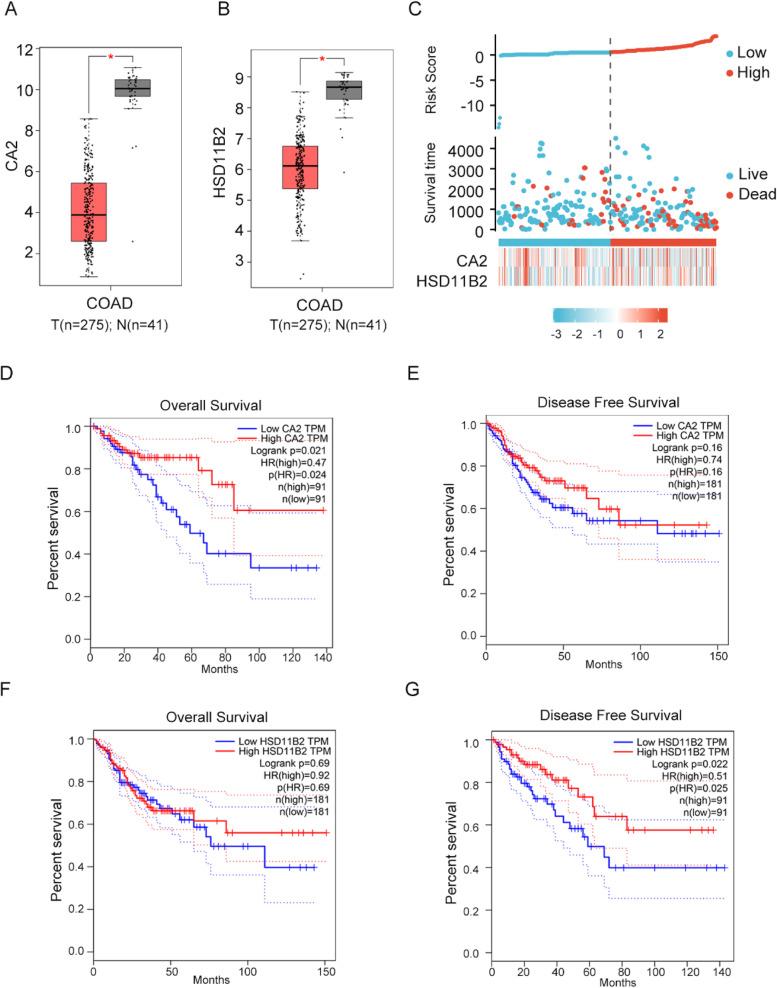
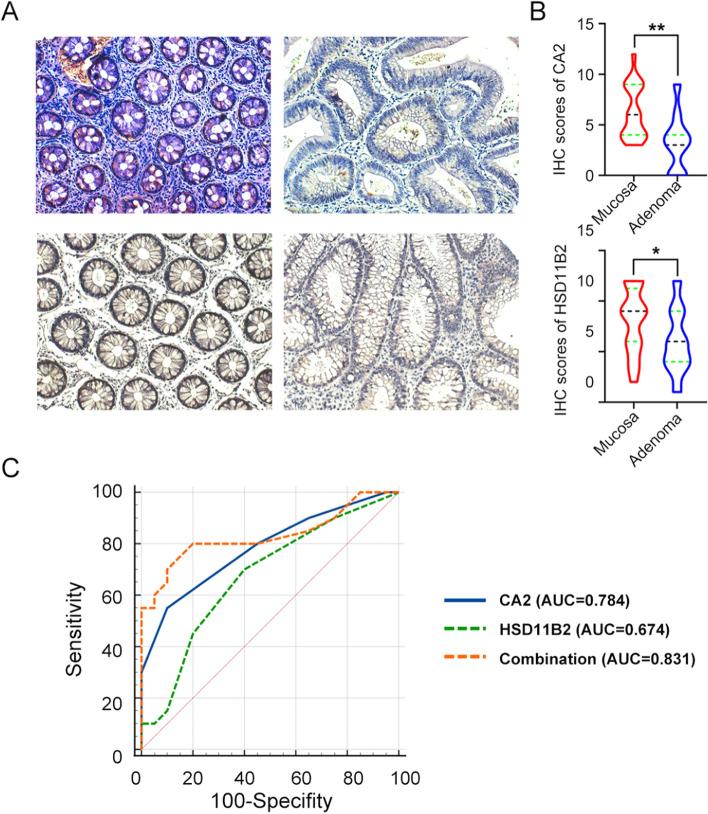
Transcriptome data of GSE8671, GSE37364, and GSE15960 were downloaded from the Gene Expression Omnibus (GEO) datasets, and differentially expressed genes (DEGs) were screened. Functional pathways enrichment, protein-protein interaction (PPI) network, stem-correlation analysis, CIBERSORT, risk score and survival analyses were performed. RT-qPCR and immunohistochemical staining were applied to verify our results. RESULTS: Screening for significant DEGs in each dataset, we identified 230 robust DEGs, including 127 upregulated and 103 downregulated genes. Functional pathways enrichment showed that these DEGs were distinctly enriched in various tumor-associated pathways, such as growth factor activity, extracellular structure organization, neutrophil activation, and inflammatory response. We filtered out two hub genes via STRING and Modules analysis, including CA2 and HSD11B2. Stem-correlation analysis displayed that hub genes were negatively associated with stem-related genes (Olfm4, CD44, CCND1 and MYC). The CIBERSORT algorithm indicated that Macrophage2, activated mast cells, and Neutrophils promoted CRA progression through inflammation. Survival analysis showed that CA2 and HSD11B2 were positively associated with survival outcomes in CRC.
CONCLUSION
Our study has successfully identified the critical role of two core genes in the development and oncogenesis of CRA, which provides novel insight into the underlying pathogenesis, potential biomarkers and therapeutic targets.
背景
结直肠癌(CRC)在全球范围内的发病率排名第三,死亡率排名第二,主要来源于结直肠腺瘤(CRA)。CRA 是一种常见的肠道良性疾病,其发病率迅速上升且具有恶性潜能。因此,本研究旨在识别 CRA 中的重要生物标志物和原始发病机制。
方法
从基因表达综合数据库(GEO)数据集 GSE8671、GSE37364 和 GSE15960 中下载转录组数据,筛选差异表达基因(DEGs)。进行功能通路富集、蛋白质-蛋白质相互作用(PPI)网络、干细胞相关分析、CIBERSORT、风险评分和生存分析。应用 RT-qPCR 和免疫组织化学染色来验证我们的结果。
结果
在每个数据集筛选出显著的 DEGs,我们鉴定出 230 个稳健的 DEGs,包括 127 个上调基因和 103 个下调基因。功能通路富集表明,这些 DEGs 明显富集在各种肿瘤相关通路中,如生长因子活性、细胞外结构组织、中性粒细胞激活和炎症反应。通过 STRING 和模块分析,我们筛选出两个关键基因,包括 CA2 和 HSD11B2。干细胞相关分析显示,关键基因与干细胞相关基因(Olfm4、CD44、CCND1 和 MYC)呈负相关。CIBERSORT 算法表明,巨噬细胞 2、活化肥大细胞和中性粒细胞通过炎症促进 CRA 的进展。生存分析表明,CA2 和 HSD11B2 与 CRC 的生存结果呈正相关。
结论
本研究成功鉴定了两个核心基因在 CRA 发生和癌变中的关键作用,为 CRA 的潜在发病机制、生物标志物和治疗靶点提供了新的见解。



 Zotero 插件