Universidad del Valle, Calle 13 # 100-00, Cali Valle Del Cauca, Cali, Colombia.
Universidad Santiago de Cali, Cl. 5 #No. 62 -00, Cali, Valle del Cauca, Colombia.
Eur J Pediatr. 2023 Mar;182(3):1309-1315. doi: 10.1007/s00431-022-04798-w. Epub 2023 Jan 13.
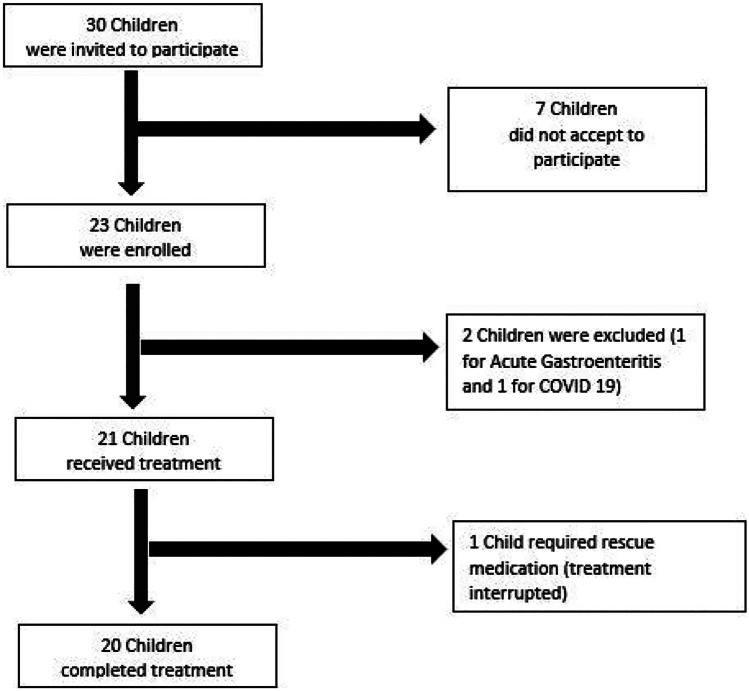
Most children with functional constipation (FC) improve with conventional treatments. However, a proportion of children have poor treatment outcomes. Management of intractable FC may include botulinum toxin injections, transanal irrigation, antegrade enemas, colonic resections, and in some cases sacral nerve stimulation (SNS). SNS is surgically placed, not readily available and expensive. Posterior tibial nerve stimulation (PTNS) allows transmission of electronic impulses and retrograde stimulation to the sacral nerve plexus in a portable, simple and non-invasive fashion. To assess the efficacy and safety of transcutaneous PTNS for the treatment of FC in children. Single-center, prospective interventional study. Children 4-14 years with Rome IV diagnosis of FC received ten daily PTNS (30 min/day) sessions. Electrodes placed over skin of ankle. Strength of stimulus was below pain threshold. Outcomes were assessed during treatment and 7 days after. Twenty-three subjects enrolled. Two children excluded (acute gastroenteritis, COVID-19 contact). Twenty completed the study (4-14 years), (8.4 ± 3.2 years, 71.4% female). We found significant improvement in the consistency of bowel movements (BM) (p = 0.005), fecal incontinence (FI) (p = 0.005), abdominal pain presence (p = < 0.001) and intensity (p = 0.005), and a significant for improvement in blood in stools (p = 0.037). There was 86.3% improvement in abdominal pain. 96.7% reported treatment satisfaction. Only one child required rescue therapy.
We found significant improvement in stool consistency, FI, abdominal pain, and hematochezia. This suggests that transcutaneous PTNS could be a promising noninvasive treatment for FC in children. Large studies are needed.
• Functional constipation is one of the most common disorders in children. • Current management of functional constipation consists of an integrative approach that includes medications, diet and behavioral strategies.
• Posterior tibial nerve stimulation is a novel noninvasive and easy to use therapy that can improve stool consistency, fecal incontinence and blood in stools.
大多数功能性便秘(FC)患儿经常规治疗可缓解,但仍有部分患儿疗效不佳。对于难治性 FC 的治疗可能包括肉毒毒素注射、经肛灌洗、顺行灌肠、结肠切除术,以及在某些情况下骶神经刺激(SNS)。SNS 是一种有创的治疗方法,不易获得且费用昂贵。胫后神经刺激(PTNS)可通过便携式、简单且非侵入性的方式,向骶神经丛传递电子脉冲和逆行刺激。本研究旨在评估经皮 PTNS 治疗儿童 FC 的疗效和安全性。
单中心前瞻性干预性研究。4-14 岁罗马 IV 诊断为 FC 的患儿接受 10 次每日 PTNS(每次 30 分钟)治疗。电极放置在踝关节皮肤表面,刺激强度低于疼痛阈值。在治疗期间和治疗后 7 天评估结局。
共纳入 23 例患儿,2 例因急性胃肠炎和 COVID-19 接触而排除。20 例完成研究(4-14 岁,8.4±3.2 岁,71.4%为女性)。研究发现患儿的粪便稠度(p=0.005)、粪便失禁(FI)(p=0.005)、腹痛存在(p<0.001)和强度(p=0.005)均有显著改善,粪便带血也有显著改善(p=0.037)。腹痛缓解率为 86.3%。96.7%的患儿对治疗满意。仅 1 例患儿需要挽救性治疗。
经皮 PTNS 可显著改善粪便稠度、FI、腹痛和粪便带血,提示其可能成为儿童 FC 的一种有前途的非侵入性治疗方法。但还需要进一步开展大样本研究。