Harrison Stephen A, Ruane Peter J, Freilich Bradley, Neff Guy, Patil Rashmee, Behling Cynthia, Hu Chen, Shringarpure Reshma, de Temple Brittany, Fong Erica, Tillman Erik J, Rolph Timothy, Cheng Andrew, Yale Kitty
Pinnacle Clinical Research, San Antonio, TX, United States.
Ruane Clinical Research Group Inc., Los Angeles, CA, United States.
JHEP Rep. 2022 Aug 23;5(1):100563. doi: 10.1016/j.jhepr.2022.100563. eCollection 2023 Jan.
BACKGROUND & AIMS: Efruxifermin has shown clinical efficacy in patients with non-alcoholic steatohepatitis (NASH) and F1-F3 fibrosis. The primary objective of the BALANCED Cohort C was to assess the safety and tolerability of efruxifermin in patients with compensated NASH cirrhosis.
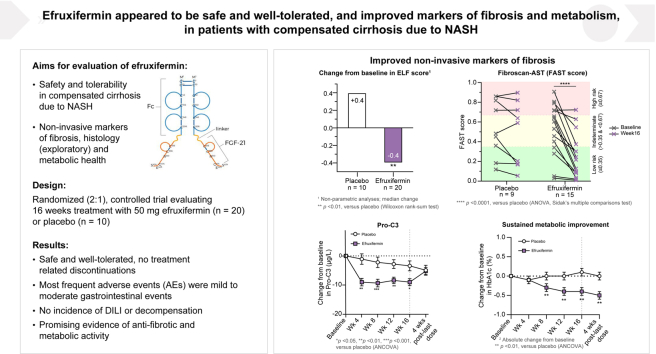
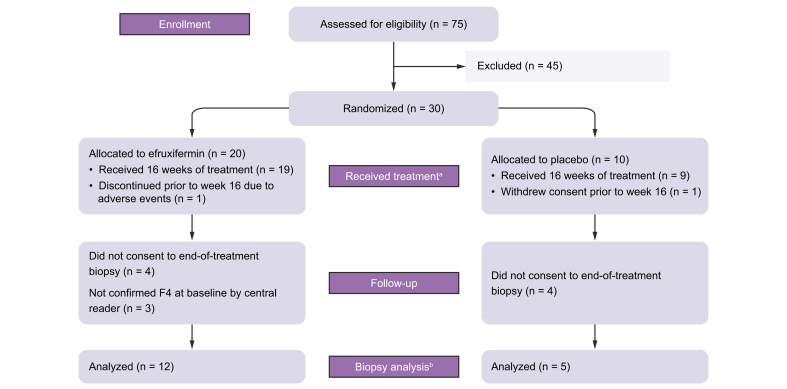
Patients with NASH and stage 4 fibrosis (n = 30) were randomized 2:1 to receive efruxifermin 50 mg (n = 20) or placebo (n = 10) once-weekly for 16 weeks. The primary endpoint was safety and tolerability of efruxifermin. Secondary and exploratory endpoints included evaluation of non-invasive markers of liver injury and fibrosis, glucose and lipid metabolism, and changes in histology in a subset of patients who consented to end-of-study liver biopsy.
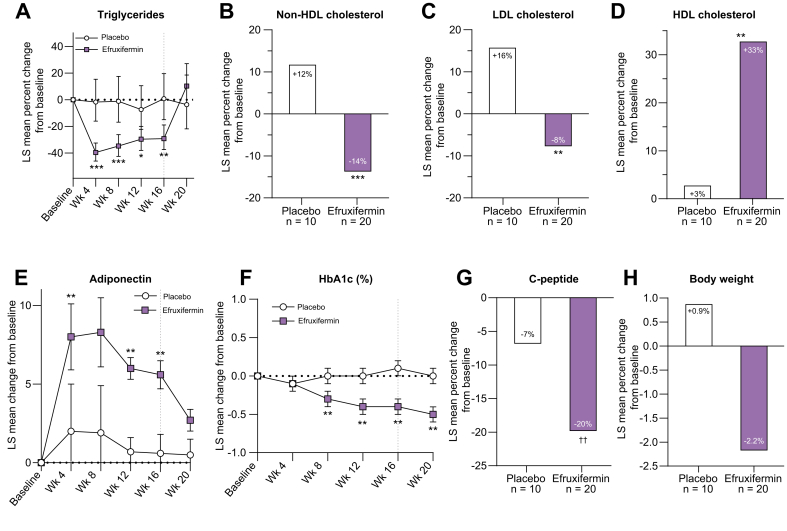
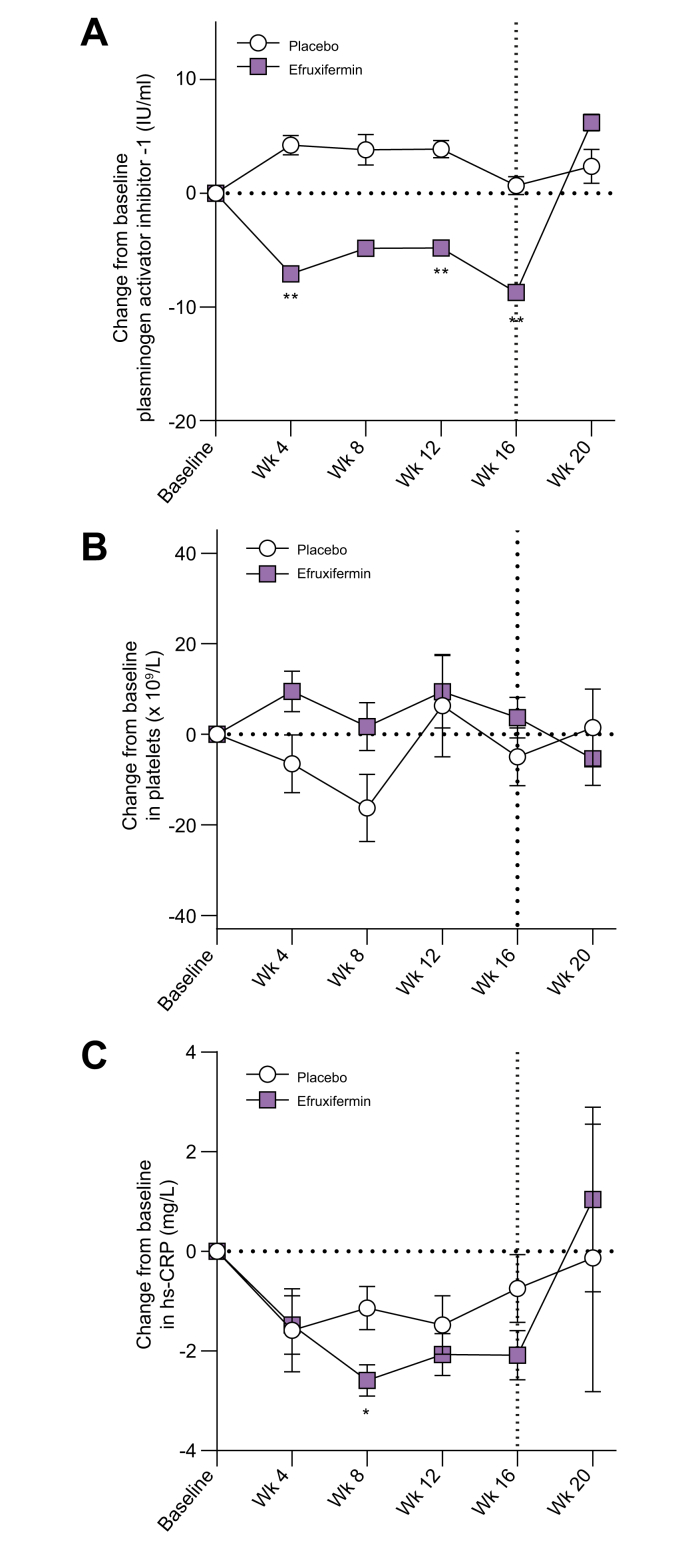
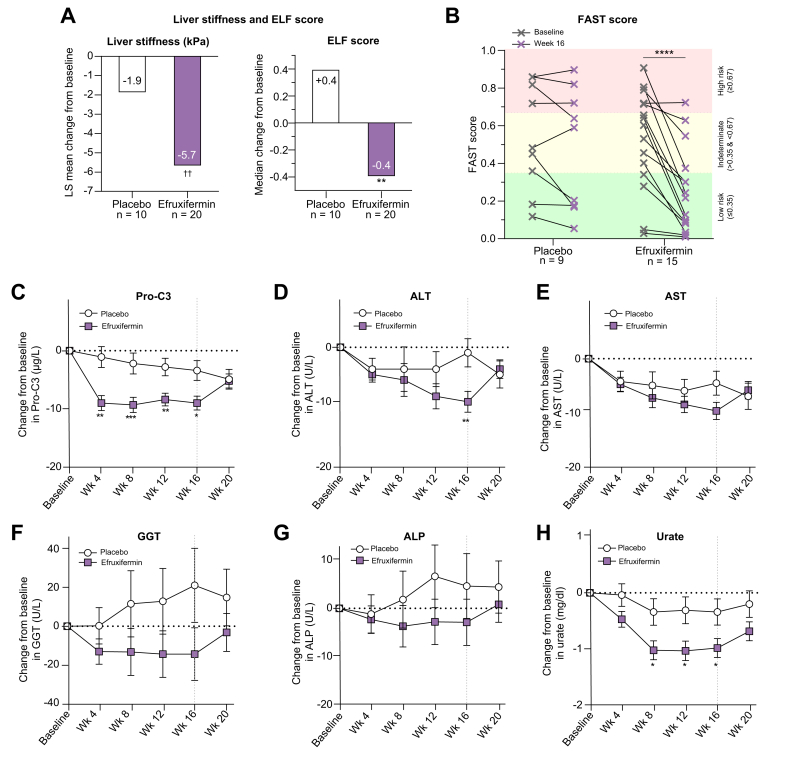
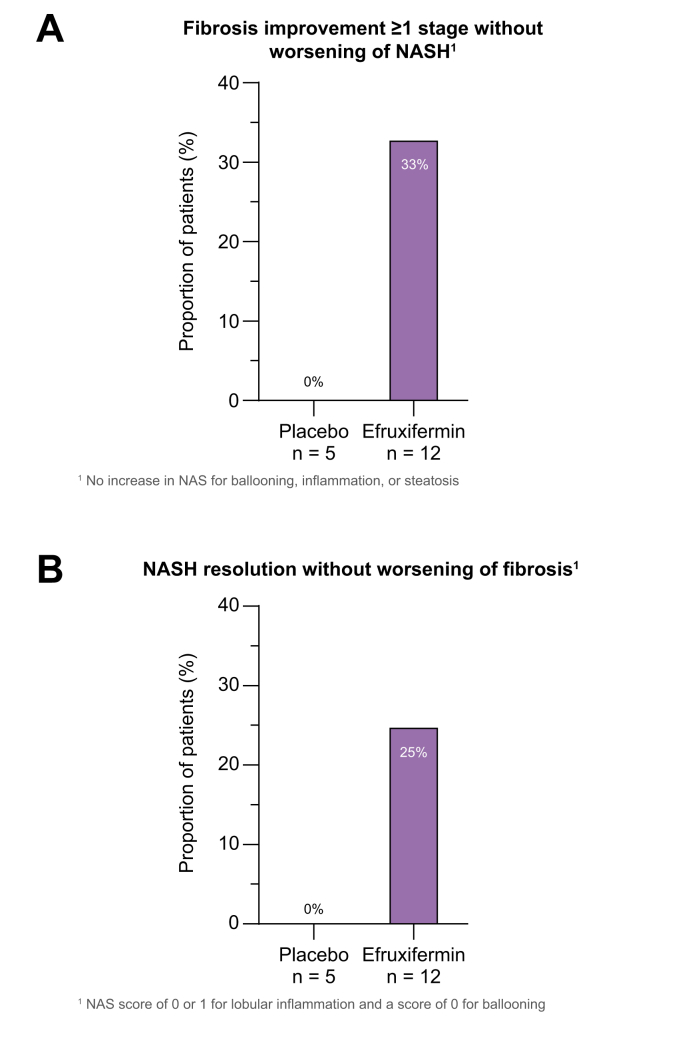
Efruxifermin was safe and well-tolerated; most adverse events (AEs) were grade 1 (n = 7, 23.3%) or grade 2 (n = 19, 63.3%). The most frequent AEs were gastrointestinal, including transient, mild to moderate diarrhea, and/or nausea. Significant improvements were noted in key markers of liver injury (alanine aminotransferase) and glucose and lipid metabolism. Sixteen-week treatment with efruxifermin was associated with significant reductions in non-invasive markers of fibrosis including Pro-C3 (least squares mean change from baseline [LSMCFB] -9 μg/L efruxifermin -3.4 μg/L placebo; = 0.0130) and ELF score (-0.4 efruxifermin +0.4 placebo; = 0.0036), with a trend towards reduced liver stiffness (LSMCFB -5.7 kPa efruxifermin -1.1 kPa placebo; n.s.). Of 12 efruxifermin-treated patients with liver biopsy after 16 weeks, 4 (33%) achieved fibrosis improvement of at least one stage without worsening of NASH, while an additional 3 (25%) achieved resolution of NASH, compared to 0 of 5 placebo-treated patients.
Efruxifermin appeared safe and well-tolerated with encouraging improvements in markers of liver injury, fibrosis, and glucose and lipid metabolism following 16 weeks of treatment, warranting confirmation in larger and longer term studies.
Cirrhosis resulting from non-alcoholic steatohepatitis (NASH), the progressive form of non-alcoholic fatty liver disease, represents a major unmet medical need. Currently there are no approved drugs for the treatment of NASH. This proof-of-concept randomized, double-blind clinical trial demonstrated the potential therapeutic benefit of efruxifermin treatment compared to placebo in patients with cirrhosis due to NASH.
NCT03976401.
艾弗鲁西费明已在非酒精性脂肪性肝炎(NASH)和F1 - F3纤维化患者中显示出临床疗效。BALANCED队列C的主要目标是评估艾弗鲁西费明在代偿性NASH肝硬化患者中的安全性和耐受性。
将30例NASH和4期纤维化患者按2:l随机分组,分别接受50mg艾弗鲁西费明(n = 20)或安慰剂(n = 10)治疗,每周1次,共16周。主要终点是艾弗鲁西费明的安全性和耐受性。次要终点和探索性终点包括评估肝损伤和纤维化的非侵入性标志物、葡萄糖和脂质代谢,以及在同意进行研究结束时肝脏活检的部分患者中组织学的变化。
艾弗鲁西费明安全且耐受性良好;大多数不良事件(AE)为1级(n = 7,23.3%)或2级(n = 19,63.3%)。最常见的AE是胃肠道反应,包括短暂的、轻度至中度腹泻和/或恶心。肝损伤(丙氨酸氨基转移酶)以及葡萄糖和脂质代谢的关键标志物有显著改善。接受16周艾弗鲁西费明治疗后,纤维化的非侵入性标志物包括前C3(艾弗鲁西费明组从基线的最小二乘均值变化[LSMCFB]为 - 9μg/L,安慰剂组为 - 3.4μg/L;P = 0.0130)和ELF评分(艾弗鲁西费明组为 - 0.4,安慰剂组为 + 0.4;P = 0.0036)显著降低,肝脏硬度有降低趋势(艾弗鲁西费明组LSMCFB为 - 5.7kPa,安慰剂组为 - 1.1kPa;无统计学意义)。16周后接受肝脏活检的12例艾弗鲁西费明治疗患者中,4例(33%)实现了至少一个阶段的纤维化改善且NASH未恶化,另有3例(25%)实现了NASH消退,而5例安慰剂治疗患者中无一例出现上述情况。
艾弗鲁西费明似乎安全且耐受性良好,治疗16周后,肝损伤、纤维化以及葡萄糖和脂质代谢标志物有令人鼓舞的改善,需要在更大规模和更长时间的研究中予以证实。
非酒精性脂肪性肝炎(NASH)导致的肝硬化是非酒精性脂肪性肝病的进展形式,是一个主要的未满足医疗需求领域。目前尚无获批用于治疗NASH的药物。这项概念验证性随机双盲临床试验证明,与安慰剂相比,艾弗鲁西费明治疗对NASH所致肝硬化患者具有潜在治疗益处。
NCT03976401。