Liu Zinuan, Ding Yipu, Dou Guanhua, Yang Xia, Wang Xi, Shan Dongkai, He Bai, Jing Jing, Chen Yundai, Yang Junjie
Department of Cardiovascular Medicine, Chinese PLA General Hospital, Beijing, China.
School of Medicine, Nankai University, Tianjin, China.
Atheroscler Plus. 2021 Jul 29;44:10-17. doi: 10.1016/j.athplu.2021.07.021. eCollection 2021 Oct.
The prognostic impact of non-obstructive coronary artery disease (CAD) has long been underestimated due to its mild stenosis (<50% stenosis). We aim to investigate the prognostic value of atherosclerotic extent in DM patients with non-obstructive CAD.
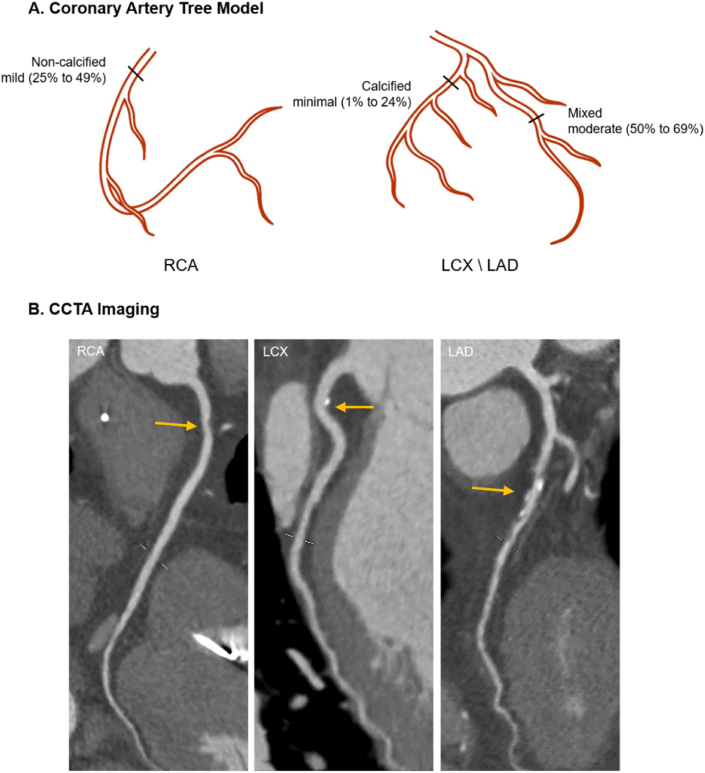
The analysis was based on a single center cohort of DM patients referred for coronary computed tomography angiography (CCTA) due to suspect CAD in 2015-2017. Based on coronary stenosis combined with segment involvement score (SIS), the study population were divided into four groups: normal (0% stenosis), non-obstructive SIS<3, non-obstructive SIS≥3 and obstructive (≥50% stenosis). The intra-class correlation (ICC) was used to test the inter-and intra-reviewer agreement. Multivariate Cox model and Kaplan-Meier method were used to evaluate the effect size of atherosclerotic extent on the prognosis.
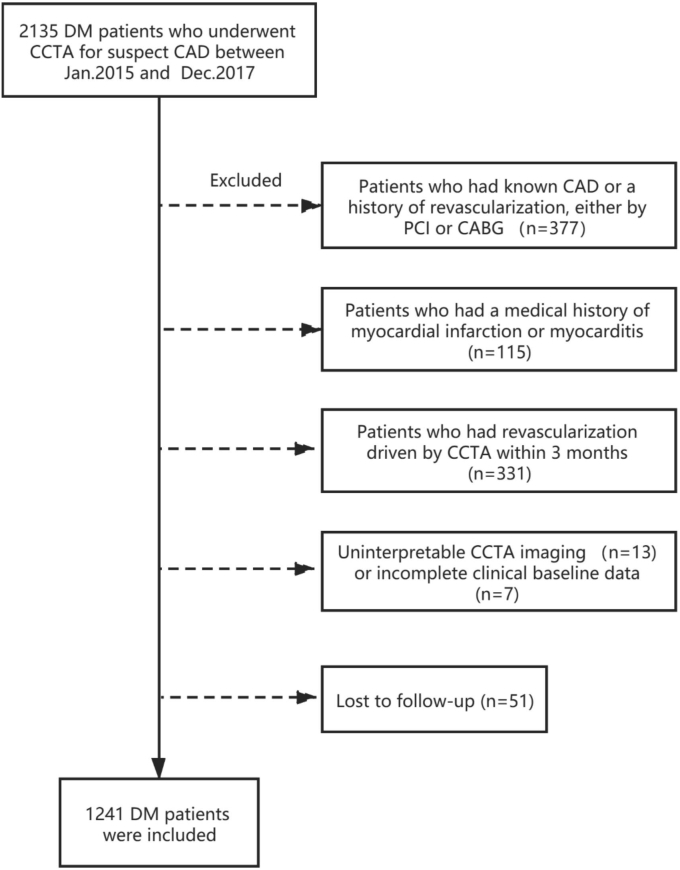
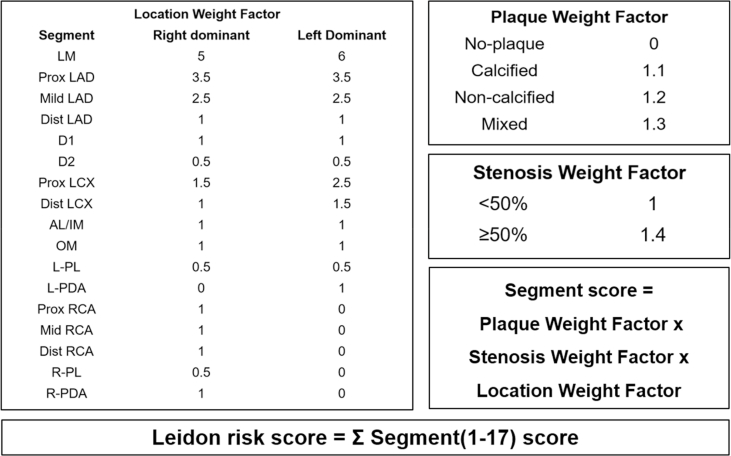
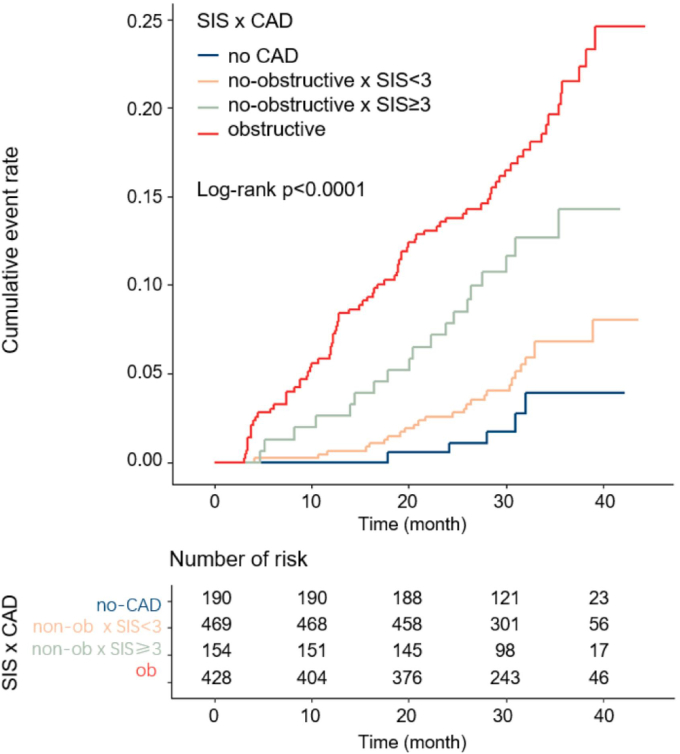
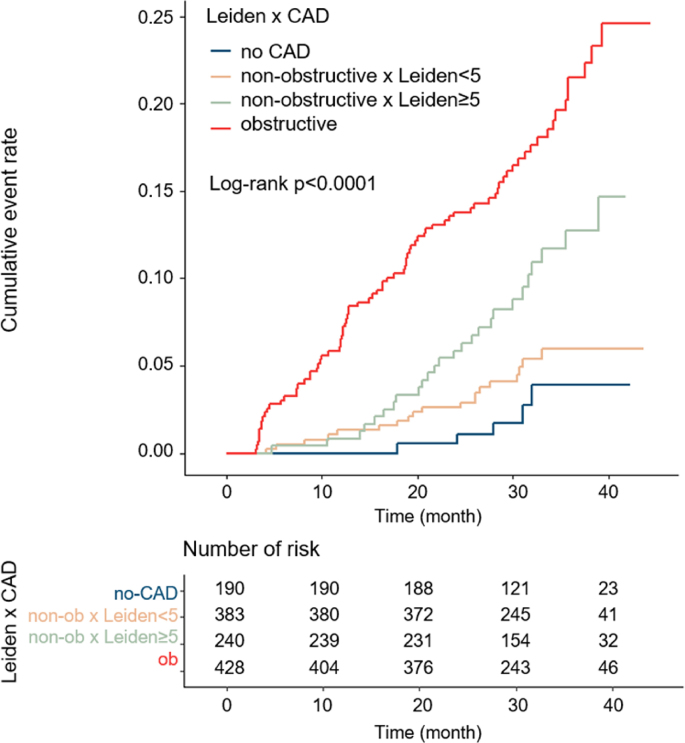
In total, 1241 patients (age 60.2 ± 10.4 years, 54.1% male) were included, of which 50.2% were non-obstructive. During a median follow-up of 2.6 years, 131 MACEs (10.6%) were adjudicated, including 17 cardiovascular deaths, 28 non-fatal myocardial infarctions, 64 unstable anginas requiring hospitalization and 22 strokes. Incremental event rates could be observed across the four groups. After adjustment for age, gender, hyperlipidemia and presence of high-risk plaque, Hazard Ratio (HR) for non-obstructive SIS<3, non-obstructive SIS≥3 and the obstructive group was 1.84 (95%CI: 0.70-4.79), 3.71 (95%CI: 1.37-10.00) and 5.46 (95%CI: 2.18-13.69), respectively. Compared with non-obstructive SIS<3, non-obstructive SIS≥3 showed a significantly higher risk (HR:2.02 95%CI:1.11-3.68, = 0.021). Similar results were demonstrated when Leiden risk score was used for sensitivity analysis.
In DM patients with non-obstructive CAD, atherosclerotic extent was associated with higher risk of major adverse cardiac events at long-term follow-up. Efforts should be made to determine risk stratification for the management of DM patients with non-obstructive CAD.
由于非阻塞性冠状动脉疾病(CAD)的狭窄程度较轻(狭窄<50%),其预后影响长期以来一直被低估。我们旨在研究非阻塞性CAD糖尿病患者动脉粥样硬化程度的预后价值。
该分析基于2015 - 2017年因疑似CAD转诊接受冠状动脉计算机断层扫描血管造影(CCTA)的糖尿病患者单中心队列。根据冠状动脉狭窄情况结合节段累及评分(SIS),将研究人群分为四组:正常(0%狭窄)、非阻塞性SIS<3、非阻塞性SIS≥3和阻塞性(≥50%狭窄)。采用组内相关系数(ICC)检验审阅者间和审阅者内的一致性。使用多变量Cox模型和Kaplan-Meier方法评估动脉粥样硬化程度对预后的影响大小。
共纳入1241例患者(年龄60.2±10.4岁,男性占54.1%),其中50.2%为非阻塞性。在中位随访2.6年期间,判定发生131例主要不良心血管事件(MACE,10.6%),包括17例心血管死亡、28例非致命性心肌梗死、64例需要住院治疗的不稳定型心绞痛和22例中风。四组间可观察到事件发生率逐步增加。在调整年龄、性别、高脂血症和高危斑块的存在后,非阻塞性SIS<3、非阻塞性SIS≥3和阻塞性组的风险比(HR)分别为1.84(95%CI:0.70 - 4.79)、3.71(95%CI:1.37 - 10.00)和5.46(95%CI:2.18 - 13.69)。与非阻塞性SIS<3相比,非阻塞性SIS≥3显示出显著更高的风险(HR:2.02,95%CI:1.11 - 3.68,P = 0.021)。使用莱顿风险评分进行敏感性分析时也得到了类似结果。
在非阻塞性CAD的糖尿病患者中,动脉粥样硬化程度与长期随访中主要不良心脏事件的较高风险相关。应努力确定非阻塞性CAD糖尿病患者管理的风险分层。