Department of Bioengineering, University of Pennsylvania, Philadelphia, PA, 19104, USA.
Department of Medicine, University of Pennsylvania, Philadelphia, PA, 19104, USA.
Nat Commun. 2023 Jan 17;14(1):75. doi: 10.1038/s41467-022-35637-z.
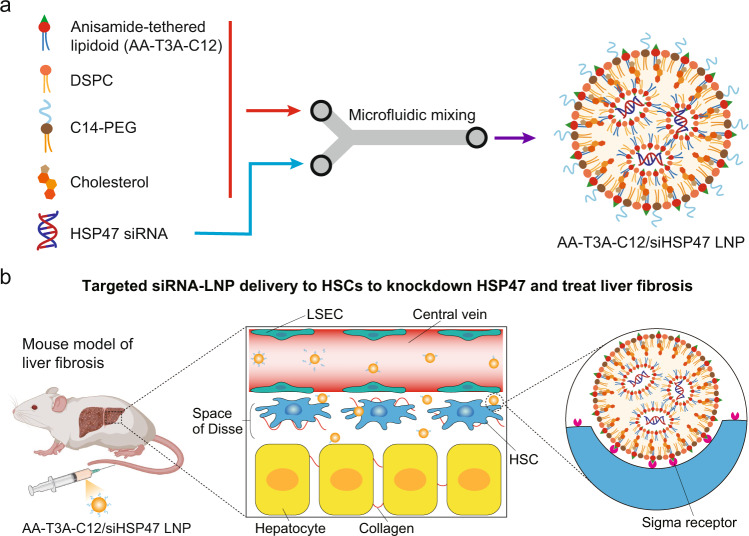
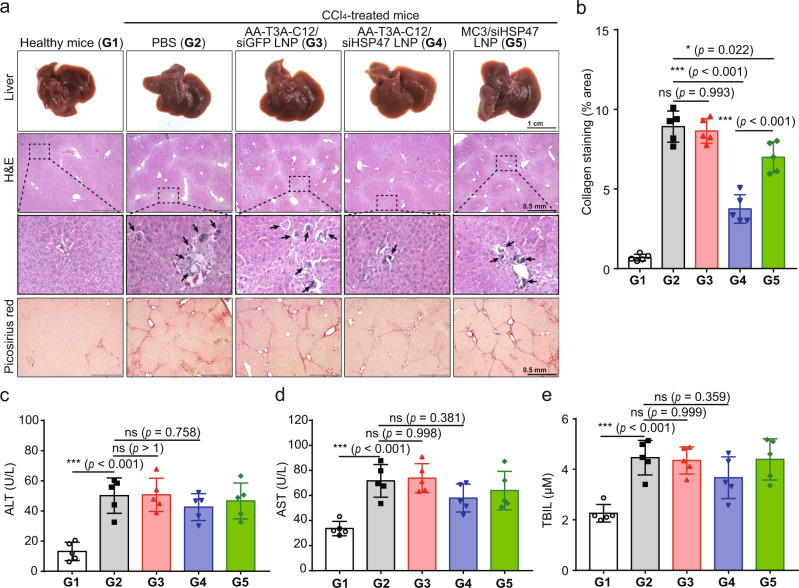
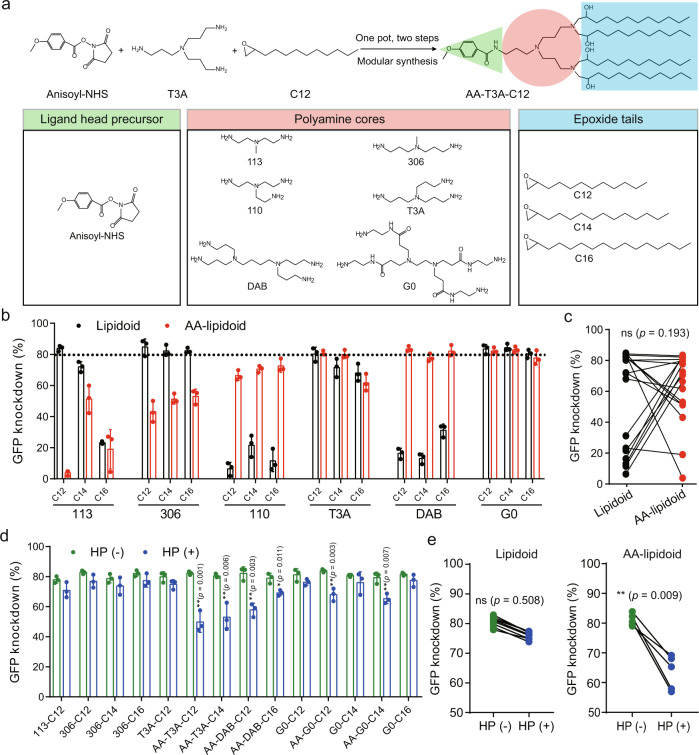
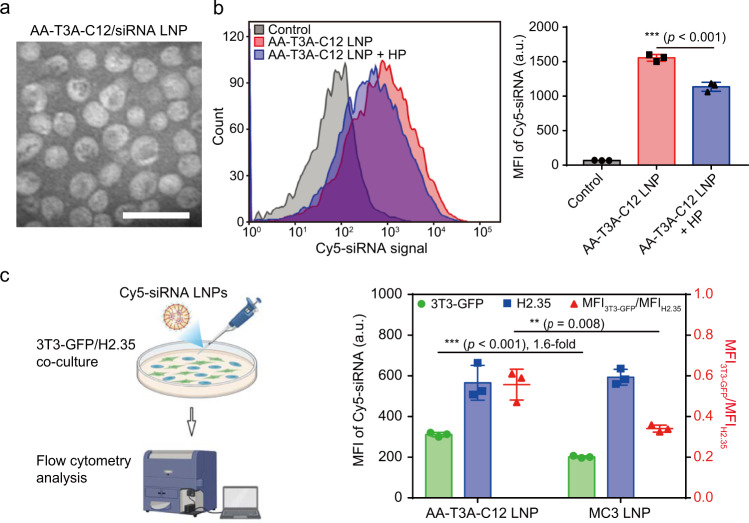
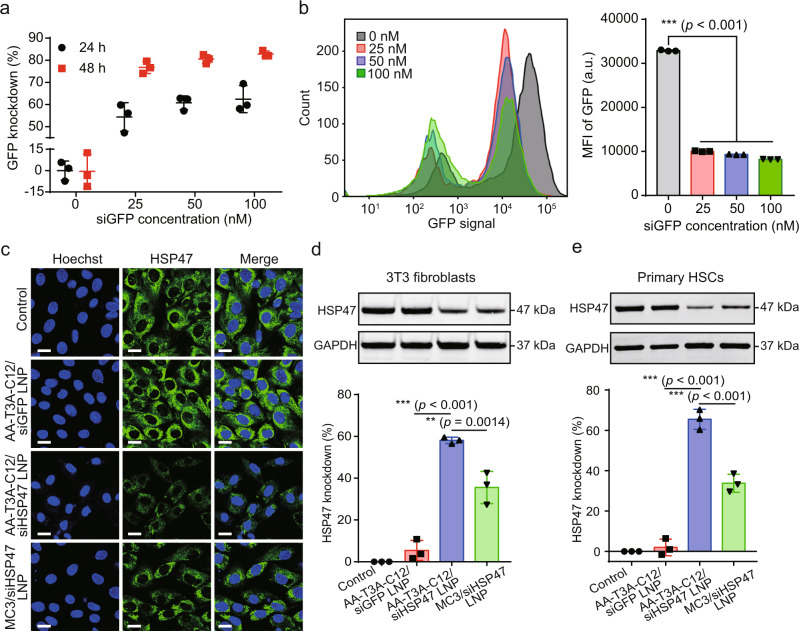
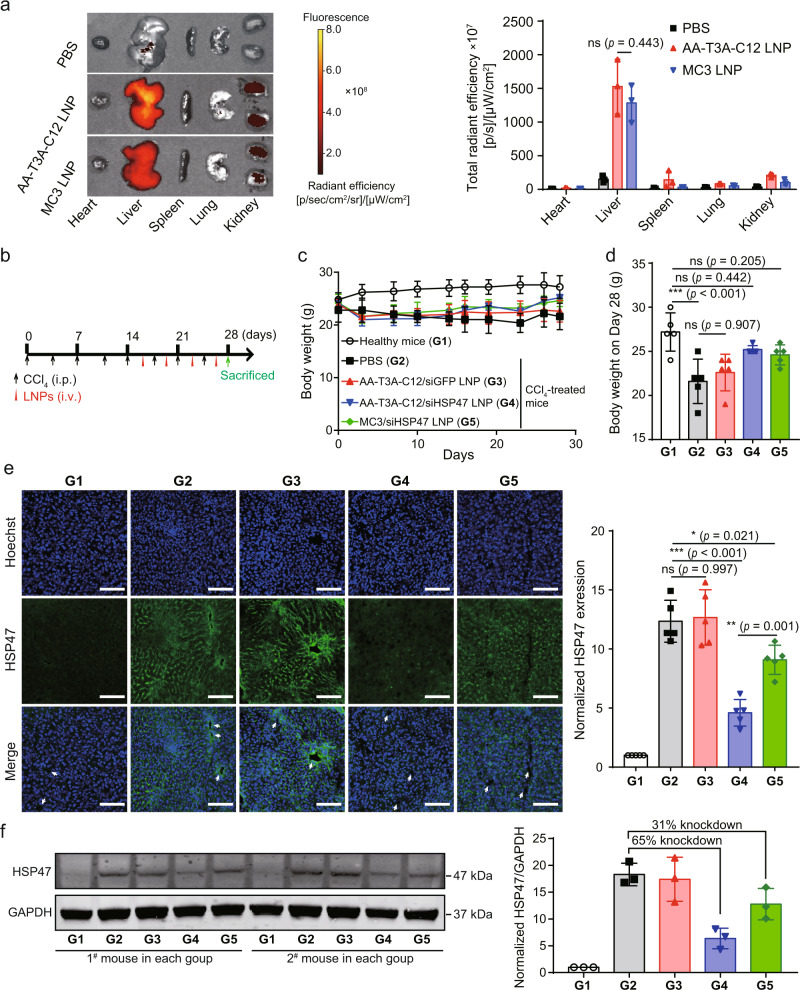
Lipid nanoparticle-mediated RNA delivery holds great potential to treat various liver diseases. However, targeted delivery of RNA therapeutics to activated liver-resident fibroblasts for liver fibrosis treatment remains challenging. Here, we develop a combinatorial library of anisamide ligand-tethered lipidoids (AA-lipidoids) using a one-pot, two-step modular synthetic method and adopt a two-round screening strategy to identify AA-lipidoids with both high potency and selectivity to deliver RNA payloads to activated fibroblasts. The lead AA-lipidoid AA-T3A-C12 mediates greater RNA delivery and transfection of activated fibroblasts than its analog without anisamide and the FDA-approved MC3 ionizable lipid. In a preclinical model of liver fibrosis, AA-T3A-C12 enables ~65% silencing of heat shock protein 47, a therapeutic target primarily expressed by activated fibroblasts, which is 2-fold more potent than MC3, leading to significantly reduced collagen deposition and liver fibrosis. These results demonstrate the potential of AA-lipidoids for targeted RNA delivery to activated fibroblasts. Furthermore, these synthetic methods and screening strategies open a new avenue to develop and discover potent lipidoids with targeting properties, which can potentially enable RNA delivery to a range of cell and tissue types that are challenging to access using traditional lipid nanoparticle formulations.
脂质纳米颗粒介导的 RNA 递送至关重要,可用于治疗多种肝脏疾病。然而,将 RNA 疗法靶向递送至激活的肝固有成纤维细胞以治疗肝纤维化仍然具有挑战性。在这里,我们使用一锅两步模块化合成方法开发了一种酰胺配体连接的脂质体(AA-脂质体)组合文库,并采用两轮筛选策略来鉴定同时具有高效力和选择性的 AA-脂质体,以将 RNA 有效载荷递送至激活的成纤维细胞。先导 AA-脂质体 AA-T3A-C12 介导的 RNA 递送至激活的成纤维细胞的转染效率比没有酰胺的类似物和 FDA 批准的 MC3 可离子化脂质更高。在肝纤维化的临床前模型中,AA-T3A-C12 可使热休克蛋白 47(主要由激活的成纤维细胞表达的治疗靶点)的沉默率达到约 65%,比 MC3 高 2 倍,导致胶原沉积和肝纤维化明显减少。这些结果表明 AA-脂质体具有靶向递送至激活的成纤维细胞的潜力。此外,这些合成方法和筛选策略为开发和发现具有靶向特性的有效脂质体开辟了新途径,这可能使 RNA 递送至使用传统脂质纳米颗粒制剂难以到达的一系列细胞和组织类型成为可能。