Department of Psychiatry, Yale School of Medicine, West Haven, Connecticut.
Veterans Affairs Connecticut Healthcare Center, West Haven.
JAMA Netw Open. 2023 Jan 3;6(1):e2251214. doi: 10.1001/jamanetworkopen.2022.51214.
Endometriosis is a common chronic gynecologic pathology with a large negative impact on women's health. Beyond severe physical symptoms, endometriosis is also associated with several psychiatric comorbidities, including depression and anxiety.
To investigate whether pleiotropy contributes to the association of endometriosis with depression, anxiety, and eating disorders.
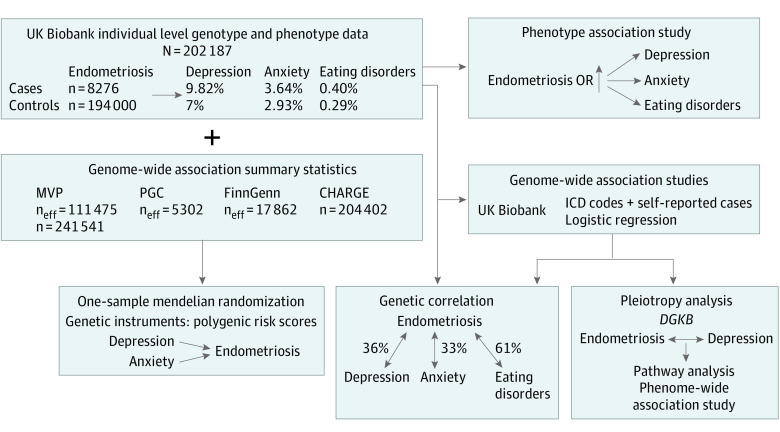
DESIGN, SETTING, AND PARTICIPANTS: This genetic association study was performed between September 13, 2021, and June 24, 2022, in 202 276 unrelated female participants. Genotypic and phenotypic information from the UK Biobank was combined with genome-wide association statistics available from the Psychiatric Genomics Consortium (11 countries), the Million Veteran Program (US), the FinnGen study (Finland), and the CHARGE (Cohorts for Heart and Aging Research in Genomic Epidemiology) consortium (5 countries).
The main outcomes were the phenotypic and genetic associations of endometriosis with anxiety, depression, and eating disorders.
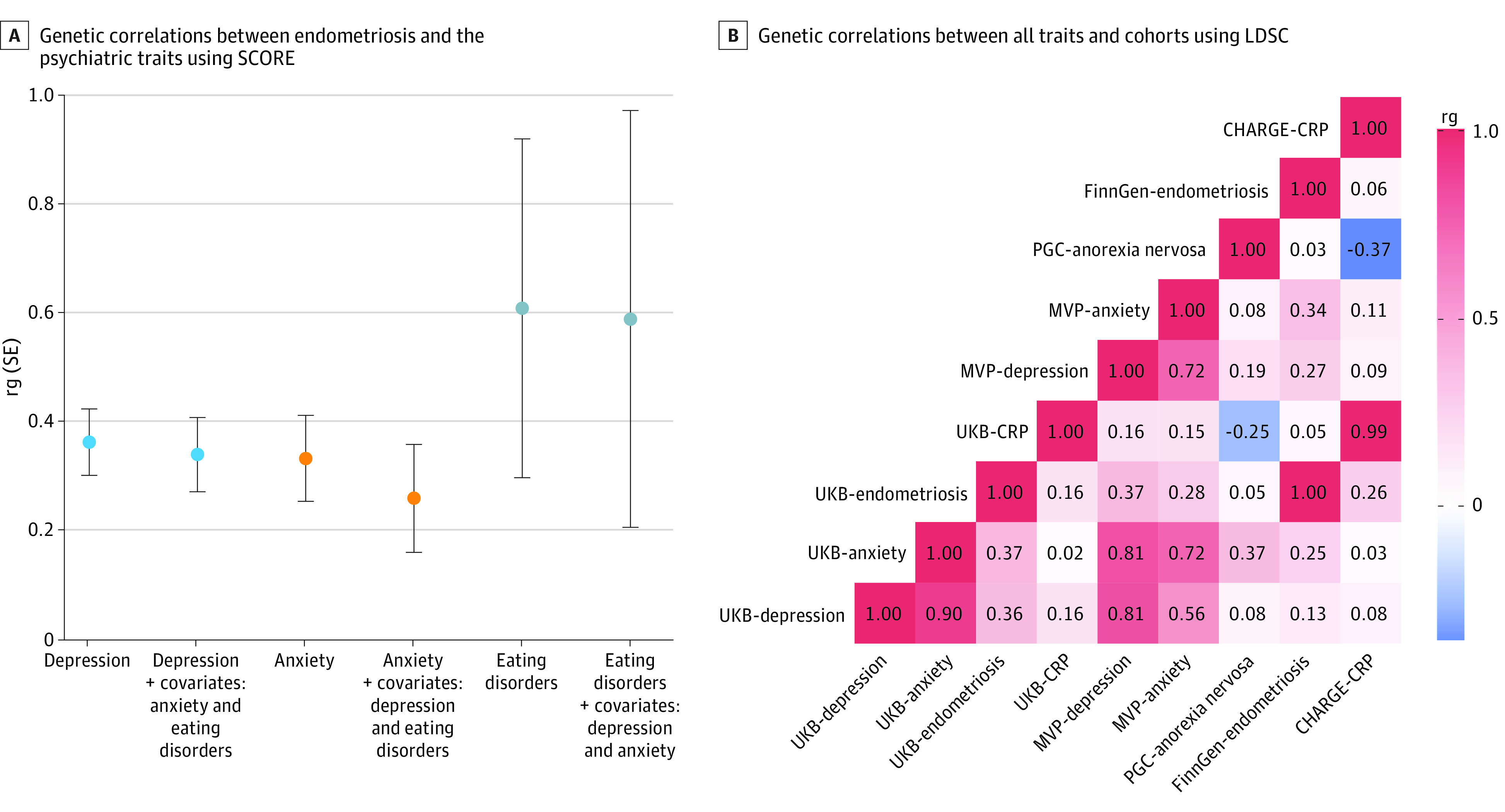
A total of 8276 women with endometriosis (mean [SD] age, 53.1 [7.9] years) and 194 000 female controls (mean [SD] age, 56.7 [7.9] years) were included in the study. In a multivariate regression analysis accounting for age, body mass index, socioeconomic status, chronic pain-related phenotypes, irritable bowel syndrome, and psychiatric comorbidities, endometriosis was associated with increased odds of depression (odds ratio [OR], 3.61; 95% CI, 3.32-3.92), eating disorders (OR, 2.94; 95% CI, 1.96-4.41), and anxiety (OR, 2.61; 95% CI, 2.30-2.97). These associations were supported by consistent genetic correlations (rg) (depression rg, 0.36, P = 1.5 × 10⁻⁹; anxiety rg, 0.33, P = 1.17 × 10⁻⁵; and eating disorders rg, 0.61, P = .02). With the application of a 1-sample mendelian randomization, the genetic liabilities to depression and anxiety were associated with increased odds of endometriosis (depression: OR, 1.09; 95% CI, 1.08-1.11; anxiety: OR, 1.39; 95% CI, 1.13-1.65). A genome-wide analysis of pleiotropic associations shared between endometriosis and psychiatric disorders identified 1 locus, DGKB rs12666606, with evidence of pleiotropy between endometriosis and depression after multiple testing correction (z = -9.46 for endometriosis, z = 8.10 for depression, P = 5.56 × 10⁻⁸; false discovery rate q = 4.95 × 10⁻⁴).
These findings highlight that endometriosis is associated with women's mental health through pleiotropic mechanisms. To our knowledge, this is the first large-scale study to provide genetic and phenotypic evidence of the processes underlying the psychiatric comorbidities of endometriosis.
子宫内膜异位症是一种常见的慢性妇科疾病,对女性健康有很大的负面影响。除了严重的身体症状外,子宫内膜异位症还与多种精神科合并症有关,包括抑郁和焦虑。
研究多效性是否有助于子宫内膜异位症与抑郁、焦虑和饮食障碍之间的关联。
设计、设置和参与者:这项遗传关联研究于 2021 年 9 月 13 日至 2022 年 6 月 24 日在英国生物银行的 202276 名无关女性参与者中进行。英国生物银行的基因型和表型信息与精神病学基因组联盟(11 个国家)、百万退伍军人计划(美国)、芬兰的 FinnGen 研究和 CHARGE(基因组流行病学中心和老龄化研究中的心脏和衰老)联盟(5 个国家)的全基因组关联统计数据相结合。
主要结果是子宫内膜异位症与焦虑、抑郁和饮食障碍的表型和遗传关联。
共纳入 8276 名患有子宫内膜异位症的女性(平均[标准差]年龄,53.1[7.9]岁)和 194000 名女性对照(平均[标准差]年龄,56.7[7.9]岁)。在一项考虑年龄、体重指数、社会经济地位、慢性疼痛相关表型、肠易激综合征和精神科合并症的多变量回归分析中,子宫内膜异位症与抑郁(比值比[OR],3.61;95%置信区间[CI],3.32-3.92)、饮食障碍(OR,2.94;95%CI,1.96-4.41)和焦虑(OR,2.61;95%CI,2.30-2.97)的患病风险增加相关。这些关联得到了一致的遗传相关性(rg)(抑郁 rg,0.36,P = 1.5×10⁻⁹;焦虑 rg,0.33,P = 1.17×10⁻⁵;饮食障碍 rg,0.61,P = 0.02)的支持。通过单样本 Mendelian 随机化分析,抑郁和焦虑的遗传易感性与子宫内膜异位症的患病风险增加相关(抑郁:OR,1.09;95%CI,1.08-1.11;焦虑:OR,1.39;95%CI,1.13-1.65)。对子宫内膜异位症和精神障碍之间共享的多效性关联的全基因组分析确定了 1 个位点,DGKB rs12666606,在经过多次测试校正后,该位点与子宫内膜异位症和抑郁之间存在多效性证据(子宫内膜异位症 z 值为-9.46,抑郁 z 值为 8.10,P = 5.56×10⁻⁸;错误发现率 q 值为 4.95×10⁻⁴)。
这些发现强调了子宫内膜异位症通过多效性机制与女性的心理健康有关。据我们所知,这是第一项提供遗传和表型证据的大规模研究,这些证据支持了子宫内膜异位症精神科合并症的潜在过程。