From the Department of Epidemiology, University of Michigan, Ann Arbor, Michigan.
From the Department of Epidemiology, University of Michigan, Ann Arbor, Michigan.
Am J Prev Med. 2023 Apr;64(4 Suppl 1):S32-S41. doi: 10.1016/j.amepre.2022.07.019. Epub 2023 Jan 16.
In the U.S., low-income individuals generally smoke more than high-income individuals. However, detailed information about how smoking patterns differ by income, especially differences by birth cohort, is lacking.
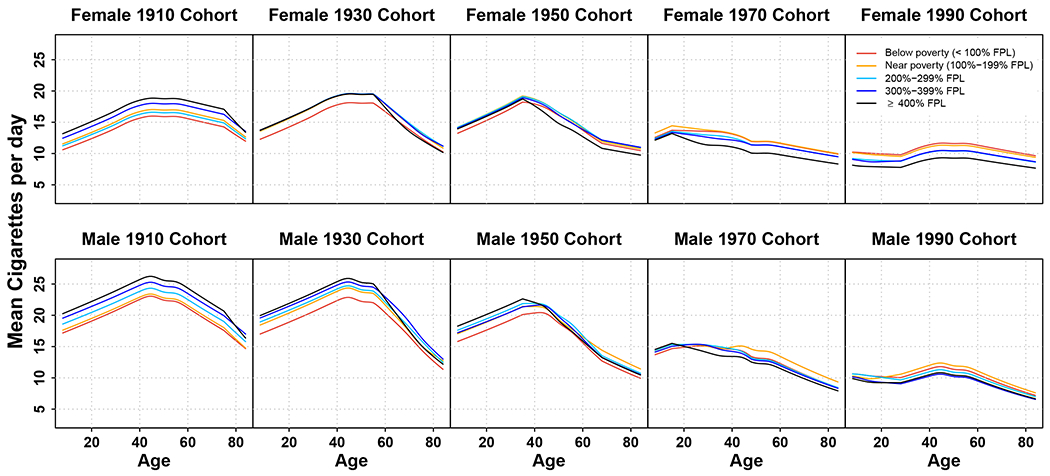
Using the National Health Interview Survey 1983-2018 data, individual family income was calculated as a ratio of the federal poverty level. Missing income data from 1983 to 1996 were imputed using sequential regression multivariate imputation. Age‒period‒cohort models with constrained natural splines were used to estimate annual probabilities of smoking initiation and cessation and smoking prevalence and intensity by gender and birth cohort (1900-2000) for 5 income groups: <100%, 100%-199%, 200%-299%, 300%-399%, and ≥400% of the federal poverty level. Analysis was conducted in 2020-2021.
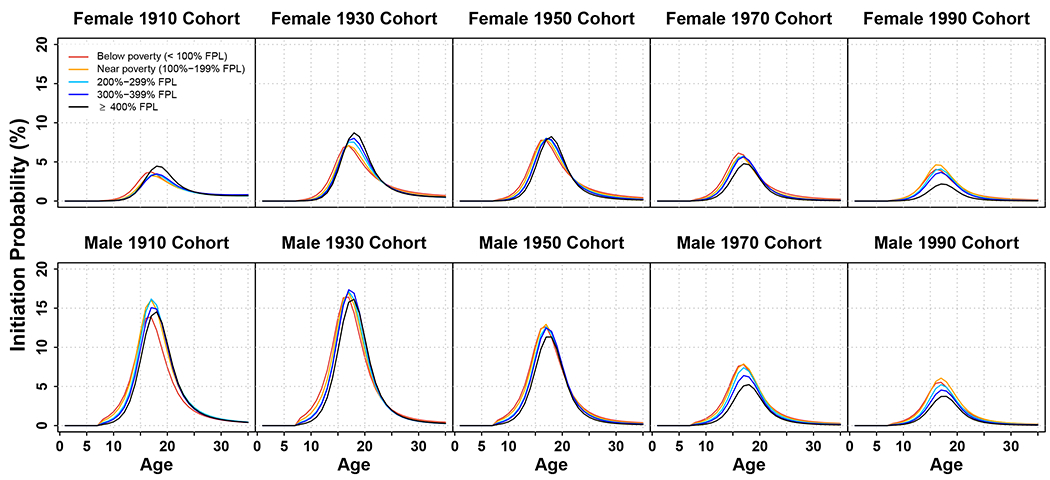
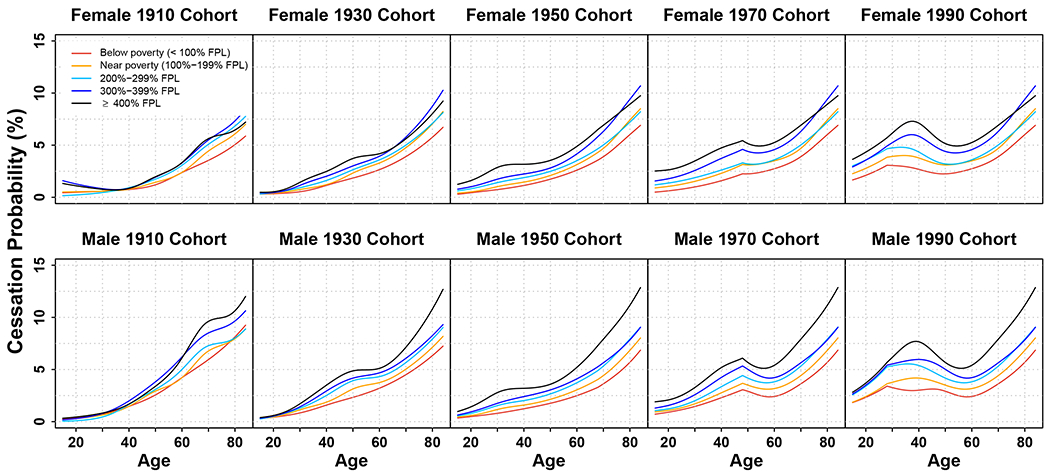
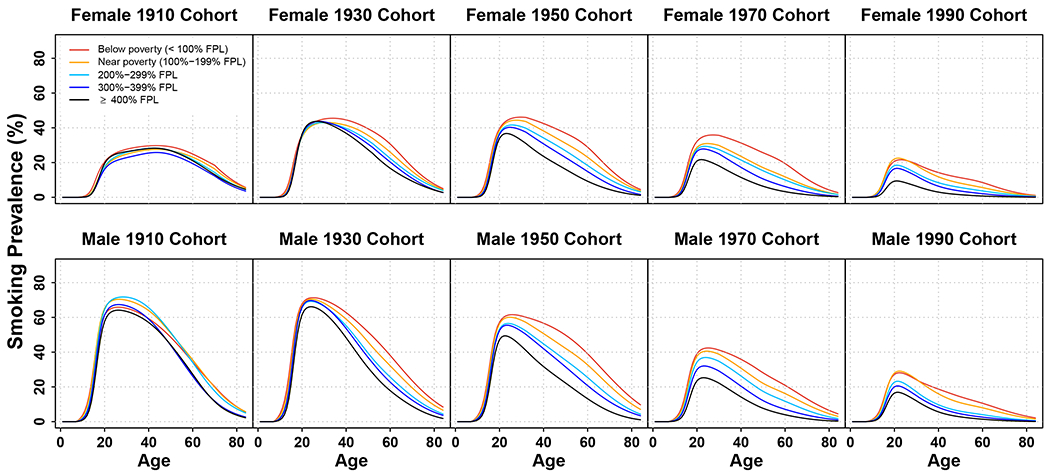
Across all income groups, smoking prevalence and initiation probabilities are decreasing by birth cohort, whereas cessation probabilities are increasing. However, relative differences between low- and high-income groups are increasing markedly, such that there were greater declines in prevalence among those in high-income groups in more recent cohorts. Smoking initiation probabilities are lowest in the ≥400% federal poverty level group for males across birth cohorts, whereas for females, this income group has the highest initiation probabilities in older cohorts but the lowest in recent cohorts. People living below the federal poverty level have the lowest cessation probabilities across cohorts.
Smoking prevalence has been decreasing in all income groups; however, disparities in smoking by family income are widening in recent birth cohorts. Future studies evaluating smoking disparities should account for cohort differences. Intervention strategies should focus on reducing initiation and improving quit success among low-income groups.
在美国,低收入人群的吸烟率通常高于高收入人群。然而,关于收入差异如何影响吸烟模式,尤其是不同出生队列之间的差异,相关信息还很缺乏。
利用 1983-2018 年全国健康访谈调查数据,将个人家庭收入计算为联邦贫困线的比率。1983 年至 1996 年期间缺失的收入数据采用序列回归多元插补法进行插补。采用受约束自然样条年龄-时期-队列模型,根据性别和出生队列(1900-2000 年)对 5 个收入组(<100%、100%-199%、200%-299%、300%-399%和≥400%联邦贫困线)的吸烟起始、戒烟、吸烟流行率和吸烟强度的年概率进行估计。分析于 2020-2021 年进行。
在所有收入组中,吸烟流行率和起始率随着出生队列的推移而下降,而戒烟率则在上升。然而,低收入和高收入群体之间的相对差异明显增大,最近出生队列中高收入群体的流行率下降幅度更大。在所有出生队列中,男性的吸烟起始率在≥400%联邦贫困线家庭收入组中最低,而女性在较老的出生队列中,该收入组的起始率最高,但在最近的出生队列中最低。在所有队列中,生活在联邦贫困线以下的人群戒烟率最低。
所有收入组的吸烟流行率都在下降;然而,最近出生队列中家庭收入的吸烟差异正在扩大。未来评估吸烟差异的研究应考虑队列差异。干预策略应侧重于降低低收入群体的吸烟起始率并提高戒烟成功率。