Zibaei Mohammad, Bahadory Saeed, Saadati Hassan, Pourrostami Kumars, Firoozeh Farzaneh, Foroutan Masoud
Department of Parasitology and Mycology, School of Medicine, Alborz University of Medical Sciences, Karaj, Iran.
Evidence-based Phytotherapy and Complementary Medicine Research Center, Alborz University of Medical Sciences, Karaj, Iran.
New Microbes New Infect. 2022 Dec 24;51:101065. doi: 10.1016/j.nmni.2022.101065. eCollection 2023 Jan.
Investigating the association between infectious agents and non-communicable diseases is an interesting emerging field of research. Intestinal parasites (IPs) are one of the causes of gastrointestinal complications, malnutrition, growth retardation and disturbances in host metabolism, which can play a potential role in metabolic diseases such as diabetes. The aim of the present study was to investigate the prevalence of IPs in diabetic patients and the association between IPs and diabetes.
A systematic literature search was conducted from January 2000 to November 2022in published records by using PubMed, Scopus, and Web of Science databases as well as Google scholar search engine; Out of a total of 29 included studies, fourteen cross-sectional studies (2676 diabetic subjects) and 15 case-control studies (5478 diabetic/non-diabetic subjects) were reviewed. The pooled prevalence of IPs in diabetics and the Odds Ratio (OR) were evaluated by CMA V2.
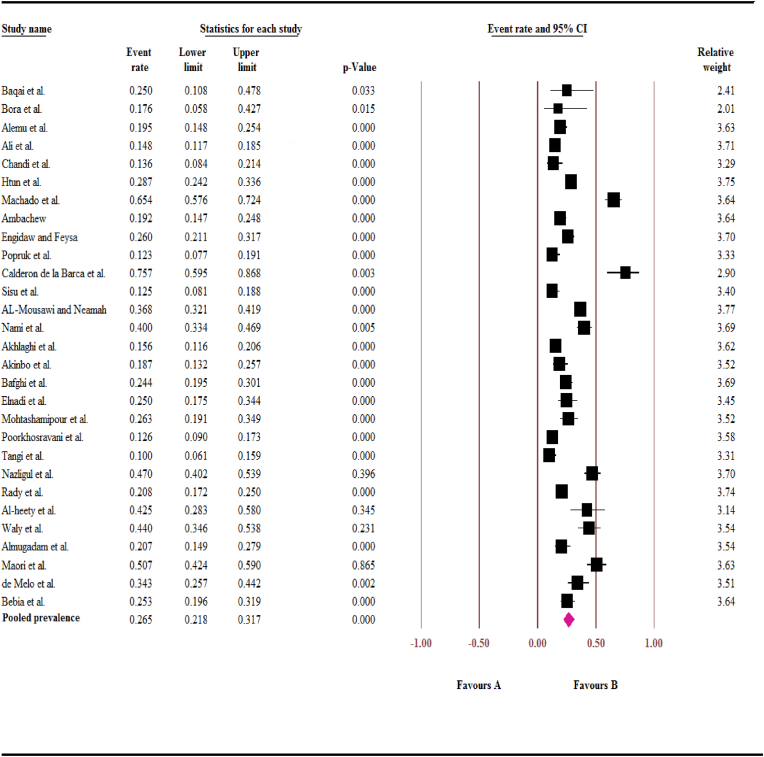
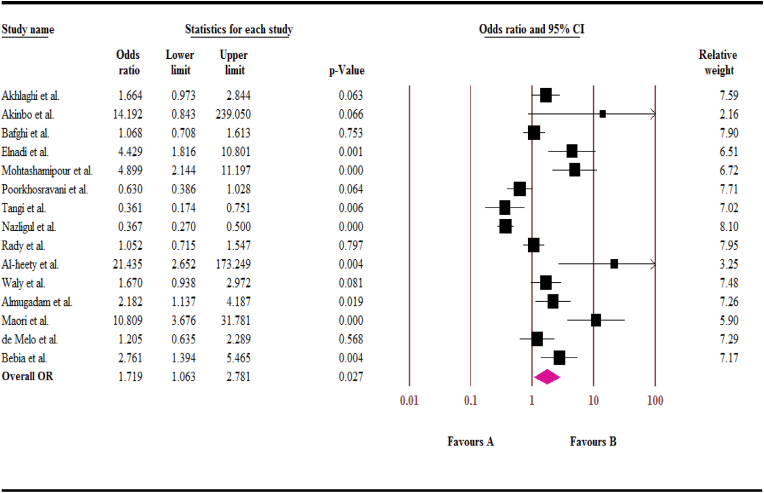
In the current systematic review and meta-analysis, the pooled prevalence of IPs in diabetic patients was 26.5% (95% CI: 21.8-31.7%) with heterogeneity of I = 93.24%; < 0.001. The highest prevalence based on geographical area was in Region of the Americas (13.3% (95% CI: 9.6-18.0)).There was significant association between the prevalence of intestinal parasites in diabetic cases compared to controls (OR, 1.72; 95% CI: 1.06-2.78).
In line with the high prevalence of IPs in diabetic patients, significant association was found however, due to the limitations of the study, more studies should be conducted in developing countries and, the prevalence of IPs in diabetics should not be neglected.
研究感染因子与非传染性疾病之间的关联是一个有趣的新兴研究领域。肠道寄生虫是胃肠道并发症、营养不良、生长发育迟缓及宿主代谢紊乱的病因之一,可能在糖尿病等代谢性疾病中发挥潜在作用。本研究旨在调查糖尿病患者中肠道寄生虫的患病率以及肠道寄生虫与糖尿病之间的关联。
通过使用PubMed、Scopus和Web of Science数据库以及谷歌学术搜索引擎,对2000年1月至2022年11月发表的记录进行系统文献检索;在纳入的29项研究中,对14项横断面研究(2676名糖尿病受试者)和15项病例对照研究(5478名糖尿病/非糖尿病受试者)进行了综述。采用CMA V2评估糖尿病患者中肠道寄生虫的合并患病率及比值比(OR)。
在当前的系统评价和荟萃分析中,糖尿病患者中肠道寄生虫的合并患病率为26.5%(95%CI:21.8 - 31.7%),异质性I = 93.24%;P < 0.001。按地理区域划分,患病率最高的是美洲地区(13.3%(95%CI:9.6 - 18.0))。与对照组相比,糖尿病病例中肠道寄生虫的患病率存在显著关联(OR,1.72;95%CI:1.06 - 2.78)。
鉴于糖尿病患者中肠道寄生虫的高患病率,发现了显著关联;然而,由于研究的局限性,应在发展中国家开展更多研究,且糖尿病患者中肠道寄生虫的患病率不应被忽视。