Smrt Sean T, Gonzalez Salguero Nicole, Thomas Justin K, Zandian Mohamad, Poirier Michael G, Jaroniec Christopher P
Department of Chemistry and Biochemistry, The Ohio State University, Columbus, OH, United States.
Department of Physics, The Ohio State University, Columbus, OH, United States.
Front Mol Biosci. 2023 Jan 4;9:1106588. doi: 10.3389/fmolb.2022.1106588. eCollection 2022.
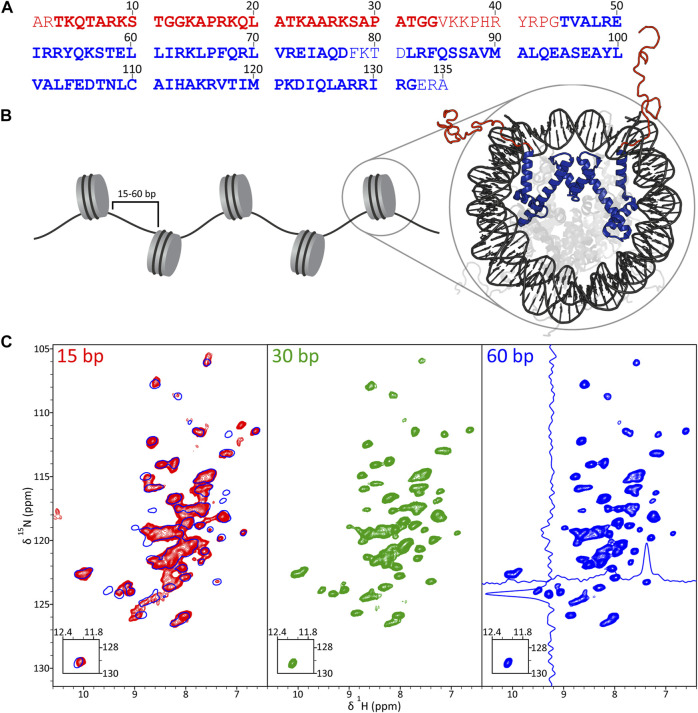
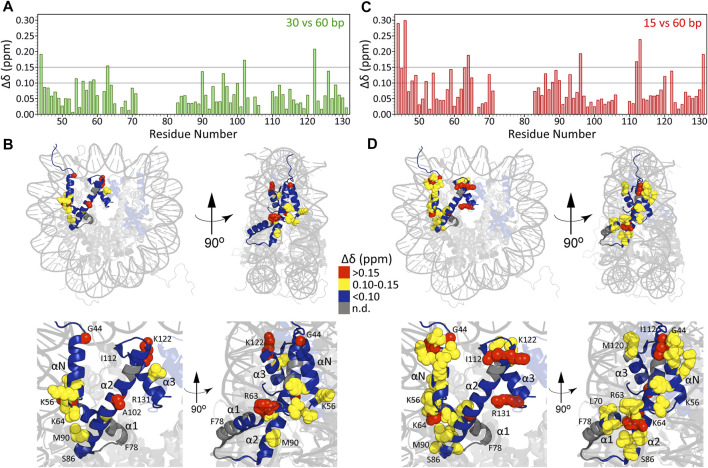
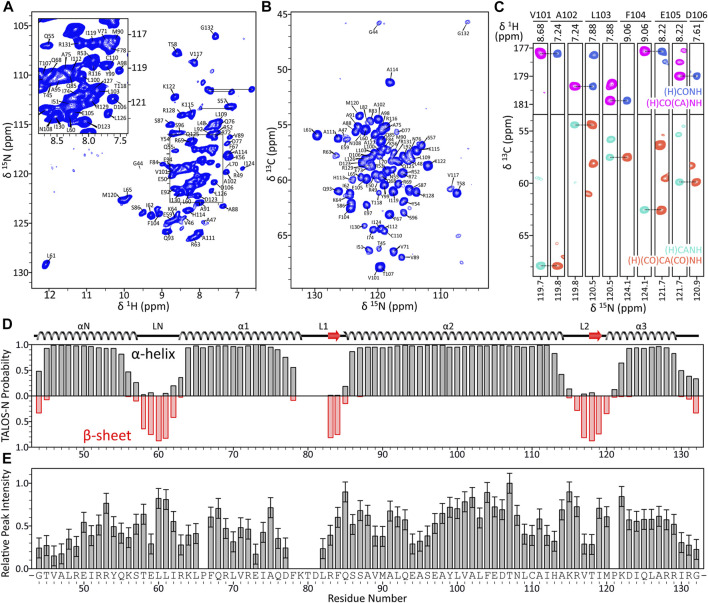
Chromatin, a dynamic protein-DNA complex that regulates eukaryotic genome accessibility and essential functions, is composed of nucleosomes connected by linker DNA with each nucleosome consisting of DNA wrapped around an octamer of histones H2A, H2B, H3 and H4. Magic angle spinning solid-state nuclear magnetic resonance (NMR) spectroscopy can yield unique insights into histone structure and dynamics in condensed nucleosomes and nucleosome arrays representative of chromatin at physiological concentrations. Recently we used J-coupling-based solid-state NMR methods to investigate with residue-specific resolution the conformational dynamics of histone H3 N-terminal tails in 16-mer nucleosome arrays containing 15, 30 or 60 bp DNA linkers. Here, we probe the H3 core domain in the 16-mer arrays as a function of DNA linker length dipolar coupling-based H-detected solid-state NMR techniques. Specifically, we established nearly complete assignments of backbone chemical shifts for H3 core residues in arrays with 15-60 bp DNA linkers reconstituted with H,C,N-labeled H3. Overall, these chemical shifts were similar irrespective of the DNA linker length indicating no major changes in H3 core conformation. Notably, however, multiple residues at the H3-nucleosomal DNA interface in arrays with 15 bp DNA linkers exhibited relatively pronounced differences in chemical shifts and line broadening compared to arrays with 30 and 60 bp linkers. These findings are consistent with increased heterogeneity in nucleosome packing and structural strain within arrays containing short DNA linkers that likely leads to side-chains of these interfacial residues experiencing alternate conformations or shifts in their rotamer populations relative to arrays with the longer DNA linkers.
染色质是一种动态的蛋白质 - DNA 复合物,可调节真核生物基因组的可及性和基本功能,它由通过连接 DNA 相连的核小体组成,每个核小体由缠绕在组蛋白 H2A、H2B、H3 和 H4 八聚体上的 DNA 构成。魔角旋转固态核磁共振(NMR)光谱能够为浓缩核小体和代表生理浓度染色质的核小体阵列中的组蛋白结构和动力学提供独特见解。最近,我们使用基于 J - 耦合的固态 NMR 方法,以残基特异性分辨率研究了含有 15、30 或 60 bp DNA 连接子的 16 聚体核小体阵列中组蛋白 H3 氨基末端尾巴的构象动力学。在此,我们使用基于偶极耦合的 H 检测固态 NMR 技术,探究 16 聚体阵列中 H3 核心结构域与 DNA 连接子长度的关系。具体而言,我们对用 H、C、N 标记的 H3 重构的含有 15 - 60 bp DNA 连接子的阵列中 H3 核心残基的主链化学位移进行了几乎完全的归属。总体而言,无论 DNA 连接子长度如何,这些化学位移都相似,表明 H3 核心构象没有重大变化。然而,值得注意的是,与含有 30 和 60 bp 连接子的阵列相比,含有 15 bp DNA 连接子的阵列中 H3 - 核小体 DNA 界面处的多个残基在化学位移和谱线展宽方面表现出相对明显的差异。这些发现与含有短 DNA 连接子的阵列中核小体堆积的异质性增加和结构应变一致,这可能导致这些界面残基的侧链相对于含有较长 DNA 连接子的阵列经历不同构象或其旋转异构体群体的变化。