
加利西亚蜂花粉(西班牙西北部)的植物来源:酚类物质含量及抗氧化活性的表征
Botanical Origin of Galician Bee Pollen (Northwest Spain) for the Characterization of Phenolic Content and Antioxidant Activity.
作者信息
Rojo Sergio, Escuredo Olga, Rodríguez-Flores María Shantal, Seijo María Carmen
机构信息
Department of Vegetal Biology and Soil Sciences, Faculty of Sciences, University of Vigo, 32004 Ourense, Spain.
出版信息
Foods. 2023 Jan 8;12(2):294. doi: 10.3390/foods12020294.
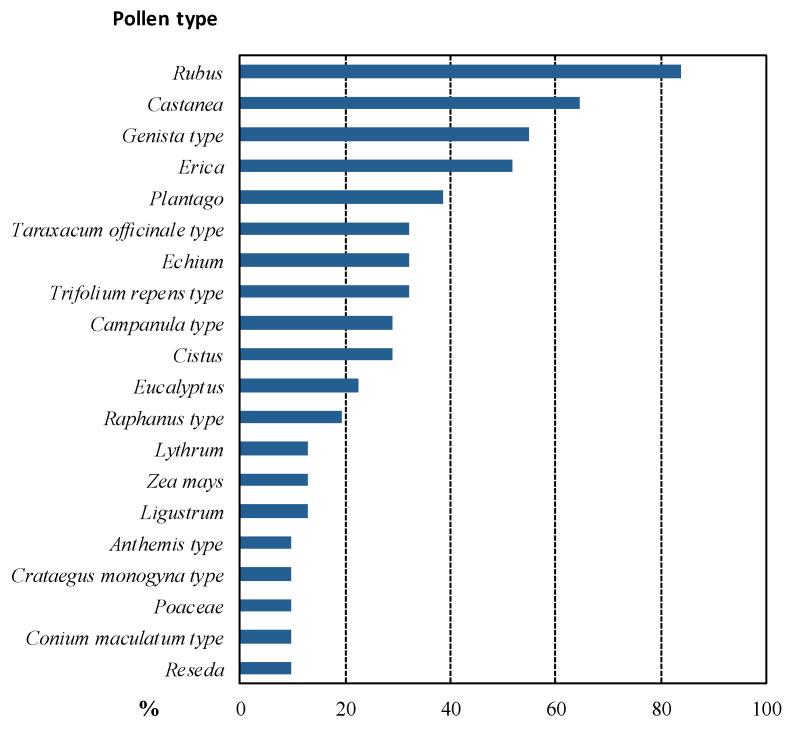
Bee pollen is considered a natural product, relevant for its nutritional and antioxidant properties. Its composition varies widely depending on its botanical and geographical origins. In this study, the botanical characteristics of 31 bee pollen samples from Galicia (Northwest Spain) were analyzed; samples have not been studied until now from this geographical area. The study focused on the evaluation of the influence of plant origin on total phenol and flavonoid contents and antioxidant activity measured by radical scavenging methods. The multivariate statistical treatment showed the contribution of certain pollen types in the extract of bee pollen as to phenols, flavonoids and antioxidant capacity. Specifically, the bee pollen samples with higher presence of Castanea, Erica, Lythrum and Campanula type indicated higher total phenol and flavonoid contents and antioxidant activities according to the principal component analysis. On the contrary, Plantago and Taraxacum officinale type contributed a lower content of these compounds and radical scavenging activity. The cluster analysis classified the bee pollen samples into three groups with significant differences (p > 0.05) for the main pollen types, total phenol and flavonoid contents and antioxidant capacities. These results demonstrate the richness and botanical diversity in the pollen spectrum of bee pollen and enhance the possible beneficial nutraceutical properties of this beekeeping product.
蜂花粉被认为是一种天然产品,因其营养和抗氧化特性而备受关注。其成分因植物来源和地理来源的不同而有很大差异。在本研究中,分析了来自西班牙西北部加利西亚地区的31个蜂花粉样本的植物学特征;此前尚未对该地理区域的样本进行过研究。该研究重点评估了植物来源对通过自由基清除法测定的总酚和黄酮含量以及抗氧化活性的影响。多元统计分析显示了某些花粉类型对蜂花粉提取物中酚类、黄酮类和抗氧化能力的贡献。具体而言,根据主成分分析,栗属、欧石楠属、千屈菜属和风铃草属花粉类型含量较高的蜂花粉样本,其总酚和黄酮含量以及抗氧化活性也较高。相反,车前属和蒲公英属花粉类型的这些化合物含量和自由基清除活性较低。聚类分析将蜂花粉样本分为三组,主要花粉类型、总酚和黄酮含量以及抗氧化能力存在显著差异(p>0.05)。这些结果证明了蜂花粉花粉谱的丰富性和植物多样性,并增强了这种养蜂产品可能具有的有益营养特性。



 Zotero 插件