Department of Radiology, Medical Imaging Centre, Semmelweis University, Korányi Sándor u. 2, 1083 Budapest, Hungary.
Health Services Management Training Centre, Semmelweis University, Kútvölgyi út 2, 1125 Budapest, Hungary.
Medicina (Kaunas). 2023 Jan 12;59(1):153. doi: 10.3390/medicina59010153.
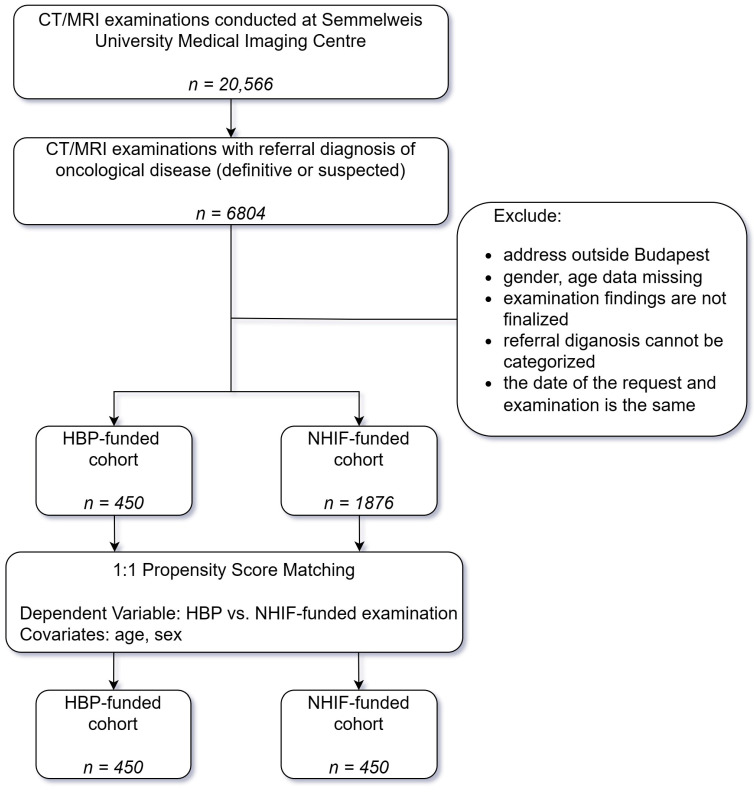
Medical imaging is a key element in the clinical workup of patients with suspected oncological disease. In Hungary, due to the high number of patients, waiting lists for Computed Tomography (CT) and Magnetic Resonance Imaging (MRI) were created some years ago. The Municipality of Budapest and Semmelweis University signed a cooperation agreement with an extra budget in 2020 (HBP: Healthy Budapest Program) to reduce the waiting lists for these patients. The aim of our study was to analyze the impact of the first experiences with the HBP. : The study database included all the CT/MRI examinations conducted at Semmelweis University with a referral diagnosis of suspected oncological disease within the first 13 months of the HBP (6804 cases). In our retrospective, two-armed, comparative clinical study, different components of the waiting times in the oncology diagnostics pathway were analyzed. Using propensity score matching, we compared the data of the HBP-funded patients ( = 450) to those of the patients with regular care provided by the National Health Insurance Fund (NHIF) ( = 450). : In the HBP-funded vs. the NHIF-funded patients, the time interval from the first suspicion of oncological disease to the request for imaging examinations was on average 15.2 days shorter (16.1 vs. 31.3 days), and the mean waiting time for the CT/MRI examination was reduced by 13.0 days (4.2 vs. 17.2 days, respectively). In addition, the imaging medical records were prepared on average 1.7 days faster for the HBP-funded patients than for the NHIF-funded patients (3.4 vs. 5.1 days, respectively). No further shortening of the different time intervals during the subsequent oncology diagnostic pathway (histological investigation and multidisciplinary team decision) or in the starting of specific oncological therapy (surgery, irradiation, and chemotherapy) was observed in the HBP-funded vs. the NHIF-funded patients. We identified a moderately strong negative correlation (r = -0.5736, = 0.0350) between the CT/MR scans requested and the active COVID-19 case rates during the pandemic waves. : The waiting lists for diagnostic CT/MR imaging can be effectively shortened with a targeted project, but a more comprehensive intervention is needed to shorten the time from the radiological diagnosis, through the decisions of the oncoteam, to the start of the oncological treatment.
医学影像学是疑似肿瘤疾病患者临床评估的关键要素。在匈牙利,由于患者数量众多,几年前就为计算机断层扫描(CT)和磁共振成像(MRI)创建了等候名单。布达佩斯市和塞梅尔维斯大学于 2020 年(HBP:健康布达佩斯计划)签署了一项预算外合作协议,以减少这些患者的等候名单。我们研究的目的是分析 HBP 的初步经验的影响。:研究数据库包括在 HBP 实施后的前 13 个月内在塞梅尔维斯大学进行的所有 CT/MRI 检查,这些检查的转诊诊断为疑似肿瘤疾病(共 6804 例)。在我们的回顾性、双臂、对照临床研究中,分析了肿瘤学诊断途径中不同的等候时间组成部分。使用倾向评分匹配,我们将 HBP 资助患者的数据(n=450)与国家健康保险基金(NHIF)提供常规护理的患者的数据(n=450)进行比较。:在 HBP 资助的患者与 NHIF 资助的患者相比,从最初怀疑肿瘤疾病到影像学检查请求的时间间隔平均缩短了 15.2 天(16.1 天与 31.3 天),CT/MRI 检查的平均等候时间缩短了 13.0 天(4.2 天与 17.2 天)。此外,HBP 资助的患者的影像学病历平均比 NHIF 资助的患者快 1.7 天(分别为 3.4 天和 5.1 天)。在 HBP 资助的患者与 NHIF 资助的患者中,没有观察到肿瘤学诊断途径(组织学检查和多学科团队决策)后续的不同时间间隔或特定肿瘤治疗(手术、放疗和化疗)的开始进一步缩短。我们发现,在大流行期间,请求的 CT/MR 扫描与活跃的 COVID-19 病例率之间存在中度强烈的负相关(r=-0.5736,p=0.0350)。:通过有针对性的项目,可以有效地缩短诊断性 CT/MR 成像的等候名单,但需要更全面的干预措施来缩短从放射学诊断到肿瘤团队决策再到开始肿瘤治疗的时间。