Nikolaieva Nataliia, Sevcikova Aneta, Omelka Radoslav, Martiniakova Monika, Mego Michal, Ciernikova Sona
Department of Genetics, Cancer Research Institute, Biomedical Research Center of Slovak Academy of Sciences, 845 05 Bratislava, Slovakia.
Department of Botany and Genetics, Faculty of Natural Sciences and Informatics, Constantine the Philosopher University in Nitra, 949 74 Nitra, Slovakia.
Microorganisms. 2022 Dec 31;11(1):107. doi: 10.3390/microorganisms11010107.
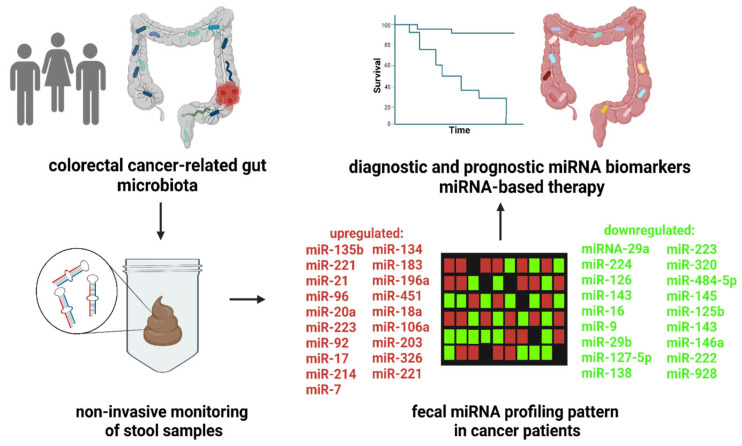
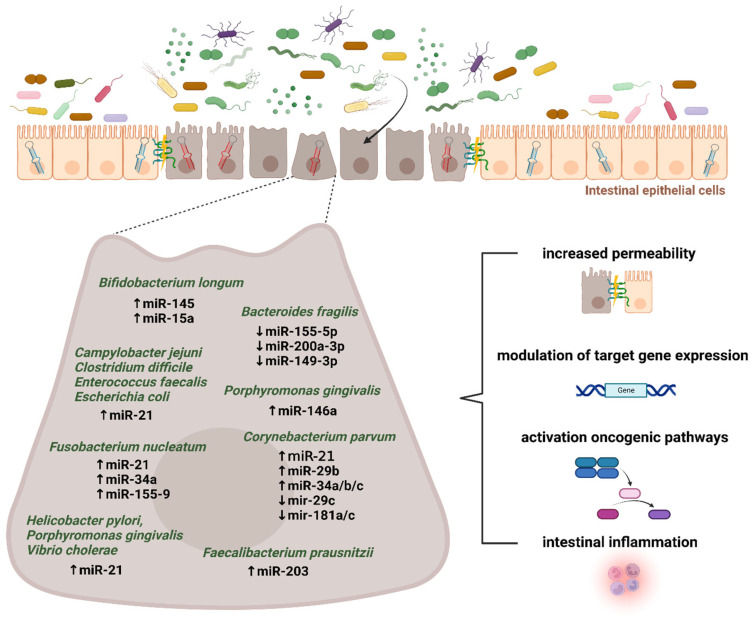
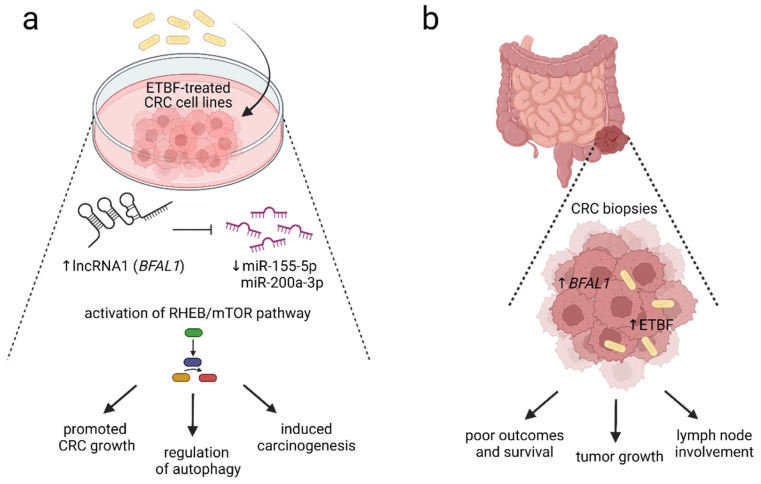
Pre-clinical models and clinical studies highlight the significant impact of the host-microbiota relationship on cancer development and treatment, supporting the emerging trend for a microbiota-based approach in clinical oncology. Importantly, the presence of polymorphic microbes is considered one of the hallmarks of cancer. The epigenetic regulation of gene expression by microRNAs affects crucial biological processes, including proliferation, differentiation, metabolism, and cell death. Recent evidence has documented the existence of bidirectional gut microbiota-microRNA interactions that play a critical role in intestinal homeostasis. Importantly, alterations in microRNA-modulated gene expression are known to be associated with inflammatory responses and dysbiosis in gastrointestinal disorders. In this review, we summarize the current findings about miRNA expression in the intestine and focus on specific gut microbiota-miRNA interactions linked to intestinal homeostasis, the immune system, and cancer development. We discuss the potential clinical utility of fecal miRNA profiling as a diagnostic and prognostic tool in colorectal cancer, and demonstrate how the emerging trend of gut microbiota modulation, together with the use of personalized microRNA therapeutics, might bring improvements in outcomes for patients with gastrointestinal cancer in the era of precision medicine.
临床前模型和临床研究突出了宿主-微生物群关系对癌症发展和治疗的重大影响,支持了临床肿瘤学中基于微生物群方法的新趋势。重要的是,多态性微生物的存在被认为是癌症的标志之一。微小RNA对基因表达的表观遗传调控影响关键的生物学过程,包括增殖、分化、代谢和细胞死亡。最近的证据表明存在双向肠道微生物群-微小RNA相互作用,其在肠道内环境稳态中起关键作用。重要的是,已知微小RNA调节的基因表达改变与胃肠道疾病中的炎症反应和生态失调有关。在这篇综述中,我们总结了目前关于肠道中微小RNA表达的研究结果,并关注与肠道内环境稳态、免疫系统和癌症发展相关的特定肠道微生物群-微小RNA相互作用。我们讨论了粪便微小RNA谱作为结直肠癌诊断和预后工具的潜在临床应用,并展示了肠道微生物群调节的新趋势以及个性化微小RNA疗法的使用如何在精准医学时代改善胃肠道癌症患者的治疗结果。