• 文献检索
  • 文档翻译
  • 深度研究
  • 学术资讯
  • Suppr Zotero 插件Zotero 插件
  • 邀请有礼
  • 套餐&价格
  • 历史记录
应用&插件
Suppr Zotero 插件Zotero 插件浏览器插件Mac 客户端Windows 客户端微信小程序
定价
高级版会员购买积分包购买API积分包
服务
文献检索文档翻译深度研究API 文档MCP 服务
关于我们
关于 Suppr公司介绍联系我们用户协议隐私条款
关注我们

Suppr 超能文献

核心技术专利:CN118964589B侵权必究
粤ICP备2023148730 号-1Suppr @ 2026

文献检索

告别复杂PubMed语法,用中文像聊天一样搜索,搜遍4000万医学文献。AI智能推荐,让科研检索更轻松。

立即免费搜索

文件翻译

保留排版,准确专业,支持PDF/Word/PPT等文件格式,支持 12+语言互译。

免费翻译文档

深度研究

AI帮你快速写综述,25分钟生成高质量综述,智能提取关键信息,辅助科研写作。

立即免费体验

脊髓损伤患者地面机器人训练与传统运动训练的成本效果分析。

Cost-effectiveness analysis of overground robotic training versus conventional locomotor training in people with spinal cord injury.

机构信息

Department of Physical Therapy, College of Health Sciences, Marquette University, Milwaukee, USA.

World Health Organization Collaborating Center for the Epidemiology of Musculoskeletal Health and Aging, University of Liege, Liege, Belgium.

出版信息

J Neuroeng Rehabil. 2023 Jan 21;20(1):10. doi: 10.1186/s12984-023-01134-7.

DOI:10.1186/s12984-023-01134-7
PMID:36681852
原文链接:https://pmc.ncbi.nlm.nih.gov/articles/PMC9867867/
Abstract

BACKGROUND

Few, if any estimates of cost-effectiveness for locomotor training strategies following spinal cord injury (SCI) are available. The purpose of this study was to estimate the cost-effectiveness of locomotor training strategies following spinal cord injury (overground robotic locomotor training versus conventional locomotor training) by injury status (complete versus incomplete) using a practice-based cohort.

METHODS

A probabilistic cost-effectiveness analysis was conducted using a prospective, practice-based cohort from four participating Spinal Cord Injury Model System sites. Conventional locomotor training strategies (conventional training) were compared to overground robotic locomotor training (overground robotic training). Conventional locomotor training included treadmill-based training with body weight support, overground training, and stationary robotic systems. The outcome measures included the calculation of quality adjusted life years (QALYs) using the EQ-5D and therapy costs. We estimate cost-effectiveness using the incremental cost utility ratio and present results on the cost-effectiveness plane and on cost-effectiveness acceptability curves.

RESULTS

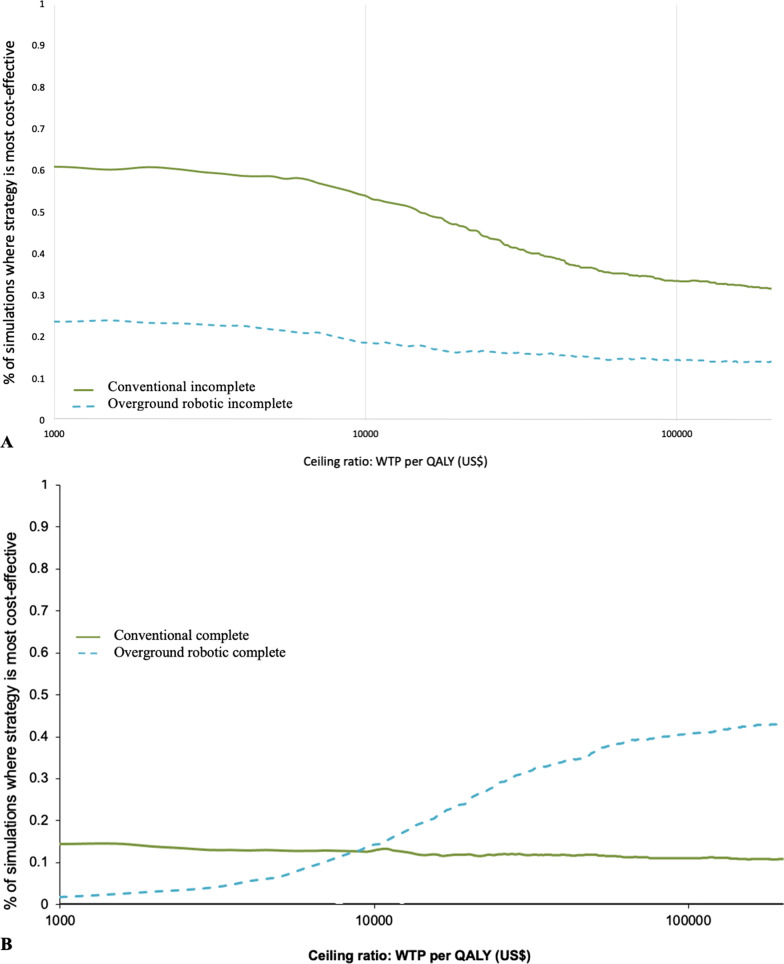
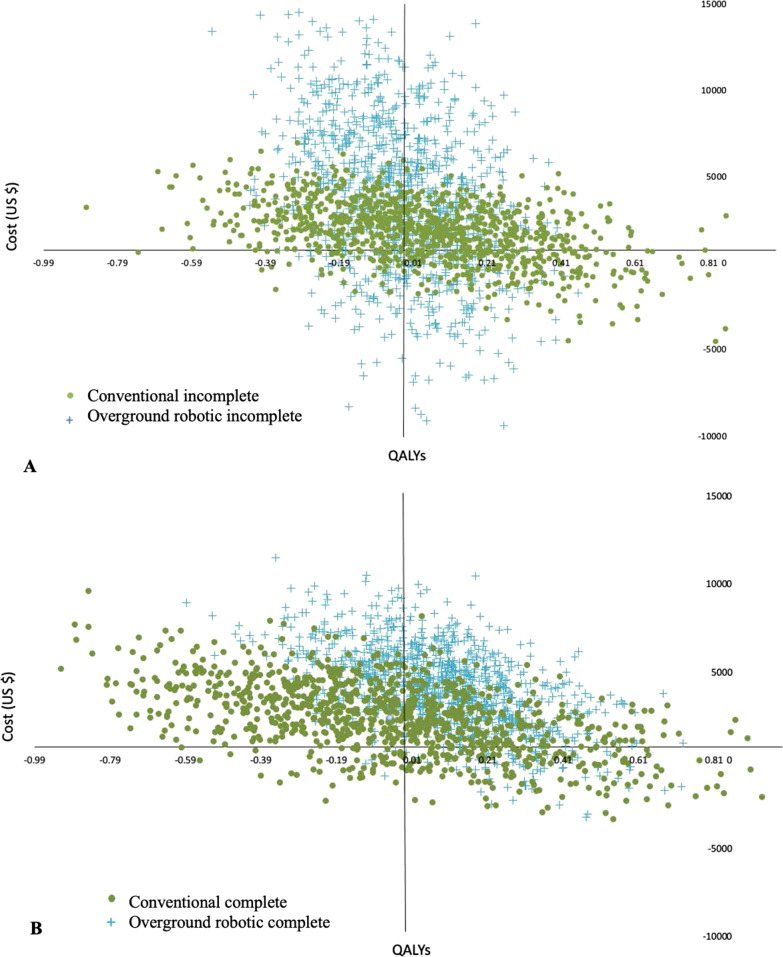
Participants in the prospective, practice-based cohort with complete EQ-5D data (n = 99) qualified for the analysis. Both conventional training and overground robotic training experienced an improvement in QALYs. Only people with incomplete SCI improved with conventional locomotor training, 0.045 (SD 0.28), and only people with complete SCI improved with overground robotic training, 0.097 (SD 0.20). Costs were lower for conventional training, $1758 (SD $1697) versus overground robotic training $3952 (SD $3989), and lower for those with incomplete versus complete injury. Conventional overground training was more effective and cost less than robotic therapy for people with incomplete SCI. Overground robotic training was more effective and cost more than conventional training for people with complete SCI. The incremental cost utility ratio for overground robotic training for people with complete spinal cord injury was $12,353/QALY.

CONCLUSIONS

The most cost-effective locomotor training strategy for people with SCI differed based on injury completeness. Conventional training was more cost-effective than overground robotic training for people with incomplete SCI. Overground robotic training was more cost-effective than conventional training for people with complete SCI. The effect estimates may be subject to limitations associated with small sample sizes and practice-based evidence methodology. These estimates provide a baseline for future research.

摘要

背景

目前,针对脊髓损伤(SCI)后运动训练策略的成本效益评估很少,如果有的话。本研究的目的是通过损伤状态(完全性与不完全性),利用基于实践的队列,来评估 SCI 后运动训练策略(地面机器人训练与传统运动训练)的成本效益。

方法

通过来自四个参与脊髓损伤模型系统(Spinal Cord Injury Model System)站点的前瞻性基于实践的队列,进行概率性成本效益分析。传统运动训练策略(常规训练)与地面机器人运动训练(地面机器人训练)进行比较。传统运动训练包括带有体重支撑的跑步机训练、地面训练和固定机器人系统。使用 EQ-5D 计算质量调整生命年(QALYs)和治疗费用。我们使用增量成本效用比(incremental cost utility ratio)来评估成本效益,并在成本效益平面和成本效益接受曲线中呈现结果。

结果

具有完整 EQ-5D 数据的前瞻性基于实践的队列中的参与者(n=99)符合分析条件。常规训练和地面机器人训练都能提高 QALYs。只有不完全性 SCI 患者接受常规运动训练后有改善,0.045(标准差 0.28),只有完全性 SCI 患者接受地面机器人训练后有改善,0.097(标准差 0.20)。常规训练的成本较低,1758 美元(标准差 1697 美元),地面机器人训练的成本较高,3952 美元(标准差 3989 美元),而且不完全性损伤的成本低于完全性损伤。对于不完全性 SCI 患者,常规地面训练比机器人治疗更有效且成本更低。对于完全性 SCI 患者,地面机器人训练比常规训练更有效且成本更高。对于完全性脊髓损伤患者,地面机器人训练的增量成本效用比为 12353 美元/QALY。

结论

针对 SCI 患者的最具成本效益的运动训练策略因损伤完整性而异。对于不完全性 SCI 患者,常规训练比地面机器人训练更具成本效益。对于完全性 SCI 患者,地面机器人训练比常规训练更具成本效益。这些估计值可能受到小样本量和基于实践的证据方法的限制。这些估计值为未来的研究提供了基线。
https://cdn.ncbi.nlm.nih.gov/pmc/blobs/76da/9867867/6a23fed8fdb3/12984_2023_1134_Fig2_HTML.jpg
https://cdn.ncbi.nlm.nih.gov/pmc/blobs/76da/9867867/b5242159a130/12984_2023_1134_Fig1_HTML.jpg
https://cdn.ncbi.nlm.nih.gov/pmc/blobs/76da/9867867/6a23fed8fdb3/12984_2023_1134_Fig2_HTML.jpg
https://cdn.ncbi.nlm.nih.gov/pmc/blobs/76da/9867867/b5242159a130/12984_2023_1134_Fig1_HTML.jpg
https://cdn.ncbi.nlm.nih.gov/pmc/blobs/76da/9867867/6a23fed8fdb3/12984_2023_1134_Fig2_HTML.jpg

相似文献

1
Cost-effectiveness analysis of overground robotic training versus conventional locomotor training in people with spinal cord injury.脊髓损伤患者地面机器人训练与传统运动训练的成本效果分析。
J Neuroeng Rehabil. 2023 Jan 21;20(1):10. doi: 10.1186/s12984-023-01134-7.
2
Budget impact analysis of robotic exoskeleton use for locomotor training following spinal cord injury in four SCI Model Systems.四种脊髓损伤模型系统中,使用机器人外骨骼进行运动训练对脊髓损伤后康复的预算影响分析。
J Neuroeng Rehabil. 2020 Jan 10;17(1):4. doi: 10.1186/s12984-019-0639-0.
3
Effects of locomotor training after incomplete spinal cord injury: a systematic review.不完全性脊髓损伤后运动训练的效果:系统评价。
Arch Phys Med Rehabil. 2013 Nov;94(11):2297-308. doi: 10.1016/j.apmr.2013.06.023. Epub 2013 Jul 9.
4
Locomotor training using an overground robotic exoskeleton in long-term manual wheelchair users with a chronic spinal cord injury living in the community: Lessons learned from a feasibility study in terms of recruitment, attendance, learnability, performance and safety.在社区中居住的长期使用手动轮椅的慢性脊髓损伤患者中使用地面机器人外骨骼进行运动训练:从一项可行性研究中吸取的关于招募、出勤率、可学习性、性能和安全性的经验教训。
J Neuroeng Rehabil. 2018 Mar 1;15(1):12. doi: 10.1186/s12984-018-0354-2.
5
Is body-weight-supported treadmill training or robotic-assisted gait training superior to overground gait training and other forms of physiotherapy in people with spinal cord injury? A systematic review.对于脊髓损伤患者,体重支持式跑步机训练或机器人辅助步态训练是否优于地面步态训练及其他形式的物理治疗?一项系统综述。
Spinal Cord. 2017 Aug;55(8):722-729. doi: 10.1038/sc.2017.31. Epub 2017 Apr 11.
6
Robotic resistance treadmill training improves locomotor function in human spinal cord injury: a pilot study.机器人抗阻跑台训练改善脊髓损伤患者的运动功能:一项初步研究。
Arch Phys Med Rehabil. 2012 May;93(5):782-9. doi: 10.1016/j.apmr.2011.12.018. Epub 2012 Mar 27.
7
Predicting Duration of Outpatient Physical Therapy Episodes for Individuals with Spinal Cord Injury Based on Locomotor Training Strategy.基于运动训练策略预测脊髓损伤患者门诊物理治疗疗程。
Arch Phys Med Rehabil. 2022 Apr;103(4):665-675. doi: 10.1016/j.apmr.2021.07.815. Epub 2021 Oct 11.
8
Influence of a locomotor training approach on walking speed and distance in people with chronic spinal cord injury: a randomized clinical trial.一种运动训练方法对慢性脊髓损伤患者行走速度和距离的影响:一项随机临床试验。
Phys Ther. 2011 Jan;91(1):48-60. doi: 10.2522/ptj.20090359. Epub 2010 Nov 4.
9
Lokomat robotic-assisted versus overground training within 3 to 6 months of incomplete spinal cord lesion: randomized controlled trial.3 至 6 个月不完全性脊髓损伤后使用 Lokomat 机器人辅助与地面训练:随机对照试验。
Neurorehabil Neural Repair. 2012 Nov-Dec;26(9):1058-63. doi: 10.1177/1545968312448232. Epub 2012 Jun 13.
10
Effectiveness of automated locomotor training in patients with chronic incomplete spinal cord injury: a multicenter trial.慢性不完全性脊髓损伤患者自动运动训练的有效性:一项多中心试验。
Arch Phys Med Rehabil. 2005 Apr;86(4):672-80. doi: 10.1016/j.apmr.2004.08.004.

引用本文的文献

1
Improving Early Dementia Detection Among Diverse Older Adults With Cognitive Concerns With the 5-Cog Paradigm: Protocol for a Hybrid Effectiveness-Implementation Clinical Trial.采用5认知范式改善有认知问题的不同老年人群体的早期痴呆症检测:一项混合有效性-实施临床试验方案
JMIR Res Protoc. 2025 Apr 3;14:e60471. doi: 10.2196/60471.
2
OpenSEA: a 3D printed planetary gear series elastic actuator for a compliant elbow joint exoskeleton.OpenSEA:一种用于柔顺肘关节外骨骼的3D打印行星齿轮系列弹性致动器。
Front Robot AI. 2025 Feb 28;12:1528266. doi: 10.3389/frobt.2025.1528266. eCollection 2025.
3
Remote Extended Reality with Markerless Motion Tracking for Sitting Posture Training.

本文引用的文献

1
Improvement of quality of life after 2-month exoskeleton training in patients with chronic spinal cord injury.慢性脊髓损伤患者进行2个月外骨骼训练后生活质量的改善。
J Spinal Cord Med. 2024 May;47(3):354-360. doi: 10.1080/10790268.2022.2052502. Epub 2022 Apr 4.
2
Overground robotic training effects on walking and secondary health conditions in individuals with spinal cord injury: systematic review.地面机器人训练对脊髓损伤患者行走和次要健康状况的影响:系统评价。
J Neuroeng Rehabil. 2022 Mar 15;19(1):27. doi: 10.1186/s12984-022-01003-9.
3
Innovations in cost-effectiveness analysis that advance equity can expand its use in health policy.
用于坐姿训练的无标记运动跟踪远程扩展现实技术。
IEEE Robot Autom Lett. 2024 Nov;9(11):9860-9867. doi: 10.1109/lra.2024.3460412. Epub 2024 Sep 13.
4
Characterizing the Effects of Adding Virtual and Augmented Reality in Robot-Assisted Training.描述虚拟现实和增强现实在机器人辅助训练中的影响。
IEEE Trans Neural Syst Rehabil Eng. 2024;32:2709-2718. doi: 10.1109/TNSRE.2024.3432661. Epub 2024 Jul 31.
5
Economic analysis of digital motor rehabilitation technologies: a systematic review.数字运动康复技术的经济分析:一项系统综述
Health Econ Rev. 2024 Jul 17;14(1):52. doi: 10.1186/s13561-024-00523-5.
6
A Protocol for Comprehensive Analysis of Gait in Individuals with Incomplete Spinal Cord Injury.一项针对不完全性脊髓损伤患者步态综合分析的方案
Methods Protoc. 2024 May 4;7(3):39. doi: 10.3390/mps7030039.
7
Economic Cost of Rehabilitation with Robotic and Virtual Reality Systems in People with Neurological Disorders: A Systematic Review.神经系统疾病患者使用机器人和虚拟现实系统进行康复治疗的经济成本:一项系统综述
J Clin Med. 2024 Mar 7;13(6):1531. doi: 10.3390/jcm13061531.
8
Providing Insights into the Challenges of Implementing Activity-Based Therapy in Canada: A Comparative Analysis Using Focus Group Interviews with Key Interest Groups.提供加拿大实施基于活动的治疗挑战的见解:使用焦点小组访谈对主要利益相关群体进行比较分析。
Top Spinal Cord Inj Rehabil. 2023 Fall;29(Suppl):53-74. doi: 10.46292/sci23-00022S. Epub 2023 Nov 17.
推进公平性的成本效益分析创新能够扩大其在卫生政策中的应用。
BMJ Glob Health. 2022 Feb;7(2). doi: 10.1136/bmjgh-2021-008140.
4
Consolidated Health Economic Evaluation Reporting Standards 2022 (CHEERS 2022) Statement: Updated Reporting Guidance for Health Economic Evaluations.《2022 年健康经济评估报告标准》(CHEERS 2022)声明:健康经济评估报告的更新指南。
Value Health. 2022 Jan;25(1):3-9. doi: 10.1016/j.jval.2021.11.1351.
5
Predicting Duration of Outpatient Physical Therapy Episodes for Individuals with Spinal Cord Injury Based on Locomotor Training Strategy.基于运动训练策略预测脊髓损伤患者门诊物理治疗疗程。
Arch Phys Med Rehabil. 2022 Apr;103(4):665-675. doi: 10.1016/j.apmr.2021.07.815. Epub 2021 Oct 11.
6
How Does Cost-Effectiveness Analysis Inform Health Care Decisions?成本效益分析如何为医疗决策提供信息?
AMA J Ethics. 2021 Aug 1;23(8):E639-647. doi: 10.1001/amajethics.2021.639.
7
Systematic review on wearable lower-limb exoskeletons for gait training in neuromuscular impairments.系统评价可穿戴下肢外骨骼在神经肌肉障碍步态训练中的应用。
J Neuroeng Rehabil. 2021 Feb 1;18(1):22. doi: 10.1186/s12984-021-00815-5.
8
Clinician Perceptions of Robotic Exoskeletons for Locomotor Training After Spinal Cord Injury: A Qualitative Approach.临床医生对脊髓损伤后用于运动训练的机器人外骨骼的看法:一种定性方法。
Arch Phys Med Rehabil. 2021 Feb;102(2):203-215. doi: 10.1016/j.apmr.2020.08.024. Epub 2020 Nov 7.
9
Effect of Exoskeletal-Assisted Walking on Soft Tissue Body Composition in Persons With Spinal Cord Injury.外骨骼辅助行走对脊髓损伤患者软组织身体成分的影响。
Arch Phys Med Rehabil. 2021 Feb;102(2):196-202. doi: 10.1016/j.apmr.2020.07.018. Epub 2020 Nov 7.
10
Users with spinal cord injury experience of robotic Locomotor exoskeletons: a qualitative study of the benefits, limitations, and recommendations.脊髓损伤患者使用机器人助行外骨骼的体验:一项关于获益、局限和建议的定性研究。
J Neuroeng Rehabil. 2020 Sep 11;17(1):124. doi: 10.1186/s12984-020-00752-9.