Feng Yuntao, Liu Xuebo, Tan Hongwei
Department of Cardiology, Tongji Hospital, Tongji University School of Medicine, Shanghai, China.
Front Cardiovasc Med. 2023 Jan 6;9:1042938. doi: 10.3389/fcvm.2022.1042938. eCollection 2022.
Atrial fibrillation (AF) is the most common and persistent form of arrhythmia. Recently, increasing evidence has shown a link between immune responses and atrial fibrillation. However, whether the immune response is a cause or consequence of AF remains unknown. We aimed to determine whether genetically predicted peripheral immunity might have a causal effect on AF.
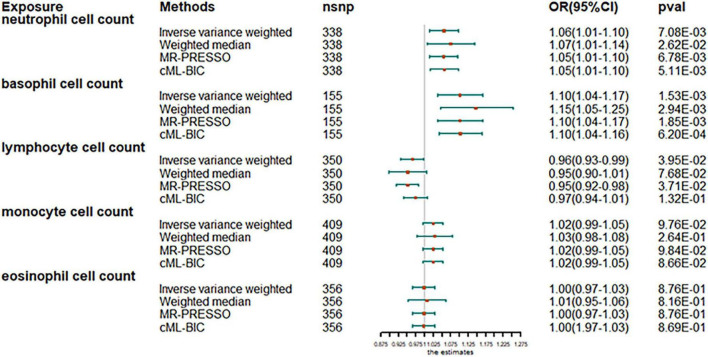
First, we performed Mendelian randomization (MR) analyses using genetic variants strongly associated with neutrophil, eosinophil, basophil, lymphocyte, and monocyte cell counts as instrumental variables (IVs). Lymphocyte counts were then subjected to further subgroup analysis. The effect of immune cell counts on AF risk was measured using summary statistics from genome-wide association studies (GWAS).
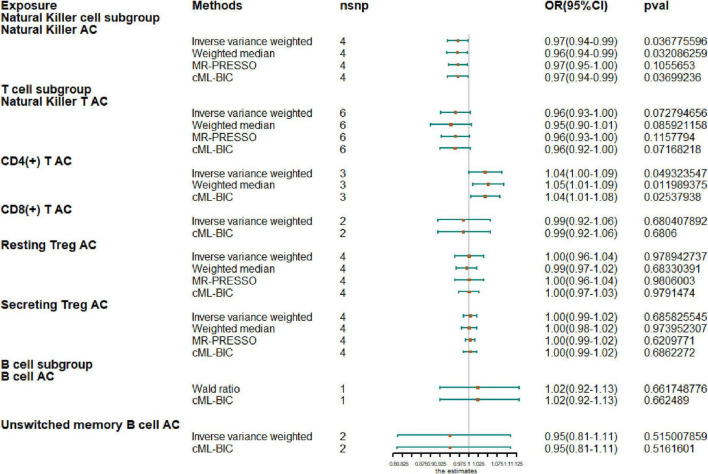
Two-sample MR analysis revealed that a higher neutrophil count, basophil count and lymphocyte count had a causal effect on AF [Odds ratio (OR), 1.06, 95% confidence interval (CI), 1.01-1.10, = 0.0070; OR, 1.10; 95% CI, 1.04-1.17; = 0.0015; OR, 0.96; 95% CI, 0.93-0.99; = 0.0359]. In addition, in our further analysis, genetically predicted increases in CD4 + T-cell counts were also associated with an increased risk of AF (OR, 1.04; 95% CI, 1.0-.09; = 0.0493).
Our MR analysis provided evidence of a genetically predicted causal relationship between higher peripheral immune cell counts and AF. Subgroup analysis revealed the key role of peripheral lymphocytes in AF, especially the causal relationship between CD4 + T cell count and AF. These findings are beneficial for future exploration of the mechanism of AF.
心房颤动(AF)是最常见且持续存在的心律失常形式。最近,越来越多的证据表明免疫反应与心房颤动之间存在联系。然而,免疫反应是AF的原因还是结果仍不清楚。我们旨在确定基因预测的外周免疫是否可能对AF有因果效应。
首先,我们使用与中性粒细胞、嗜酸性粒细胞、嗜碱性粒细胞、淋巴细胞和单核细胞计数密切相关的基因变异作为工具变量(IVs)进行孟德尔随机化(MR)分析。然后对淋巴细胞计数进行进一步的亚组分析。使用全基因组关联研究(GWAS)的汇总统计数据来衡量免疫细胞计数对AF风险的影响。
两样本MR分析显示,较高的中性粒细胞计数、嗜碱性粒细胞计数和淋巴细胞计数对AF有因果效应[优势比(OR),1.06,95%置信区间(CI),1.01 - 1.10,P = 0.0070;OR,1.10;95% CI,1.04 - 1.17;P = 0.0015;OR,0.96;95% CI,0.93 - 0.99;P = 0.0359]。此外,在我们的进一步分析中,基因预测的CD4 + T细胞计数增加也与AF风险增加相关(OR,1.04;95% CI,1.0 - 0.09;P = 0.0493)。
我们的MR分析提供了基因预测的较高外周免疫细胞计数与AF之间因果关系的证据。亚组分析揭示了外周淋巴细胞在AF中的关键作用,特别是CD4 + T细胞计数与AF之间的因果关系。这些发现有助于未来对AF机制的探索。