Department of Paediatric, The First Affiliated Hospital of Nanjing Medical University, Nanjing, China.
Department of Cardiology, The First Affiliated Hospital of Nanjing Medical University, Nanjing, China.
Front Endocrinol (Lausanne). 2023 Jan 5;13:1072419. doi: 10.3389/fendo.2022.1072419. eCollection 2022.
Children and adolescents increasingly commonly suffer from obesity and headache. It has been confirmed that there is an association between obesity and headache in adults; however, evidence of such an association in paediatric populations is still controversial. Therefore, this study examined the relationship between obesity and headache among children and adolescents in the US.
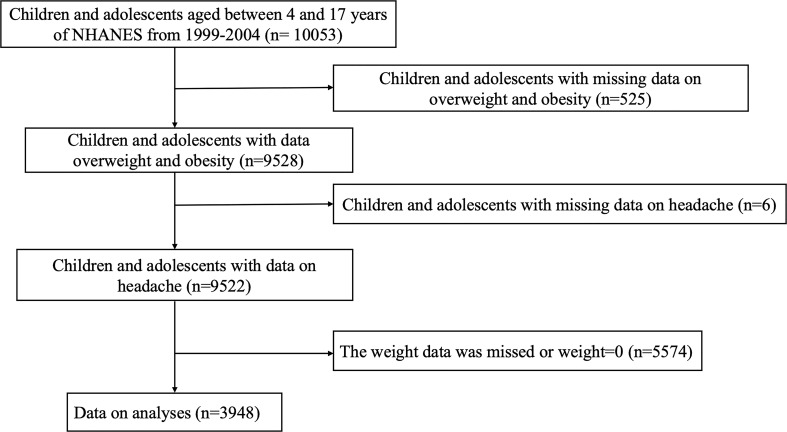
The cross-sectional data of 3948 participants were obtained from the National Health and Nutrition Examination Survey 1999-2004. Weighted logistic regression models were applied to investigate the association between obesity and headache. Subgroup analysis stratified by sex and age was performed to explore the potential difference in the association of paediatric obesity with headache. The performance of paediatric obesity on headache was assessed by receiver operating characteristic (ROC) curve.
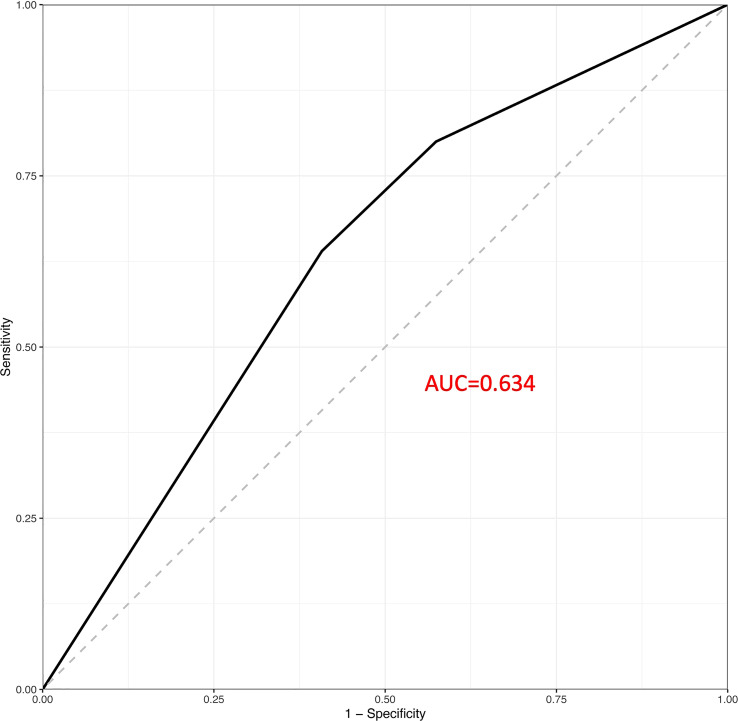
The present study involved 3948 participants, of whom 713 (18.1%) had headache. Compared to those without headache, participants with headache tended to be girls and adolescents, have less calcium intake, and have higher levels of body mass index (BMI), C-reactive protein (CRP), serum ferritin and triglycerides (TGs) (all < 0.05). After fully adjusting for potential confounders, the ORs with 95% CIs for headache were 1.03 (0.58-1.54) and 1.25 (0.68-2.30) for overweight and obese participants in comparison with normal-weight controls, respectively, implying no association of paediatric obesity with headache independent of other potential confounding factors. In addition, although higher odds of headache were noted in girls and adolescents (aged 10-17 years), no statistically significant difference was found across any subgroups. The area under the ROC (AUC) of paediatric obesity on headache was 0.634.
In summary, our study indicated that obesity is not associated with headache among US children and adolescents. Further prospective studies with larger sample size are needed to validate our findings.
儿童和青少年肥胖和头痛的发病率越来越高。已有研究证实成年人肥胖与头痛之间存在关联,但儿童人群中这种关联的证据仍存在争议。因此,本研究在美国儿童和青少年中检验了肥胖与头痛之间的关系。
本研究使用了 1999-2004 年国家健康和营养调查(NHANES)的横断面数据,共涉及 3948 名参与者。采用加权逻辑回归模型来研究肥胖与头痛之间的关联。通过性别和年龄分层的亚组分析来探讨儿童肥胖与头痛之间关联的潜在差异。采用受试者工作特征(ROC)曲线来评估儿童肥胖对头痛的预测性能。
本研究共纳入 3948 名参与者,其中 713 人(18.1%)患有头痛。与无头痛者相比,头痛患者更可能为女性和青少年,钙摄入量较少,且体重指数(BMI)、C 反应蛋白(CRP)、血清铁蛋白和甘油三酯(TGs)水平更高(均<0.05)。在校正了所有潜在混杂因素后,与正常体重对照组相比,超重和肥胖参与者患头痛的 OR(95%CI)分别为 1.03(0.58-1.54)和 1.25(0.68-2.30),表明儿童肥胖与头痛之间不存在独立于其他潜在混杂因素的关联。此外,尽管在女孩和青少年(10-17 岁)中头痛的可能性更高,但各亚组之间无统计学差异。ROC 曲线下面积(AUC)为 0.634。
总之,我们的研究表明美国儿童和青少年肥胖与头痛无关。需要进一步开展样本量更大的前瞻性研究来验证我们的发现。