Meng Shu-Han, Wang Ming-Xue, Kang Li-Xin, Fu Jin-Ming, Zhou Hai-Bo, Li Xin, Li Xia, Li Xue-Ting, Zhao Ya-Shuang
Department of Epidemiology, College of Public Health, Harbin Medical University, Harbin, China.
Front Nutr. 2021 Mar 5;8:653765. doi: 10.3389/fnut.2021.653765. eCollection 2021.
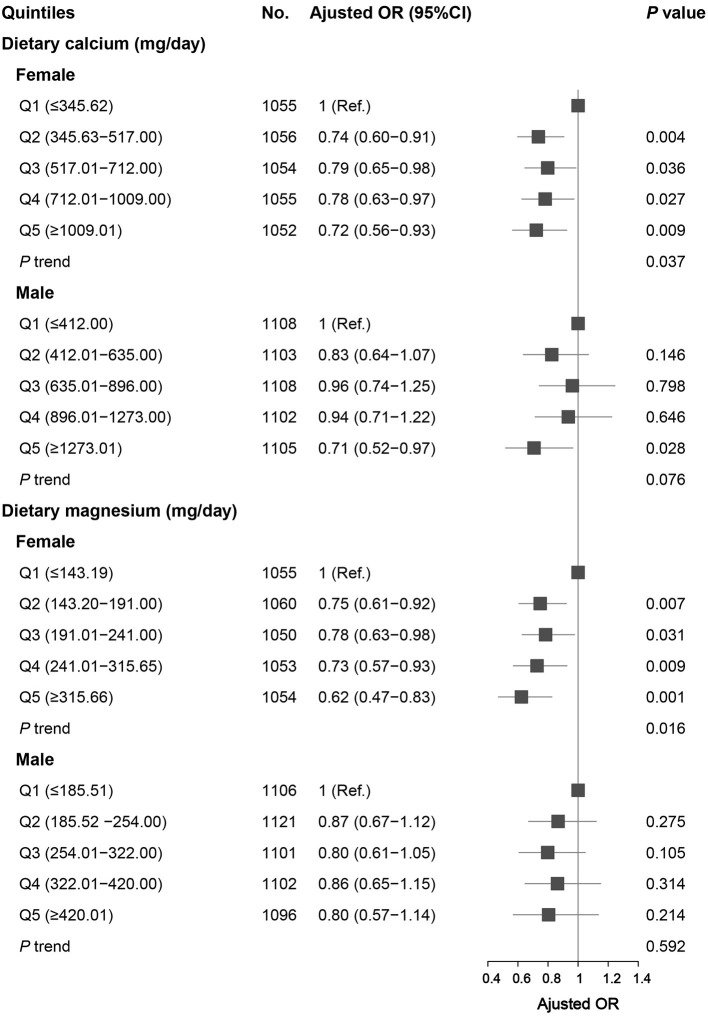
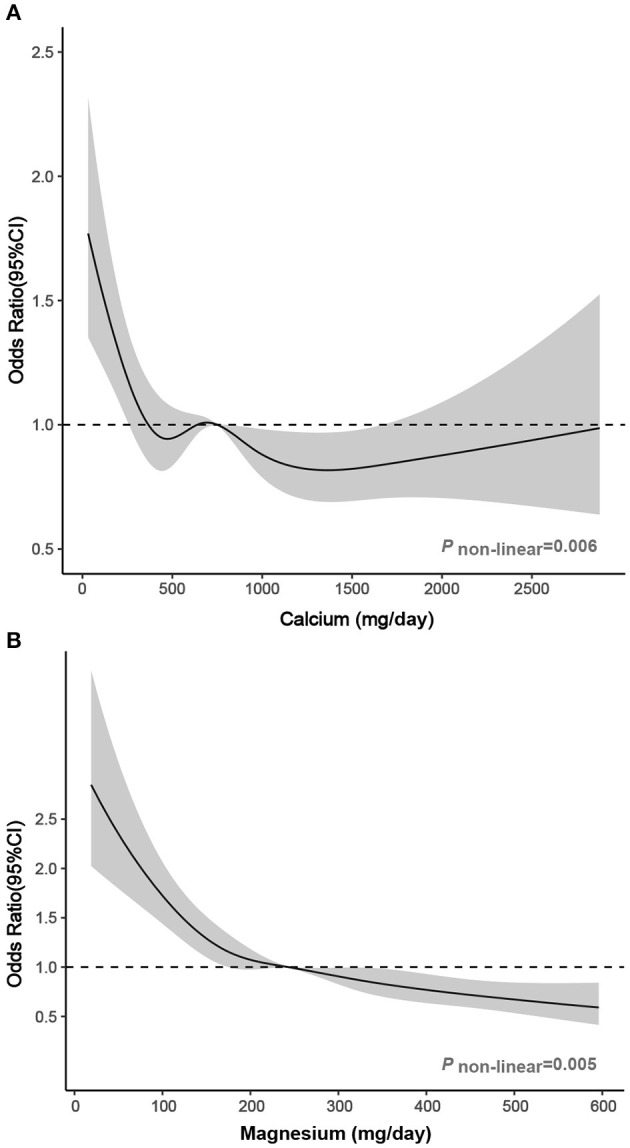
Migraine is a common neurological disorder and is affected by nutrients. Calcium and magnesium are essential minerals that play an important role in nerve function. So we investigated the association between dietary calcium and magnesium and migraine. We extracted 10,798 adults from the National Health and Nutrition Examination Surveys (NHANES) of America in 1999 to 2004. We classified patients who reported having severe headache or migraine as having possible migraine. Multivariable logistic regression and restricted cubic spline regression were conducted to determine the association between dietary calcium and magnesium and migraine. We found that the adjusted ORs of the association between dietary calcium and magnesium and migraine for comparing the highest quintile intake with the lowest quintile intake were 0.77 (95% CI: 0.63-0.93, = 0.008) and 0.69 (95% CI: 0.55-0.86, = 0.001), respectively. For women, the adjusted ORs of dietary calcium and magnesium were 0.72 (95% CI: 0.56-0.93, = 0.009) and 0.62 (95% CI: 0.47-0.83, = 0.001), respectively. For men, the adjusted OR was 0.71 (95% CI: 0.52-0.97, = 0.028) comparing the highest and the lowest quintile of calcium intake, but there was no statistically significant association between dietary magnesium intake and migraine. Joint analyses showed that the OR in the high-calcium and high-magnesium group was 0.74 (95% CI: 0.60-0.92, = 0.006) compared with the low-calcium and low-magnesium group in women. High dietary intake of calcium and magnesium, independently or in combination, were inversely associated with migraine in women. For men, high dietary calcium was negatively related to migraine, but magnesium was not associated with migraine.
偏头痛是一种常见的神经系统疾病,会受到营养物质的影响。钙和镁是必需矿物质,在神经功能中发挥重要作用。因此,我们研究了饮食中钙和镁与偏头痛之间的关联。我们从1999年至2004年美国国家健康与营养检查调查(NHANES)中提取了10798名成年人。我们将报告患有严重头痛或偏头痛的患者归类为可能患有偏头痛。进行多变量逻辑回归和受限立方样条回归以确定饮食中钙和镁与偏头痛之间的关联。我们发现,将最高五分位数摄入量与最低五分位数摄入量进行比较时,饮食中钙和镁与偏头痛之间关联的调整后比值比分别为0.77(95%置信区间:0.63 - 0.93,P = 0.008)和0.69(95%置信区间:0.55 - 0.86,P = 0.001)。对于女性,饮食中钙和镁的调整后比值比分别为0.72(95%置信区间:0.56 - 0.93,P = 0.009)和0.62(95%置信区间:0.47 - 0.83,P = 0.001)。对于男性,比较钙摄入量的最高和最低五分位数时,调整后比值比为0.71(95%置信区间:0.52 - 0.97,P = 0.028),但饮食中镁摄入量与偏头痛之间无统计学显著关联。联合分析显示,与女性的低钙和低镁组相比,高钙和高镁组的比值比为0.74(95%置信区间:0.60 - 0.92,P = 0.006)。女性饮食中高钙和高镁摄入量单独或联合与偏头痛呈负相关。对于男性,高饮食钙与偏头痛呈负相关,但镁与偏头痛无关。