
埃及伊蚊表现出独特的晚期卵巢发育模式。
Aedes aegypti exhibits a distinctive mode of late ovarian development.
机构信息
Temasek Life Sciences Laboratory, National University of Singapore, Singapore, 117604, Singapore.
Department of Biological Sciences, National University of Singapore, Singapore, 117543, Singapore.
出版信息
BMC Biol. 2023 Jan 24;21(1):11. doi: 10.1186/s12915-023-01511-7.
BACKGROUND
Insects live in almost every habitat on earth. To adapt to their diverse environments, insects have developed a myriad of different strategies for reproduction reflected in diverse anatomical and behavioral features that the reproductive systems of females exhibit. Yet, ovarian development remains largely uncharacterized in most species except Drosophila melanogaster (D. melanogaster), a high Diptera model. In this study, we investigated the detailed developmental process of the ovary in Aedes aegypti (Ae. aegypti), a major vector of various disease-causing pathogens that inhabits tropical and subtropical regions.
RESULTS
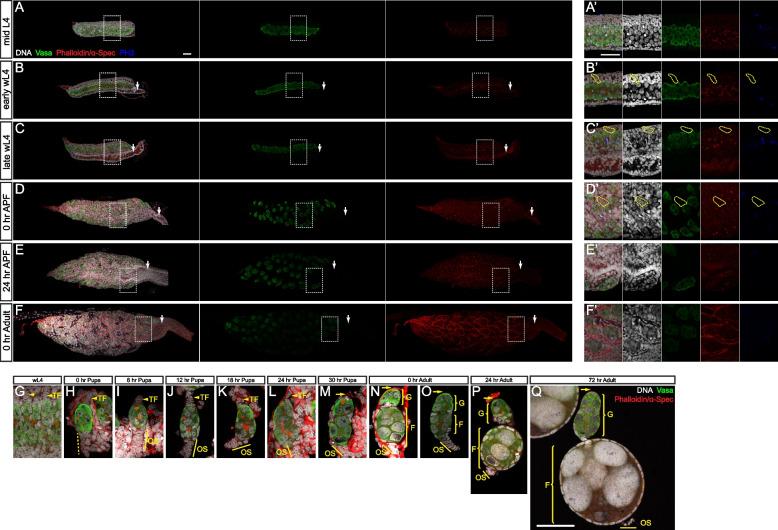
Compared with Drosophila melanogaster, a model of higher Diptera, the processes of pole cell formation and gonad establishment during embryonic stage are highly conserved in Ae. aegypti. However, Ae. aegypti utilizes a distinct strategy to form functional ovaries during larval/pupal development. First, during larval stage, Ae. aegypti primordial germ cells (PGCs) undergo a cyst-like proliferation with synchronized divisions and incomplete cytokinesis, leading to the formation of one tightly packed "PGC mass" containing several interconnected cysts, different from D. melanogaster PGCs that divide individually. This cyst-like proliferation is regulated by the target of rapamycin (TOR) pathway upon nutritional status. Second, ecdysone-triggered ovariole formation during metamorphosis exhibits distinct events, including "PGC mass" breakdown, terminal filament cell degeneration, and pre-ovariole migration. These unique developmental features might explain the structural and behavioral differences between Aedes and Drosophila ovaries. Importantly, both cyst-like proliferation and distinct ovariole formation are also observed in Culex quinquefasciatus and Anopheles sinensis, suggesting a conserved mode of ovarian development among mosquito species. In comparison with Drosophila, the ovarian development in Aedes and other mosquitoes might represent a primitive mode in the lower Diptera.
CONCLUSIONS
Our study reveals a new mode of ovarian development in mosquitoes, providing insights into a better understanding of the reproductive system and evolutionary relationship among insects.
背景
昆虫几乎生活在地球上的每一个栖息地。为了适应多样化的环境,昆虫在繁殖方面发展出了无数不同的策略,这些策略反映在雌性生殖系统的各种解剖和行为特征上。然而,除了双翅目模式生物黑腹果蝇(Drosophila melanogaster)之外,大多数物种的卵巢发育在很大程度上仍未被描述。在这项研究中,我们研究了埃及伊蚊(Aedes aegypti)卵巢的详细发育过程,埃及伊蚊是一种主要的病媒,栖息在热带和亚热带地区,携带各种致病病原体。
结果
与双翅目较高等的模式生物黑腹果蝇相比,埃及伊蚊在胚胎阶段的极细胞形成和性腺建立过程中高度保守。然而,埃及伊蚊在幼虫/蛹发育过程中利用一种独特的策略来形成功能性卵巢。首先,在幼虫阶段,埃及伊蚊原始生殖细胞(PGCs)经历类似于胞囊的增殖,有同步的分裂和不完全的胞质分裂,导致形成一个紧密包裹的“PGC 块”,其中包含几个相互连接的胞囊,与黑腹果蝇 PGC 单个分裂不同。这种类似于胞囊的增殖受营养状态下的雷帕霉素(TOR)途径调控。其次,蜕皮激素触发的卵巢形成在变态过程中表现出独特的事件,包括“PGC 块”的解体、端丝细胞的退化和前卵巢迁移。这些独特的发育特征可能解释了埃及伊蚊和果蝇卵巢之间的结构和行为差异。重要的是,类似于胞囊的增殖和独特的卵巢形成也在库蚊和按蚊中观察到,这表明蚊子物种之间存在卵巢发育的保守模式。与黑腹果蝇相比,埃及伊蚊和其他蚊子的卵巢发育可能代表了较低等双翅目昆虫的原始模式。
结论
本研究揭示了蚊子卵巢发育的新模式,为更好地理解昆虫的生殖系统和进化关系提供了新的认识。



 Zotero 插件