
细菌对藻类代谢物的生活方式转换。
Bacterial lifestyle switch in response to algal metabolites.
机构信息
Department of Plant and Environmental Sciences, Weizmann Institute of Science, Rehovot, Israel.
Life Sciences Core Facilities, Weizmann Institute of Science, Rehovot, Israel.
出版信息
Elife. 2023 Jan 24;12:e84400. doi: 10.7554/eLife.84400.
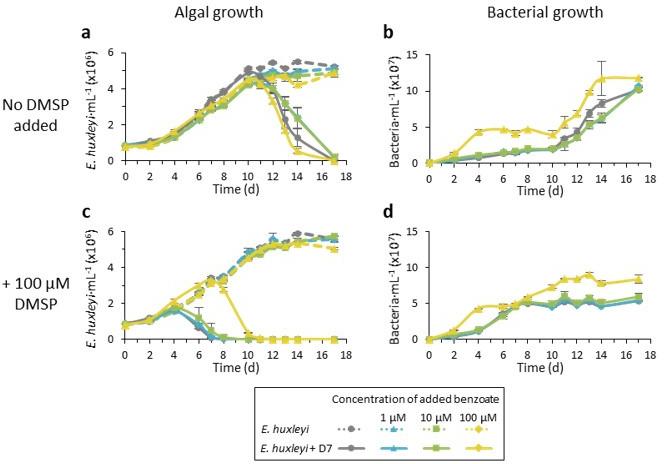
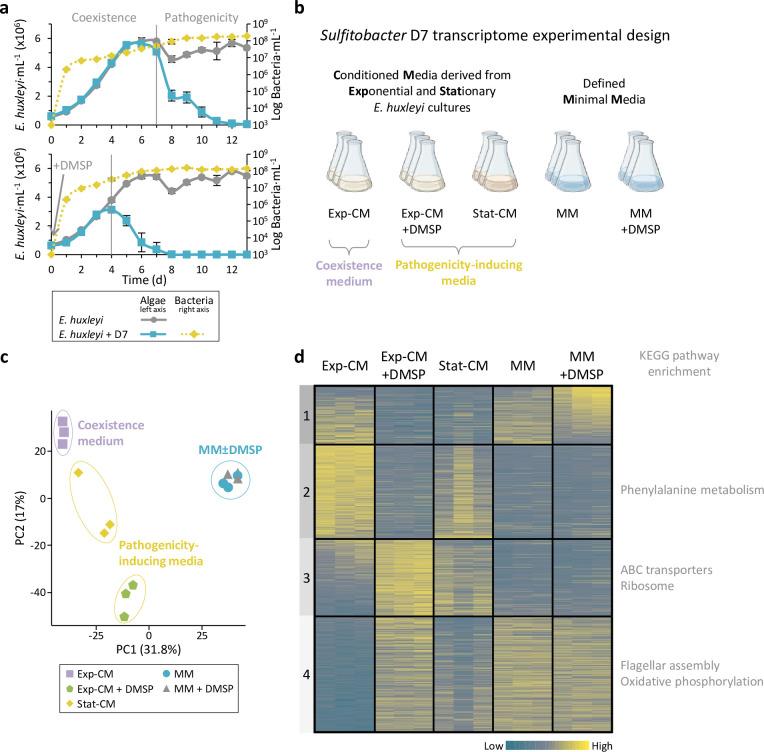
Unicellular algae, termed phytoplankton, greatly impact the marine environment by serving as the basis of marine food webs and by playing central roles in the biogeochemical cycling of elements. The interactions between phytoplankton and heterotrophic bacteria affect the fitness of both partners. It is becoming increasingly recognized that metabolic exchange determines the nature of such interactions, but the underlying molecular mechanisms remain underexplored. Here, we investigated the molecular and metabolic basis for the bacterial lifestyle switch, from coexistence to pathogenicity, in D7 during its interaction with , a cosmopolitan bloom-forming phytoplankter. To unravel the bacterial lifestyle switch, we analyzed bacterial transcriptomes in response to exudates derived from algae in exponential growth and stationary phase, which supported the D7 coexistence and pathogenicity lifestyles, respectively. In pathogenic mode, D7 upregulated flagellar motility and diverse transport systems, presumably to maximize assimilation of -derived metabolites released by algal cells upon cell death. Algal dimethylsulfoniopropionate (DMSP) was a pivotal signaling molecule that mediated the transition between the lifestyles, supporting our previous findings. However, the coexisting and pathogenic lifestyles were evident only in the presence of additional algal metabolites. Specifically, we discovered that algae-produced benzoate promoted the growth of D7 and hindered the DMSP-induced lifestyle switch to pathogenicity, demonstrating that benzoate is important for maintaining the coexistence of algae and bacteria. We propose that bacteria can sense the physiological state of the algal host through changes in the metabolic composition, which will determine the bacterial lifestyle during interaction.
单细胞藻类,被称为浮游植物,通过作为海洋食物网的基础和在元素的生物地球化学循环中发挥核心作用,极大地影响着海洋环境。浮游植物和异养细菌之间的相互作用影响着两者的适应性。人们越来越认识到,代谢交换决定了这种相互作用的性质,但潜在的分子机制仍未得到充分探索。在这里,我们研究了在与广泛分布的浮游植物 相互作用过程中,细菌从共存到致病性的生活方式转变的分子和代谢基础 。为了揭示细菌生活方式的转变,我们分析了细菌在指数生长期和静止期分别对藻类分泌物的转录组,这些分泌物分别支持 D7 的共存和致病性生活方式。在致病性模式下, D7 上调了鞭毛运动和多种运输系统,大概是为了最大限度地同化藻类细胞死亡时释放的 - 衍生代谢物。二甲亚砜(DMSP)是一种关键的信号分子,介导了生活方式的转变,这支持了我们之前的发现。然而,只有在存在额外的藻类代谢物的情况下,共存和致病性的生活方式才明显。具体来说,我们发现藻类产生的苯甲酸促进了 D7 的生长,并阻碍了 DMSP 诱导的生活方式向致病性的转变,这表明苯甲酸对于维持藻类和细菌的共存是很重要的。我们提出,细菌可以通过改变代谢组成来感知藻类宿主的生理状态,这将决定相互作用过程中细菌的生活方式。





 Zotero 插件