
脑电图解码深度学习方法的实证比较。
Empirical comparison of deep learning methods for EEG decoding.
作者信息
de Oliveira Iago Henrique, Rodrigues Abner Cardoso
机构信息
Graduate Program in Neuroengineering, Edmond and Lily Safra International Institute of Neuroscience, Santos Dumont Institute, Macaiba, Brazil.
出版信息
Front Neurosci. 2023 Jan 10;16:1003984. doi: 10.3389/fnins.2022.1003984. eCollection 2022.
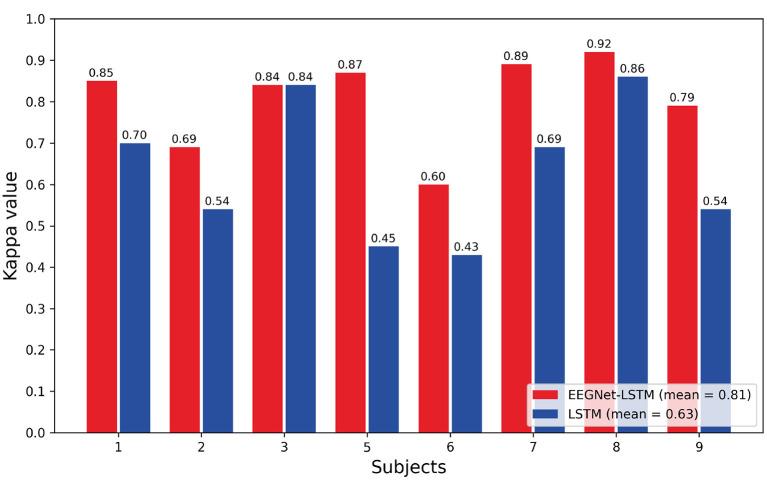
Electroencephalography (EEG) is a technique that can be used in non-invasive brain-machine interface (BMI) systems to register brain electrical activity. The EEG signals are non-linear and non-stationary, making the decoding procedure a complex task. Deep learning techniques have been successfully applied in several research fields, often improving the results compared with traditional approaches. Therefore, it is believed that these techniques can also improve the process of decoding brain signals in BMI systems. In this work, we present the implementation of two deep learning-based decoders and we compared the results with other state of art deep learning methods. The first decoder uses long short-term memory (LSTM) recurrent neural network and the second, entitled EEGNet-LSTM, combines a well-known neural decoder based on convolutional neural networks, called EEGNet, with some LSTM layers. The decoders have been tested using data set 2a from BCI Competition IV, and the results showed that the EEGNet-LSTM decoder has been approximately 23% better than the competition-winning decoder. A Wilcoxon -test showed a significant difference between the two decoders ( = 2.524, = 0.012). The LSTM-based decoder has been approximately 9% higher than the best decoder from the same competition. However, there was no significant difference ( = 1.540, = 0.123). In order to verify the replication of the EEGNet-LSTM decoder on another data, we performed a test with PhysioNet's Physiobank EEG Motor Movement/Imagery dataset. The EEGNet-LSTM presented a higher performance (0.85 accuracy) than the EEGNet (0.82 accuracy). The results of this work can be important for the development of new research, as well as EEG-based BMI systems, which can benefit from the high precision of neural decoders.
脑电图(EEG)是一种可用于非侵入性脑机接口(BMI)系统来记录脑电活动的技术。EEG信号是非线性且非平稳的,这使得解码过程成为一项复杂的任务。深度学习技术已在多个研究领域成功应用,与传统方法相比通常能改善结果。因此,人们认为这些技术也能改善BMI系统中脑信号的解码过程。在这项工作中,我们展示了两种基于深度学习的解码器的实现,并将结果与其他先进的深度学习方法进行了比较。第一个解码器使用长短期记忆(LSTM)循环神经网络,第二个名为EEGNet-LSTM,它将基于卷积神经网络的著名神经解码器EEGNet与一些LSTM层相结合。使用BCI竞赛IV的2a数据集对解码器进行了测试,结果表明EEGNet-LSTM解码器比获胜解码器的性能约高23%。威尔科克森检验显示两个解码器之间存在显著差异( = 2.524, = 0.012)。基于LSTM的解码器比同一竞赛中的最佳解码器高约9%。然而,没有显著差异( = 1.540, = 0.123)。为了验证EEGNet-LSTM解码器在另一组数据上的重复性,我们使用PhysioNet的Physiobank EEG运动/想象数据集进行了测试。EEGNet-LSTM表现出比EEGNet更高的性能(准确率0.85)(准确率0.82)。这项工作的结果对于新研究以及基于EEG的BMI系统的开发可能很重要,这些系统可受益于神经解码器的高精度。



 Zotero 插件