Department of Anesthesiology and Intensive Care Medicine, University Medical Centre Schleswig-Holstein, Campus Kiel, Arnold-Heller Str. 3, 24105, Kiel, Germany.
Department of Pediatrics, German Air Rescue Service Association "DRF Luftrettung", Filderstadt, Germany.
Scand J Trauma Resusc Emerg Med. 2023 Jan 28;31(1):5. doi: 10.1186/s13049-023-01069-x.
Pain management in the pre-hospital setting remains a particular challenge for paramedics and emergency physicians, especially in children. This study evaluates the pre-hospital use and effect of analgesics in children with trauma or pain due to other reasons.
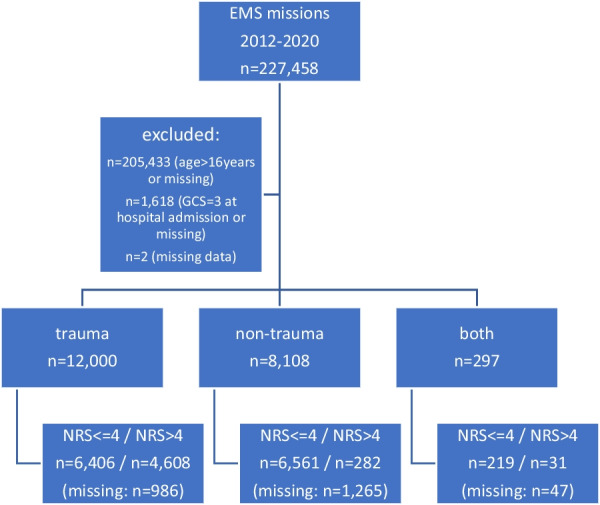
This study is a retrospective analysis of the database of a German air rescue service and was conducted over a period of 9 years (2012-2020) to assess pain in general and whether patients with trauma pain due to other reasons received treatment with analgesics. We included all patients in the registry under the age of 16 years. Patients with a Glasgow Coma Scale of 3 at hospital admission and incomplete records were excluded. The intensity of pain was determined by the emergency physician on scene at arrival and hospital admission in a ten-point rating scale (0 = no pain). Effective pain reduction was analyzed.
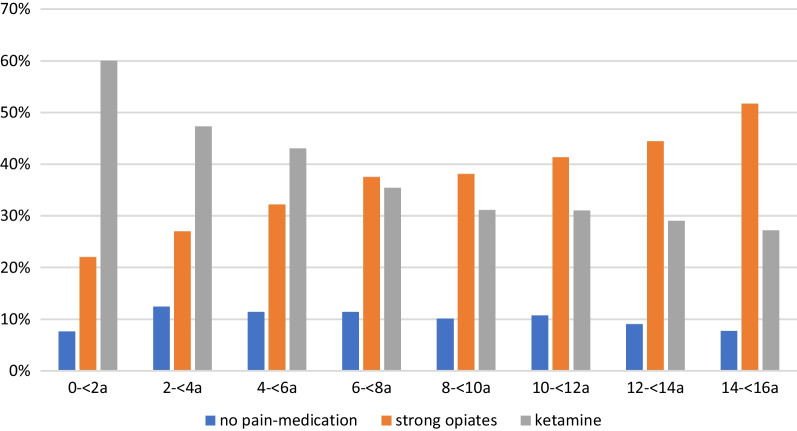
Out of 227,458 cases, a total of 22,025 emergency cases involved pediatric patients aged 0-16 years. 20,405 cases were included in the study. 12,000 (58.8%) children had suffered a trauma, 8108 (39.7%) had pain due to other reasons and 297 (1.5%) had both. In total, 4,608 (38.4%) of the children with trauma were assessed having a numerical rating scale (NRS) > 4 at EMS arrival. These patients received mainly ketamine (34.5%) and the opioids fentanyl (38.7%) and piritramide (19.1%). The value on the NRS was significantly lower at admission to hospital (mean 1.9) compared with the EMS arrival (mean 6.9). In 4.9% the NRS at hospital admission was still > 4. 282 patients within the non-trauma group had a pre-hospital NRS of > 4. The pain therapy consisted of opioids (35.8%) and ketamine (2.8%). 28.4% patients in the non-trauma group received no pain medication. In 16.0% the NRS at hospital admission was still > 4.
German emergency physicians achieved a sufficient pain therapy in pediatric patients with a NRS > 4 after trauma. In case of non-trauma, the pain management by the emergency physicians is restrained and less successful. The most common analgesic medications administered were ketamine and fentanyl, followed by piritramide.
The study has been retrospectively registered at DRKS (DRKS00026222).
在院前环境中进行疼痛管理仍然是护理人员和急诊医生面临的一个特殊挑战,尤其是在儿童中。本研究评估了在创伤或其他原因引起疼痛的儿童中,院前使用和镇痛效果。
这是对德国空中救援服务数据库的回顾性分析,研究时间为 9 年(2012-2020 年),旨在评估一般疼痛情况以及是否因其他原因导致创伤疼痛的患者接受了镇痛治疗。我们将登记册中所有 16 岁以下的患者纳入研究。入院时格拉斯哥昏迷量表评分为 3 分且记录不完整的患者被排除在外。疼痛强度由到达现场和入院时的急诊医生在 10 分制评分量表上确定(0=无疼痛)。分析有效疼痛缓解情况。
在 227458 例中,共有 22025 例急诊病例涉及 0-16 岁儿科患者。共有 20405 例纳入研究。12000 例(58.8%)儿童遭受创伤,8108 例(39.7%)因其他原因疼痛,297 例(1.5%)两者兼有。在因创伤而接受评估的儿童中,共有 4608 例(38.4%)在 EMS 到达时的数字评分量表(NRS)>4。这些患者主要接受氯胺酮(34.5%)和阿片类药物芬太尼(38.7%)和哌替啶(19.1%)治疗。与 EMS 到达时(平均 6.9)相比,入院时 NRS 值显著降低(平均 1.9)。入院时 NRS 仍>4 的患者占 4.9%。非创伤组中有 282 例患者院前 NRS>4。疼痛治疗包括阿片类药物(35.8%)和氯胺酮(2.8%)。非创伤组中 28.4%的患者未接受任何止痛药物治疗。入院时 NRS 仍>4 的患者占 16.0%。
德国急诊医生在 NRS>4 的创伤后儿科患者中实现了足够的疼痛治疗。在非创伤情况下,急诊医生的疼痛管理受到限制且效果较差。最常用的镇痛药物是氯胺酮和芬太尼,其次是哌替啶。
该研究已在 DRKS(DRKS00026222)中进行回顾性注册。