School of Human Movement and Nutrition Sciences, Faculty of Health and Behavioural Sciences, The University of Queensland, Brisbane, Australia.
Sport and Health Sciences, College of Life and Environmental Sciences, University of Exeter, Exeter, Devon, United Kingdom.
PeerJ. 2023 Jan 23;11:e14687. doi: 10.7717/peerj.14687. eCollection 2023.
During counter movement jumps, adding weight in the eccentric phase and then suddenly releasing this weight during the concentric phase, known as accentuated eccentric loading (AEL), has been suggested to immediately improve jumping performance. The level of evidence for the positive effects of AEL remains weak, with conflicting evidence over the effectiveness in enhancing performance. Therefore, we proposed to theoretically explore the influence of implementing AEL during constrained vertical jumping using computer modelling and simulation and examined whether the proposed mechanism of enhanced power, increased elastic energy storage and return, could enhance work and power.
We used a simplified model, consisting of a ball-shaped body (head, arm, and trunk), two lower limb segments (thigh and shank), and four muscles, to simulate the mechanisms of AEL. We adjusted the key activation parameters of the muscles to influence the performance outcome of the model. Numerical optimization was applied to search the optimal solution for the model. We implemented AEL and non-AEL conditions in the model to compare the simulated data between conditions.
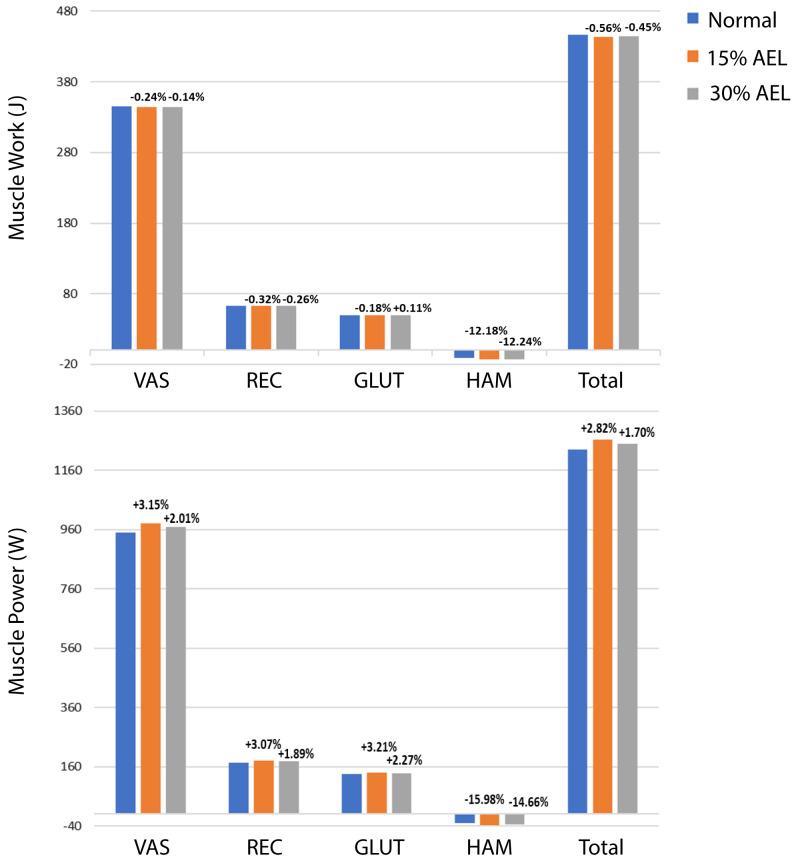
Our model predicted that the optimal jumping performance was achieved when the model utilized the whole joint range. However, there was no difference in jumping performance in AEL and non-AEL conditions because the model began its push-off at the similar state (posture, fiber length, fiber velocity, fiber force, tendon length, and the same activation level). Therefore, the optimal solution predicted by the model was primarily driven by intrinsic muscle dynamics (force-length-velocity relationship), and this coupled with the similar model state at the start of the push-off, resulting in similar push-off performance across all conditions. There was also no evidence of additional tendon-loading effect in AEL conditions compared to non-AEL condition.
Our simplified simulations did not show improved jump performance with AEL, contrasting with experimental studies. The reduced model demonstrates that increased energy storage from the additional mass alone is not sufficient to induce increased performance and that other factors like differences in activation strategies or movement paths are more likely to contribute to enhanced performance.
在反向运动跳跃中,在离心阶段增加重量,然后在向心阶段突然释放这个重量,这种方法称为增强离心负荷(AEL),被认为可以立即提高跳跃表现。然而,关于 AEL 对增强运动表现的积极影响的证据水平仍然较弱,关于其有效性的证据存在冲突。因此,我们提出使用计算机建模和模拟理论上探索在约束垂直跳跃中实施 AEL 的影响,并检查所提出的增强功率、增加弹性储能和恢复的机制是否可以提高工作和功率。
我们使用一个简化模型,由一个球形物体(头部、手臂和躯干)、两个下肢节段(大腿和小腿)和四个肌肉组成,模拟 AEL 的机制。我们调整肌肉的关键激活参数来影响模型的性能结果。数值优化用于搜索模型的最优解决方案。我们在模型中实现 AEL 和非 AEL 条件,以比较条件之间的模拟数据。
我们的模型预测,当模型利用整个关节范围时,可以达到最佳跳跃性能。然而,在 AEL 和非 AEL 条件下,跳跃性能没有差异,因为模型在相似的状态(姿势、纤维长度、纤维速度、纤维力、肌腱长度和相同的激活水平)下开始推离。因此,模型预测的最佳解决方案主要由内在肌肉动力学(力-长度-速度关系)驱动,再加上推离开始时模型状态相似,导致所有条件下的推离性能相似。与非 AEL 条件相比,AEL 条件下也没有证据表明肌腱加载效应增加。
我们的简化模拟并没有显示 AEL 可以提高跳跃表现,这与实验研究结果相反。简化模型表明,仅增加额外质量的储能不足以提高表现,其他因素,如激活策略或运动路径的差异,更有可能有助于提高表现。