Gutiérrez-Avila Iván, Riojas-Rodríguez Horacio, Colicino Elena, Rush Johnathan, Tamayo-Ortiz Marcela, Borja-Aburto Víctor Hugo, Just Allan C
Department of Environmental Medicine and Public Health, Icahn School of Medicine at Mount Sinai, New York, NY, USA.
Dirección de Salud Ambiental, Instituto Nacional de Salud Pública, Cuernavaca Morelos, México.
medRxiv. 2023 Jan 17:2023.01.15.23284576. doi: 10.1101/2023.01.15.23284576.
Satellite-based PM predictions are being used to advance exposure science and air-pollution epidemiology in developed countries; including emerging evidence about the impacts of PM on acute health outcomes beyond the cardiovascular and respiratory systems, and the potential modifying effects from individual-level factors in these associations. Research on these topics is lacking in Latin America.
We used a time-stratified case-crossover study design with 1,479,950 non-accidental deaths from Mexico City Metropolitan Area for the period of 2004-2019. Daily 1×1 km PM (median=23.4 μg/m; IQR=13.6 μg/m) estimates from our satellite-based regional model were employed for exposure assessment at the sub-municipality level. Associations between PM with broad-category (organ-system) and cause-specific mortality outcomes were estimated with distributed lag conditional logistic models. We also fit models stratifying by potential individual-level effect modifiers including; age, sex, and individual SES-related characteristics namely: education, health insurance coverage, and job categories.
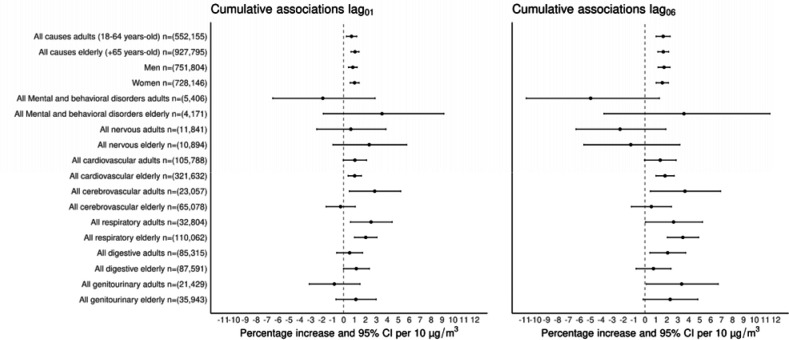
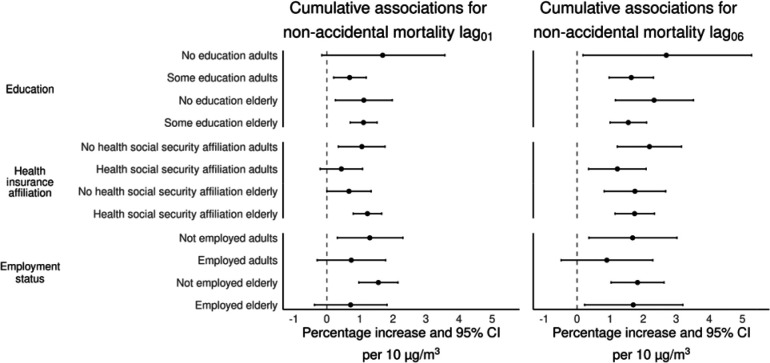
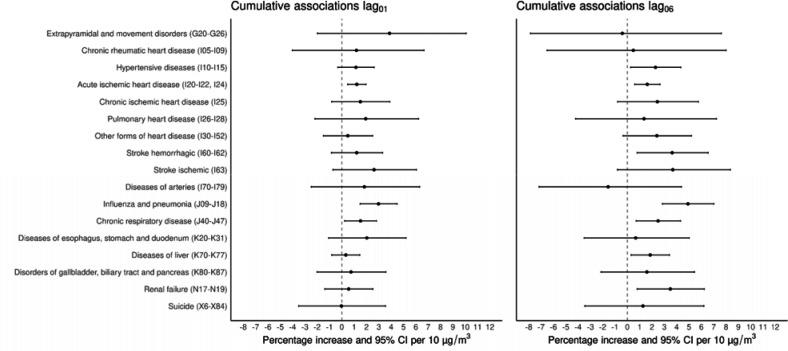
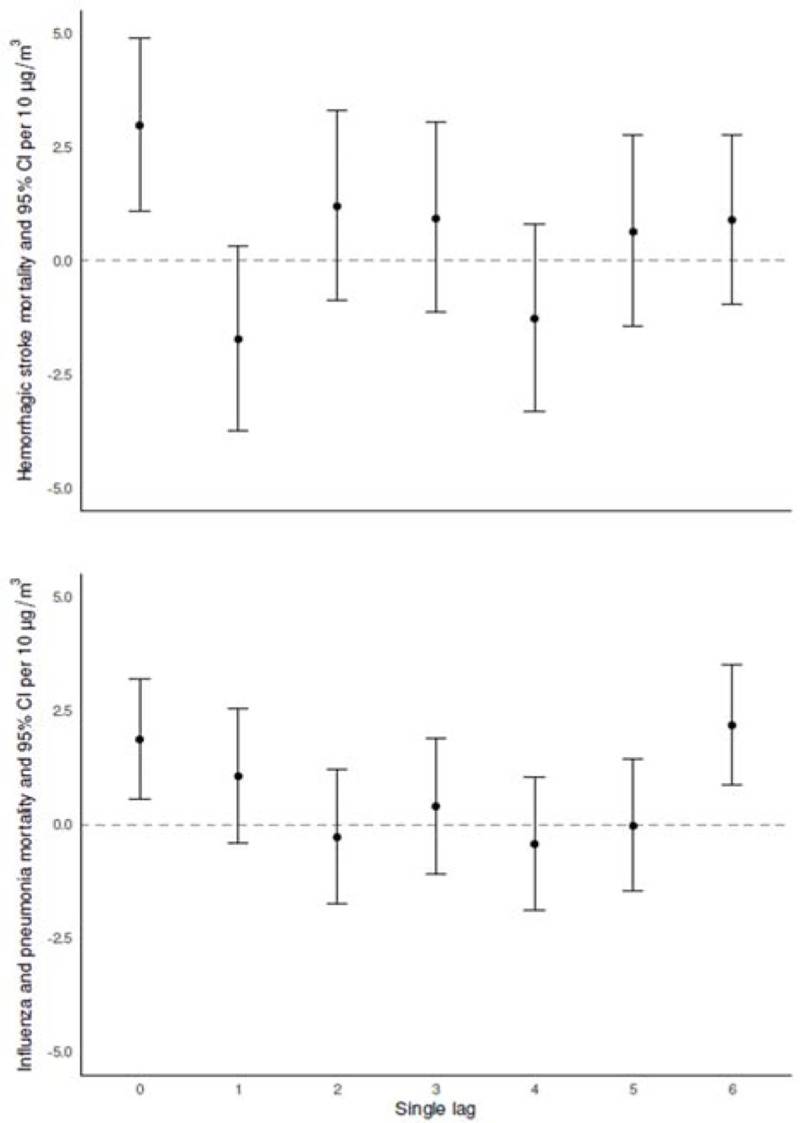
PM exposure was associated with higher total non-accidental, cardiovascular, cerebrovascular, respiratory, and digestive mortality. A 10-μg/m PM higher cumulative exposure over one week (lag) was associated with higher cause-specific mortality outcomes including hypertensive disease [2.28% (95%CI: 0.26%-4.33%)], acute ischemic heart disease [1.61% (95%CI: 0.59%-2.64%)], other forms of heart disease [2.39% (95%CI: -0.35%-5.20%)], hemorrhagic stroke [3.63% (95%CI: 0.79%-6.55%)], influenza and pneumonia [4.91% (95%CI: 2.84%-7.02%)], chronic respiratory disease [2.49% (95%CI: 0.71%-4.31%)], diseases of the liver [1.85% (95%CI: 0.31%-3.41%)], and renal failure [3.48% (95%CI: 0.79%-6.24%)]. No differences in effect size of associations were observed between SES strata.
Exposure to PM was associated with mortality outcomes beyond the cardiovascular and respiratory systems, including specific death-causes from the digestive and genitourinary systems, with no indications of effect modification by individual SES-related characteristics.
基于卫星的细颗粒物(PM)预测正被用于推动发达国家的暴露科学和空气污染流行病学发展;包括有关PM对心血管和呼吸系统以外的急性健康结果影响的新证据,以及这些关联中个体层面因素的潜在调节作用。拉丁美洲缺乏关于这些主题的研究。
我们采用了时间分层病例交叉研究设计,纳入了2004年至2019年期间墨西哥城大都市区1479950例非意外死亡病例。使用我们基于卫星的区域模型得出的每日1×1千米PM估计值(中位数=23.4微克/立方米;四分位间距=13.6微克/立方米)在次市级层面进行暴露评估。使用分布滞后条件逻辑模型估计PM与广泛类别(器官系统)和特定病因死亡率结果之间的关联。我们还根据潜在的个体层面效应修饰因素进行分层拟合模型,这些因素包括年龄、性别以及与个体社会经济地位相关的特征,即教育程度、医疗保险覆盖范围和职业类别。
PM暴露与更高的总非意外、心血管、脑血管、呼吸和消化死亡率相关。在一周(滞后)内累积暴露量每增加10微克/立方米的PM与更高的特定病因死亡率结果相关,包括高血压疾病[2.28%(95%置信区间:0.26%-4.33%)]、急性缺血性心脏病[1.61%(95%置信区间:0.59%-2.64%)]、其他形式的心脏病[2.39%(95%置信区间:-0.35%-5.20%)]、出血性中风[3.63%(95%置信区间:0.79%-6.55%)]、流感和肺炎[4.91%(95%置信区间:2.84%-7.02%)]、慢性呼吸道疾病[2.49%(95%置信区间:0.71%-4.31%)]、肝脏疾病[1.85%(95%置信区间:0.31%-3.41%)]和肾衰竭[3.48%(95%置信区间:0.79%-6.24%)]。在社会经济地位分层之间未观察到关联效应大小的差异。
PM暴露与心血管和呼吸系统以外的死亡率结果相关,包括来自消化和泌尿生殖系统的特定死亡原因,且没有迹象表明个体社会经济地位相关特征会产生效应修饰作用。