Lin Tingyi S, Luo Yue
Department of Design, National Taiwan University of Science and Technology, Taiwan Tech, #43, Keelung Rd., Sec.4, Da'an Dist., Taipei City, 106335, Taiwan.
SSM Popul Health. 2023 Jan 21;21:101343. doi: 10.1016/j.ssmph.2023.101343. eCollection 2023 Mar.
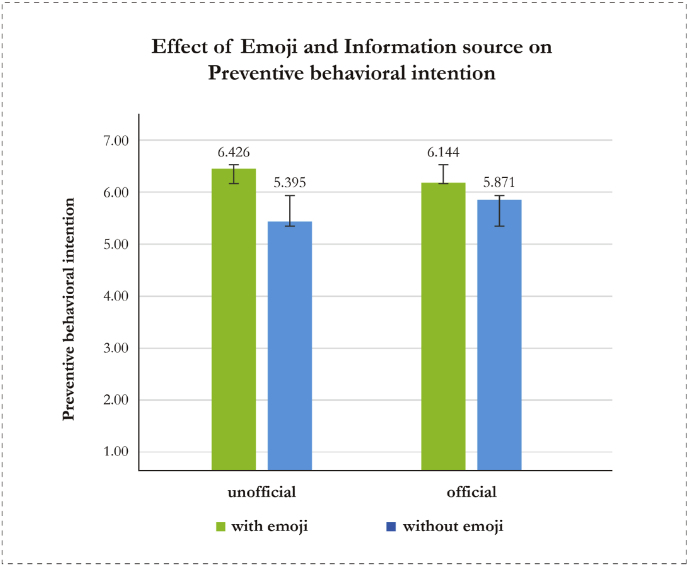
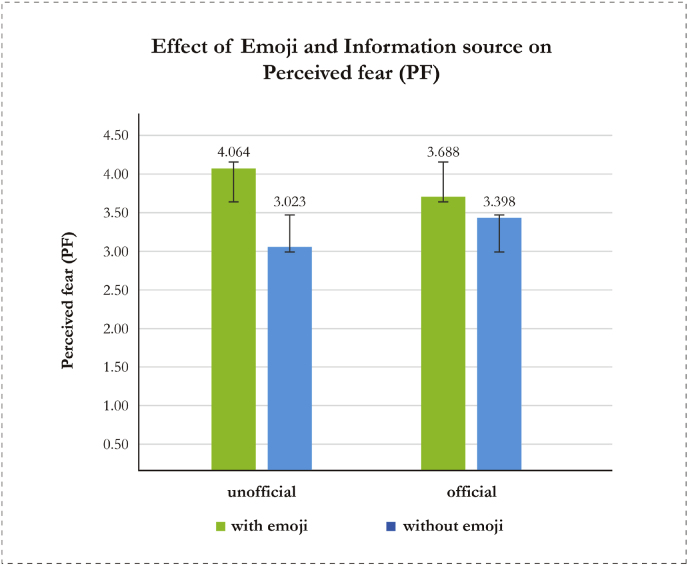
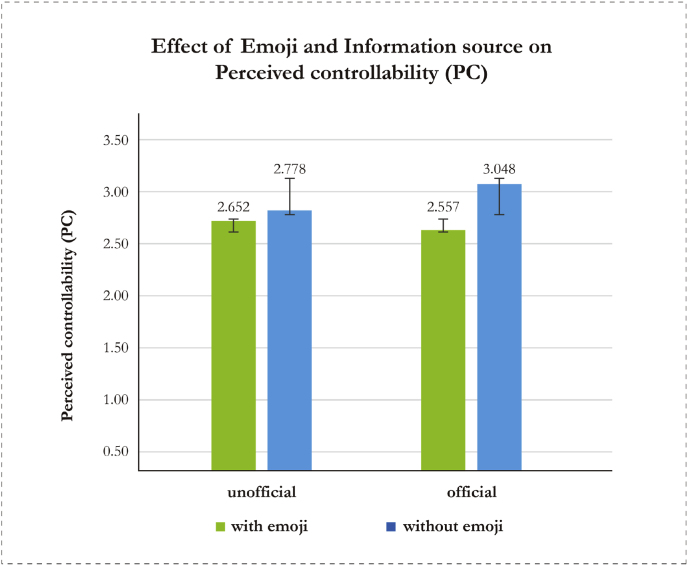
By providing health information through visual communication, public health organizations can effectively guide and persuade people to adopt healthy behaviors, which is critical in the context of public health crises. In this study, drawing upon congruity theory and the premise of visual communication, we examined how information source and emoji may shape people's preventive and self-protective behaviors through perceived fear (PF) and perceived controllability (PC). Using a convenience sample of 210 participants, we conducted a 2 (emoji: with versus without) × 2 (information source: official versus unofficial) between-subject experiment. The results indicated that, compared with nonuse, the use of emoji in information resulted in higher PF, stronger preventive behavioral intention (PBI), and lower PC. In addition, a strong interaction effect was observed between emoji and the source of information on PBI. When emoji were added to health information released by an unofficial organization, the text outperformed that from an official agency in persuading people to adopt preventive behaviors. Furthermore, we determined that PF mediated the effect of emoji on PBI, but only for unofficial information sources. These results provide a reference for enhancing the effectiveness of health information including visual cues, such as emoji.
通过视觉传播提供健康信息,公共卫生组织可以有效地引导和说服人们采取健康行为,这在公共卫生危机背景下至关重要。在本研究中,基于一致性理论和视觉传播的前提,我们考察了信息来源和表情符号如何通过感知恐惧(PF)和感知可控性(PC)影响人们的预防和自我保护行为。我们以210名参与者为便利样本,进行了一项2(表情符号:有与无)×2(信息来源:官方与非官方)的组间实验。结果表明,与不使用表情符号相比,在信息中使用表情符号会导致更高的PF、更强的预防行为意图(PBI)和更低的PC。此外,观察到表情符号和信息来源对PBI有很强的交互作用。当在非官方组织发布的健康信息中添加表情符号时,其文本在说服人们采取预防行为方面优于官方机构发布的信息。此外,我们确定PF介导了表情符号对PBI的影响,但仅针对非官方信息来源。这些结果为提高包括表情符号等视觉线索在内的健康信息的有效性提供了参考。