Li Changhao, Luo Shao-Xiong Lennon, Kim Daniel M, Wang Guoqing, Cappellaro Paola
Research Laboratory of Electronics, Massachusetts Institute of Technology, Cambridge, MA 02139, USA.
Department of Nuclear Science and Engineering, Massachusetts Institute of Technology, Cambridge, MA 02139, USA.
ArXiv. 2023 Jan 9:arXiv:2301.03143v1.
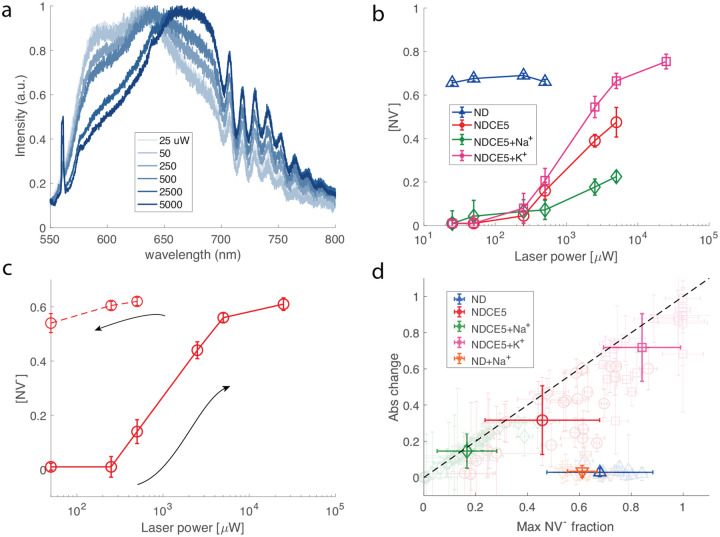
Alkali metal ions such as sodium and potassium cations play fundamental roles in biology. Developing highly sensitive and selective methods to both detect and quantify these ions is of considerable importance for medical diagnostics and bioimaging. Fluorescent nanoparticles have emerged as powerful tools for nanoscale imaging, but their optical properties need to be supplemented with specificity to particular chemical and biological signals in order to provide further information about biological processes. Nitrogen-vacancy (NV) centers in diamond are particularly attractive as fluorescence markers, thanks to their optical stability, biocompatibility and further ability to serve as highly sensitive quantum sensors of temperature, magnetic and electric fields in ambient conditions. In this work, by covalently grafting crown ether structures on the surface of nanodiamonds (NDs), we build sensors that are capable of detecting specific alkali ions such as sodium cations. We will show that the presence of these metal ions modifies the charge state of NV centers inside the ND, which can then be read out by measuring their photoluminescence spectrum. Our work paves the way for designing selective biosensors based on NV centers in diamond.
诸如钠和钾阳离子等碱金属离子在生物学中发挥着重要作用。开发高灵敏度和选择性的方法来检测和定量这些离子对于医学诊断和生物成像具有相当重要的意义。荧光纳米颗粒已成为纳米级成像的强大工具,但其光学特性需要补充对特定化学和生物信号的特异性,以便提供有关生物过程的更多信息。由于其光学稳定性、生物相容性以及在环境条件下作为温度、磁场和电场的高灵敏度量子传感器的进一步能力,金刚石中的氮空位(NV)中心作为荧光标记物特别具有吸引力。在这项工作中,通过在纳米金刚石(NDs)表面共价接枝冠醚结构,我们构建了能够检测特定碱金属离子(如钠离子)的传感器。我们将表明,这些金属离子的存在会改变ND内部NV中心的电荷状态,然后可以通过测量其光致发光光谱来读出。我们的工作为基于金刚石中NV中心设计选择性生物传感器铺平了道路。