Laboratories of Immunology and Antibody Glycan Analysis, Institute of Nutritional Medicine, University of Lübeck and University Medical Center Schleswig-Holstein, Lübeck, Germany.
Center for Proteomics and Metabolomics, Leiden University Medical Center, Leiden, Netherlands.
Front Immunol. 2023 Jan 12;13:1020844. doi: 10.3389/fimmu.2022.1020844. eCollection 2022.
The new types of mRNA-containing lipid nanoparticle vaccines BNT162b2 and mRNA-1273 and the adenovirus-based vaccine AZD1222 were developed against SARS-CoV-2 and code for its spike (S) protein. Several studies have investigated short-term antibody (Ab) responses after vaccination.
However, the impact of these new vaccine formats with unclear effects on the long-term Ab response - including isotype, subclass, and their type of Fc glycosylation - is less explored.
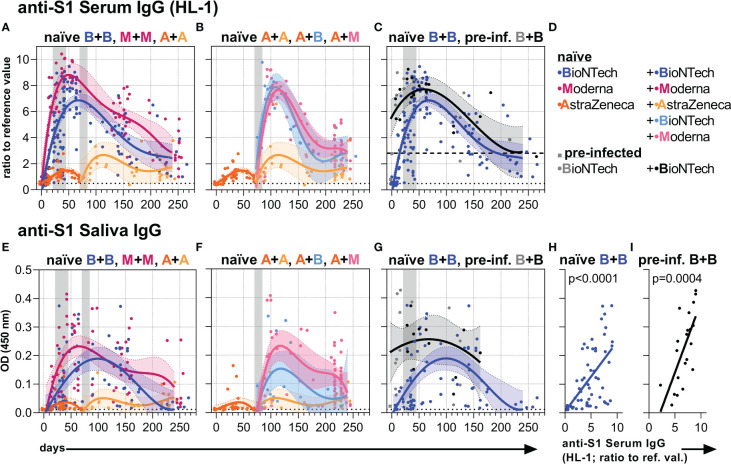
Here, we analyzed anti-S Ab responses in blood serum and the saliva of SARS-CoV-2 naïve and non-hospitalized pre-infected subjects upon two vaccinations with different mRNA- and adenovirus-based vaccine combinations up to day 270.
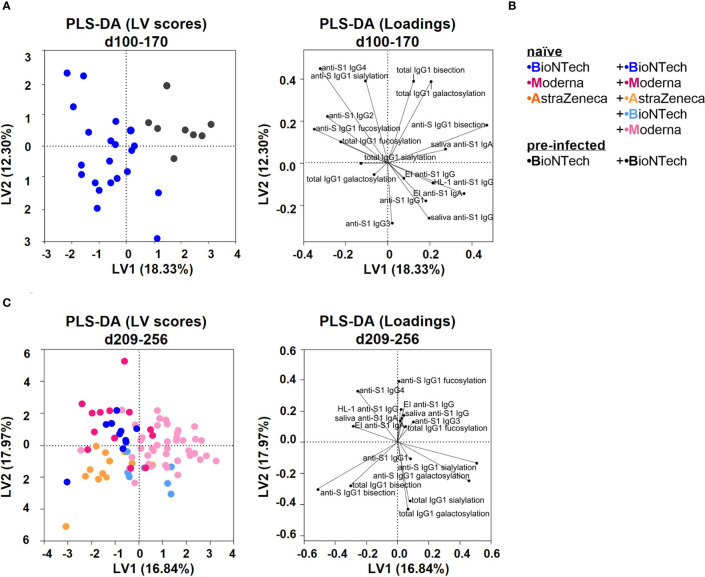
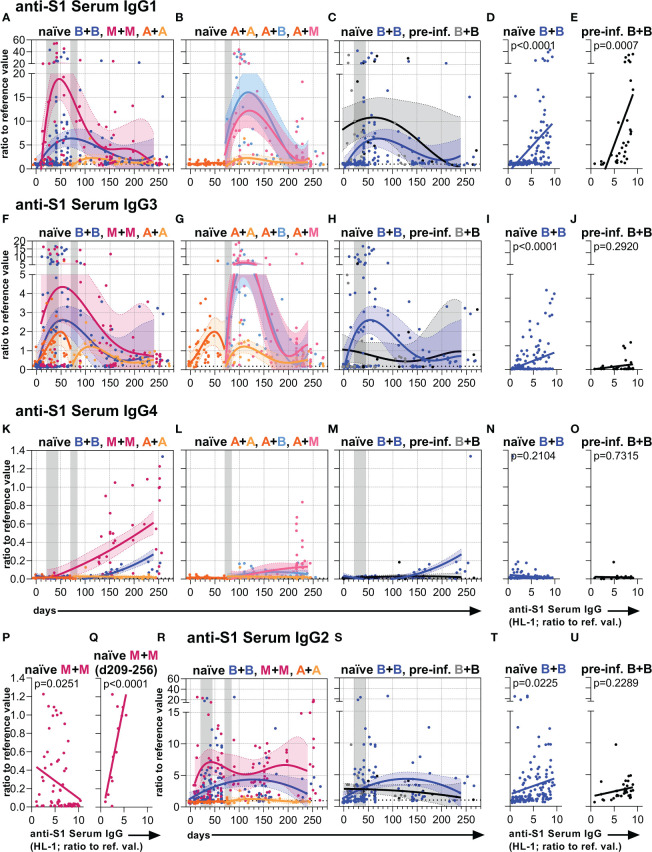
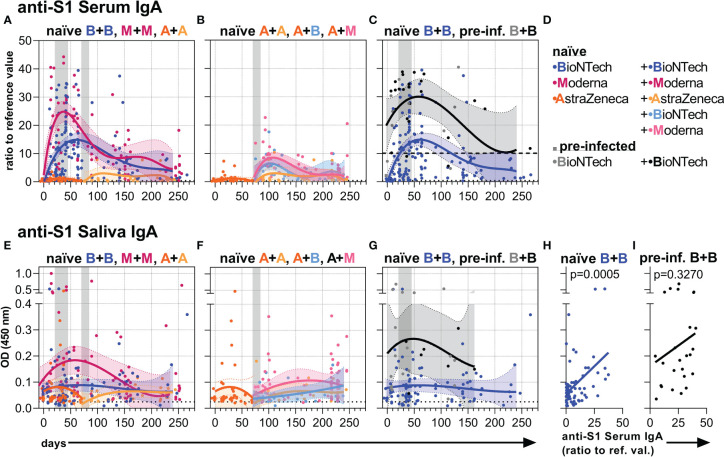
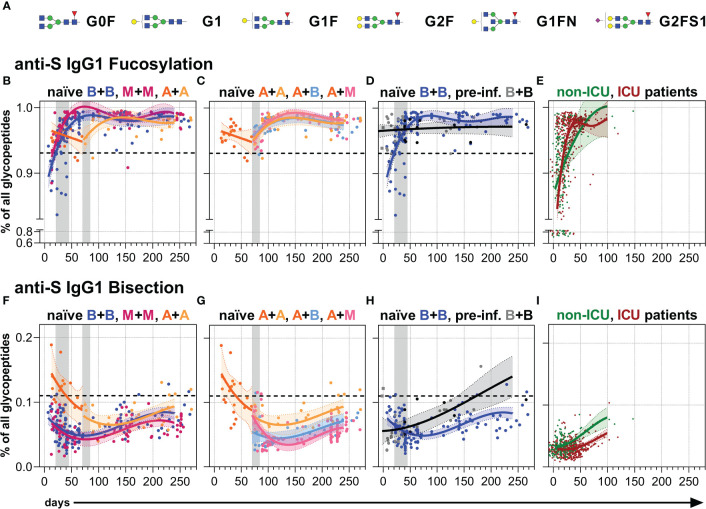
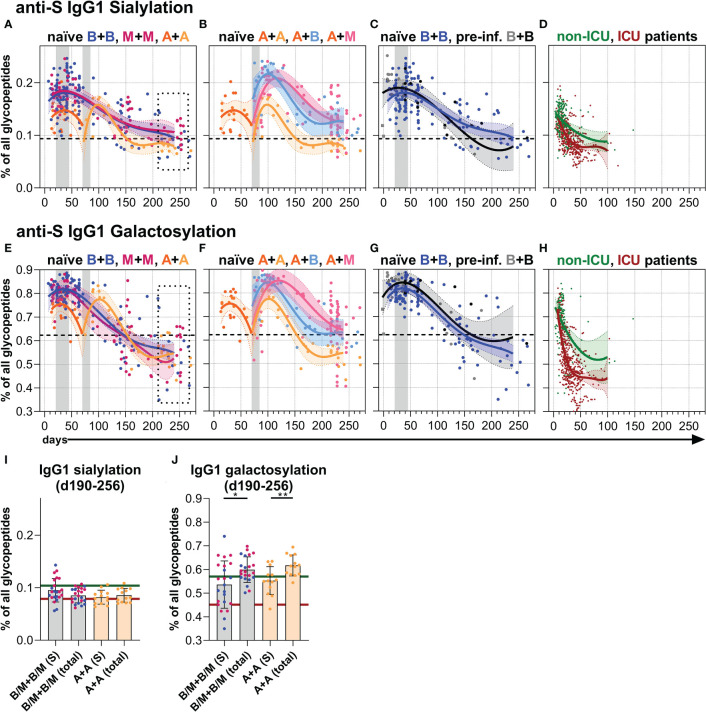
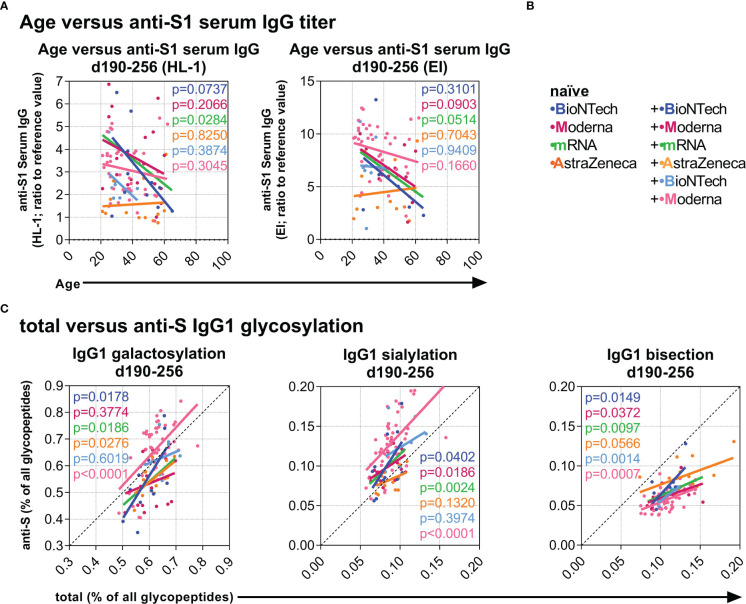
We show that the initially high mRNA vaccine-induced blood and salivary anti-S IgG levels, particularly IgG1, markedly decrease over time and approach the lower levels induced with the adenovirus-based vaccine. All three vaccines induced, contrary to the short-term anti-S IgG1 response with high sialylation and galactosylation levels, a long-term anti-S IgG1 response that was characterized by low sialylation and galactosylation with the latter being even below the corresponding total IgG1 galactosylation level. Instead, the mRNA, but not the adenovirus-based vaccines induced long-term IgG4 responses - the IgG subclass with inhibitory effector functions. Furthermore, salivary anti-S IgA levels were lower and decreased faster in naïve as compared to pre-infected vaccinees. Predictively, age correlated with lower long-term anti-S IgG titers for the mRNA vaccines. Furthermore, higher total IgG1 galactosylation, sialylation, and bisection levels correlated with higher long-term anti-S IgG1 sialylation, galactosylation, and bisection levels, respectively, for all vaccine combinations.
In summary, the study suggests a comparable "adjuvant" potential of the newly developed vaccines on the anti-S IgG Fc glycosylation, as reflected in relatively low long-term anti-S IgG1 galactosylation levels generated by the long-lived plasma cell pool, whose induction might be driven by a recently described T-driven B cell response for all three vaccines. Instead, repeated immunization of naïve individuals with the mRNA vaccines increased the proportion of the IgG4 subclass over time which might influence the long-term Ab effector functions. Taken together, these data shed light on these novel vaccine formats and might have potential implications for their long-term efficacy.
针对 SARS-CoV-2,开发了新型含 mRNA 的脂质纳米颗粒疫苗 BNT162b2 和 mRNA-1273 以及基于腺病毒的疫苗 AZD1222,它们均编码其刺突(S)蛋白。已有多项研究调查了疫苗接种后的短期抗体(Ab)反应。
然而,这些新型疫苗在长期 Ab 反应方面的影响尚不清楚,包括同种型、亚类及其 Fc 糖基化类型,目前研究较少。
在此,我们分析了 SARS-CoV-2 未感染和非住院既往感染受试者在第 0 天和第 21 天接受不同的 mRNA 和基于腺病毒的疫苗组合进行两次接种后,血清和唾液中的抗 S Ab 反应,直至第 270 天。
我们发现,最初由 mRNA 疫苗诱导的高血液和唾液抗 S IgG 水平,特别是 IgG1,随着时间的推移明显下降,接近由基于腺病毒的疫苗诱导的水平。与短期抗 S IgG1 反应的高唾液酸化和半乳糖基化水平相反,所有三种疫苗均诱导了长期抗 S IgG1 反应,其特征为低唾液酸化和半乳糖基化,后者甚至低于相应的总 IgG1 半乳糖基化水平。相反,mRNA 而不是基于腺病毒的疫苗诱导了长期 IgG4 反应 - 具有抑制效应功能的 IgG 亚类。此外,与既往感染的疫苗接种者相比,初免者的唾液抗 S IgA 水平较低且下降更快。可预测的是,年龄与 mRNA 疫苗的长期抗 S IgG 滴度较低相关。此外,较高的总 IgG1 半乳糖基化、唾液酸化和二分裂水平分别与所有疫苗组合的长期抗 S IgG1 半乳糖基化、唾液酸化和二分裂水平升高相关。
综上所述,该研究表明新开发的疫苗在抗 S IgG Fc 糖基化方面具有相当的“佐剂”潜力,这反映在由长期存在的浆细胞池产生的相对较低的长期抗 S IgG1 半乳糖基化水平中,其诱导可能由所有三种疫苗的最近描述的 T 细胞驱动的 B 细胞反应驱动。相反,mRNA 疫苗对初免个体的重复免疫会随着时间的推移增加 IgG4 亚类的比例,这可能会影响长期 Ab 效应功能。总的来说,这些数据揭示了这些新型疫苗的特点,并可能对其长期疗效产生影响。