Healthcare Public Health Team, NHS England and NHS Improvement Midlands, Nottingham, UK
Centre for Academic Primary Care, Unit of Lifespan and Population Health, School of Medicine, University of Nottingham, Nottingham, UK.
Inj Prev. 2023 Jun;29(3):227-233. doi: 10.1136/ip-2022-044745. Epub 2023 Jan 31.
Evaluate the effectiveness of systematically delivered evidence-based home safety promotion for improving child home safety practices.
Controlled before-and-after study.
Nine electoral wards in Nottingham, UK.
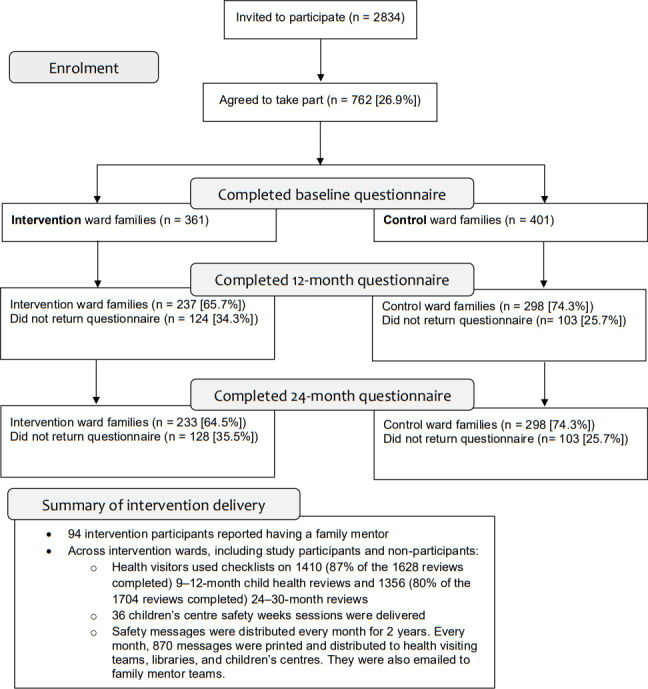
361 families with children aged 2-7 months at recruitment living in four intervention wards with high health, education and social need; and 401 in five matched control wards.
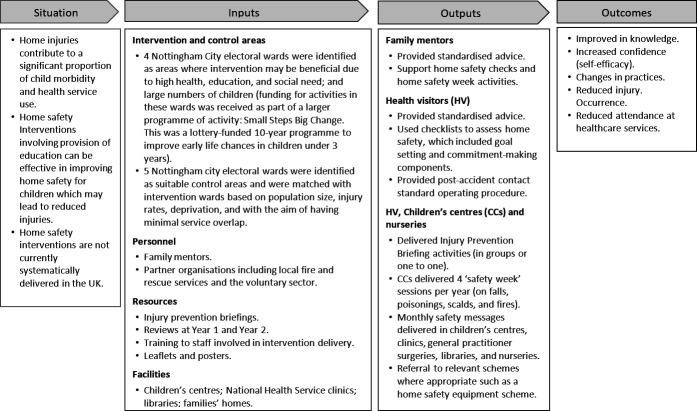
Evidence-based home safety promotion delivered by health visiting teams, family mentors and children's centres including 24 monthly safety messages; home safety activity sessions; quarterly 'safety weeks'; home safety checklists.
Primary: composite measure comprising having a working smoke alarm, storing poisons out of reach and having a stairgate. Secondary: other home safety practices; medically attended injuries. Parents completed questionnaires at 12 and 24 months after recruitment plus optional three monthly injury questionnaires.
At 24 months there was no significant difference between groups in the primary outcome (55.8% vs 48.8%; OR 1.58, 95% CI 0.98 to 2.55) or medically attended injury rates (incidence rate ratio 0.89, 95% CI 0.51 to 1.56), but intervention families were more likely to store poisons safely (OR 1.81, 95% CI 1.06 to 3.07), have a fire escape plan (OR 1.81, 95% CI 1.06 to 3.08), use a fireguard or have no fire (OR 3.17, 95% CI 1.63 to 6.16) and perform more safety practices (β 0.46, 95% CI 0.13 to 0.79).
Systematic evidence-based home safety promotion in areas with substantial need increases adoption of some safety practices. Funders should consider commissioning evidence-based multicomponent child home safety interventions.
ISRCTN31210493.
评估系统提供的循证家庭安全促进措施对改善儿童家庭安全实践的效果。
对照前后研究。
英国诺丁汉的 9 个选区。
招募时年龄为 2-7 个月的 361 个有孩子的家庭,他们居住在 4 个干预选区,这些选区的健康、教育和社会需求较高;401 个家庭居住在 5 个匹配的对照组。
由健康访视小组、家庭导师和儿童中心提供循证家庭安全促进措施,包括每月 24 次安全信息、家庭安全活动课程、每季度“安全周”、家庭安全清单。
主要结果是包括拥有工作烟雾报警器、将毒药存放在儿童够不着的地方和安装楼梯门在内的综合指标。次要结果是其他家庭安全实践和医疗相关伤害。父母在招募后 12 个月和 24 个月完成问卷调查,另外还可选填三个月一次的伤害问卷。
24 个月时,两组在主要结果(55.8%对 48.8%;OR 1.58,95%CI 0.98 至 2.55)或医疗相关伤害率(发病率比 0.89,95%CI 0.51 至 1.56)方面没有显著差异,但干预家庭更有可能安全存放毒药(OR 1.81,95%CI 1.06 至 3.07)、制定火灾逃生计划(OR 1.81,95%CI 1.06 至 3.08)、使用防火门或没有火源(OR 3.17,95%CI 1.63 至 6.16),并采取更多安全措施(β 0.46,95%CI 0.13 至 0.79)。
在需求较大的地区系统地实施循证家庭安全促进措施增加了一些安全措施的采用。资助者应考虑委托循证多组分儿童家庭安全干预措施。
ISRCTN31210493。