School of Population Health, Curtin University, Perth, Australia.
EnAble Institute, Curtin University, Perth, Australia.
Pharmacoeconomics. 2023 Apr;41(4):427-438. doi: 10.1007/s40273-023-01243-0. Epub 2023 Jan 31.
BACKGROUND/AIMS: Discrete choice experiments (DCEs) with either duration included an attribute or with dead included as an option can be used as a stand-alone approach to value health states. This paper reports on a DCE with both of these features to develop an EQ-5D-5L value set for Australia.
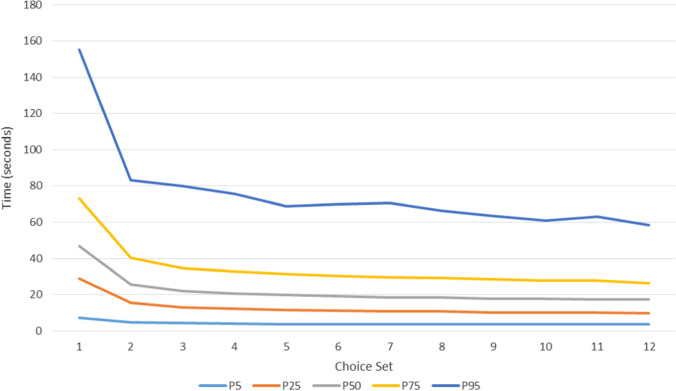
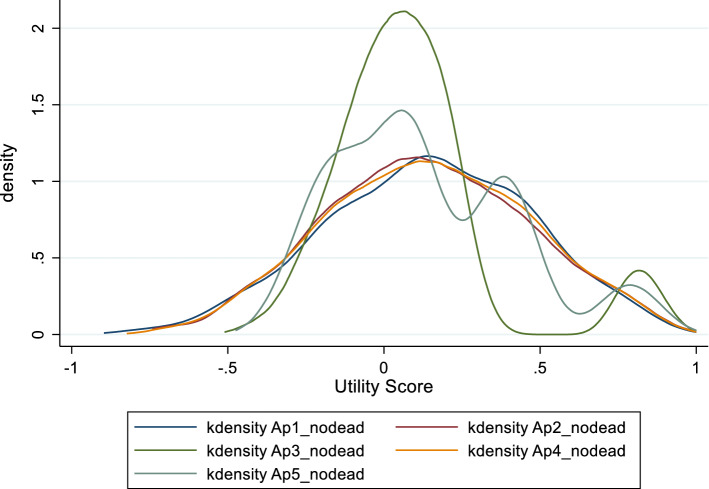
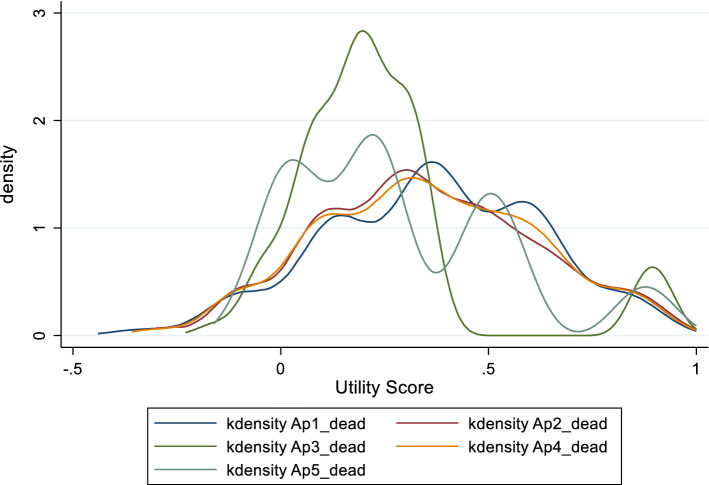
A DCE was undertaken using a large Australian panel of internet respondents, from which a sample of more than 4000 Australian adults was chosen, stratified to be population representative on age and gender. The DCE contained 500 choice triplets, with two EQ-5D-5L health states with duration, and dead as the third option. Each respondent answered 12 choice sets from the 500, stating both the best and worst options from the three available. The design was constructed to estimate a utility algorithm with main effects plus some key interaction terms. A variety of approaches to parameterising interactions, and to anchoring the value set on the required 0-1 scale, were tested. A preferred Australian adult utility algorithm for use in cost-utility analysis was then generated.
In total, 4477 people completed at least one choice set and were included in the analysis. The results reflected the monotonic structure of the EQ-5D-5L, in that moving from no problems to extreme problems led to worsening utility in each dimension. Inclusion of interaction terms demonstrates that the disutility of the first dimension moving to a poor level (defined as either level 5, or level 4 or 5) had a large impact, but subsequent dimensions moving to a poor level had a relatively smaller disutility.
This work develops a value set for the EQ-5D-5L in Australia, and also provides a range of methodological insights which can inform future work using a stand-alone DCE to value health in other countries.
背景/目的:包含持续时间的离散选择实验(DCE)或包含死亡作为选项的 DCE 可以单独用于评估健康状况。本文报告了一项具有这两个特征的 DCE,旨在为澳大利亚开发 EQ-5D-5L 值集。
使用大型澳大利亚互联网受访者小组进行 DCE,从该小组中选择了超过 4000 名澳大利亚成年人的样本,按年龄和性别进行分层以具有代表性。DCE 包含 500 个选择三联体,其中两个 EQ-5D-5L 健康状态具有持续时间,死亡是第三个选项。每个受访者从 500 个中回答了 12 个选择集,从三个可用选项中同时指出了最佳和最差选项。该设计旨在估计具有主效应加一些关键交互项的效用算法。测试了多种参数化交互的方法,并将值集锚定在所需的 0-1 范围内。然后生成了用于成本效用分析的首选澳大利亚成人效用算法。
共有 4477 人完成了至少一个选择集并包含在分析中。结果反映了 EQ-5D-5L 的单调结构,即从没有问题到极端问题导致每个维度的效用恶化。交互项的纳入表明,从第一维度移动到较差水平(定义为第 5 级,或第 4 级或第 5 级)的不舒适程度有很大影响,但随后的维度移动到较差水平的不舒适程度相对较小。
这项工作在澳大利亚开发了 EQ-5D-5L 的价值集,并提供了一系列方法学见解,可为其他国家使用独立的 DCE 评估健康状况的未来工作提供信息。