Lapointe Andrew P, Ware Ashley L, Duszynski Chris C, Stang Antonia, Yeates Keith Owen, Dunn Jeff F
Department of Radiology, Cumming School of Medicine, Experimental Imaging Centre, University of Calgary, Calgary, Alberta, Canada.
Alberta Children's Hospital Research Institute, Calgary, Alberta, Canada.
Neurotrauma Rep. 2023 Jan 24;4(1):64-70. doi: 10.1089/neur.2022.0050. eCollection 2023.
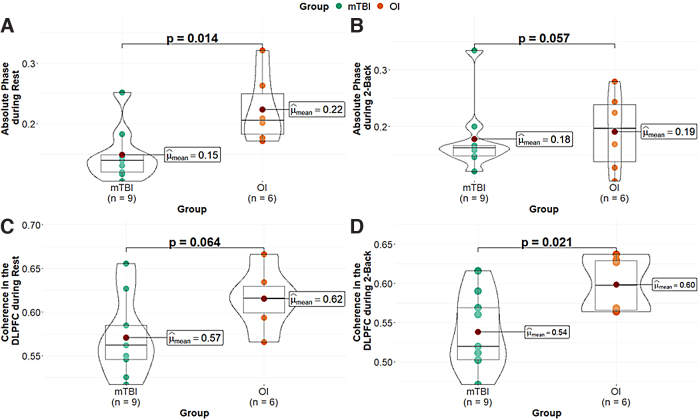
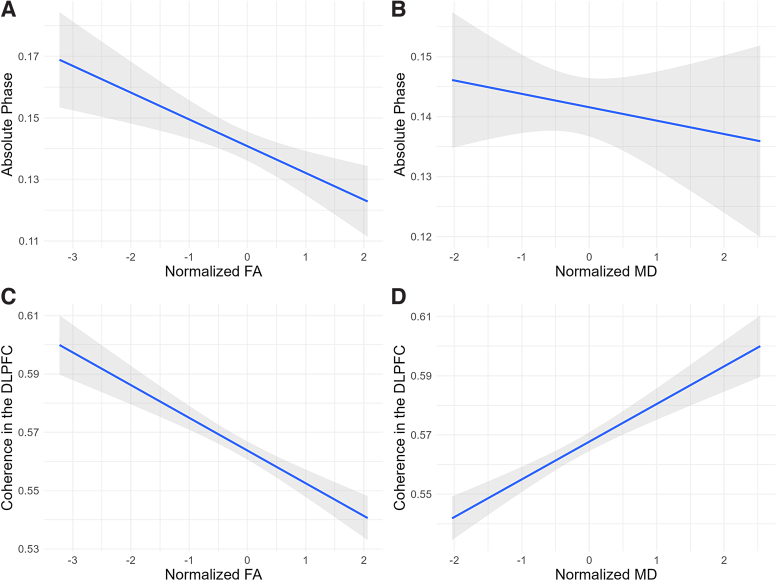
Advanced neuroimaging techniques show promise as a biomarker for mild traumatic brain injury (mTBI). However, little research has evaluated cerebral hemodynamics or its relation to white matter microstructure post-mTBI in children. This novel pilot study examined differences in cerebral hemodynamics, as measured using functional near-infrared spectroscopy (fNIRS), and its association with diffusion tensor imaging (DTI) metrics in children with mTBI or mild orthopedic injury (OI) to address these gaps. Children 8.00-16.99 years of age with mTBI ( = 9) or OI ( = 6) were recruited in a pediatric emergency department, where acute injury characteristics were assessed. Participants completed DTI twice, post-acutely (2-33 days) and chronically (3 or 6 months), and fNIRS ∼1 month post-injury. Automated deterministic tractography was used to compute DTI metrics. There was reduced absolute phase globally and coherence in the dorsolateral pre-frontal cortex (DLPFC) after mTBI compared to the OI group. Coherence in the DLPFC and absolute phase globally showed distinct associations with fractional anisotropy in interhemispheric white matter pathways. Two fNIRS metrics (coherence and absolute phase) differentiated mTBI from OI in children. Variability in cerebral hemodynamics related to white matter microstructure. The results provide initial evidence that fNIRS may have utility as a clinical biomarker of pediatric mTBI.
先进的神经成像技术有望成为轻度创伤性脑损伤(mTBI)的生物标志物。然而,很少有研究评估儿童mTBI后脑血流动力学及其与白质微观结构的关系。这项新颖的初步研究检查了使用功能近红外光谱(fNIRS)测量的脑血流动力学差异,以及它与mTBI或轻度骨科损伤(OI)儿童的扩散张量成像(DTI)指标的关联,以填补这些空白。在儿科急诊科招募了8.00 - 16.99岁患有mTBI(n = 9)或OI(n = 6)的儿童,评估急性损伤特征。参与者在急性损伤后(2 - 33天)和慢性期(3或6个月)完成两次DTI检查,在受伤后约1个月完成fNIRS检查。使用自动确定性纤维束成像来计算DTI指标。与OI组相比,mTBI后全脑绝对相位降低,背外侧前额叶皮质(DLPFC)的相干性降低。DLPFC的相干性和全脑绝对相位与半球间白质通路的分数各向异性有明显关联。两个fNIRS指标(相干性和绝对相位)在儿童中区分了mTBI和OI。脑血流动力学的变异性与白质微观结构有关。结果提供了初步证据,表明fNIRS可能作为儿科mTBI的临床生物标志物有用。