Section of Plastic Surgery, Department of Surgery, University of Michigan Medical School, Ann Arbor.
Michigan Opioid Prescribing Engagement Network, Institute for Health Care Policy and Innovation, University of Michigan Medical School, Ann Arbor.
Ann Surg. 2023 Jun 1;277(6):944-951. doi: 10.1097/SLA.0000000000005802. Epub 2023 Jan 19.
To estimate high-risk prescribing patterns among opioid prescriptions from U.S. surgeons; to characterize the distribution of high-risk prescribing among surgeons.
National data on the prevalence of opioid prescribing and high-risk opioid prescribing by U.S. surgeons are lacking.
Using the IQVIA Prescription Database, which reports dispensing from 92% of U.S. pharmacies, we identified opioid prescriptions from surgeons dispensed in 2019 to patients ages ≥12 years. "High-risk" prescriptions were characterized by: days supplied >7, daily dosage ≥50 oral morphine equivalents (OMEs), opioid-benzodiazepine overlap, and extended-release/long-acting opioid. We determined the proportion of opioid prescriptions, total OMEs, and high-risk prescriptions accounted for by "high-volume surgeons" (those in the ≥95th percentile for prescription counts). We used linear regression to identify characteristics associated with being a high-volume surgeon.
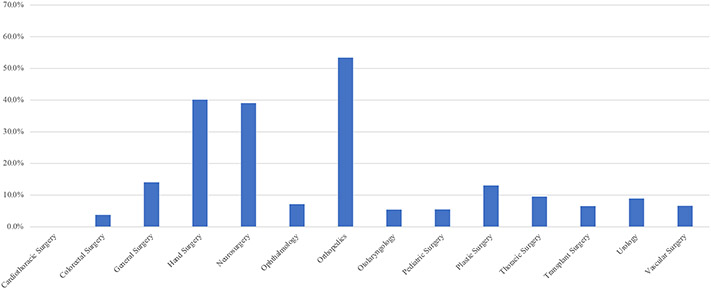
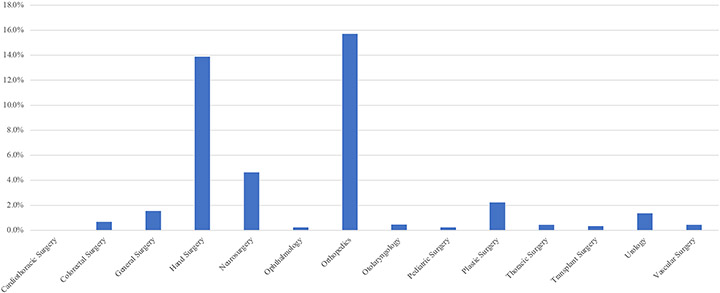
Among 15,493,018 opioid prescriptions included, 7,036,481 (45.4%) were high-risk. Among 114,610 surgeons, 5753 were in the 95th percentile or above for prescription count, with ≥520 prescriptions dispensed in 2019. High-volume surgeons accounted for 33.5% of opioid prescriptions, 52.8% of total OMEs, and 44.2% of high-risk prescriptions. Among high-volume surgeons, 73.9% were orthopedic surgeons and 60.6% practiced in the South. Older age, male sex, specialty, region, and lack of affiliation with academic institutions or health systems were correlated with high-risk prescribing.
The top 5% of surgeons account for 33.5% of opioid prescriptions and 45.4% of high-risk prescriptions. Quality improvement initiatives targeting these surgeons may have the greatest yield given their outsized role in high-risk prescribing.
评估美国外科医生开出的阿片类药物处方中的高危处方模式;描述外科医生中高危处方的分布情况。
美国外科医生开具阿片类药物处方和高危阿片类药物处方的流行率缺乏全国数据。
利用 IQVIA 处方数据库(该数据库报告了美国 92%的药店的配药情况),我们确定了 2019 年向 12 岁及以上患者开出的外科医生开具的阿片类药物处方。“高危”处方的特征为:供应天数>7 天、日剂量≥50 口服吗啡当量(OMEs)、阿片类药物-苯二氮䓬类药物重叠以及缓释/长效阿片类药物。我们确定了“高量医生”(处方数处于前 95%分位数的医生)开出的阿片类药物处方、总 OMEs 和高危处方的比例。我们使用线性回归来确定与成为高量医生相关的特征。
在纳入的 15493018 份阿片类药物处方中,有 7036481 份(45.4%)为高危处方。在 114610 名外科医生中,有 5753 名处方数处于前 95%或以上分位数,2019 年开出的处方数≥520 张。高量医生开出的阿片类药物处方占 33.5%,总 OMEs 占 52.8%,高危处方占 44.2%。在高量医生中,73.9%为骨科医生,60.6%在南部地区行医。年龄较大、男性、专业、地区以及与学术机构或医疗系统没有关联与高危处方相关。
排名前 5%的外科医生开出了 33.5%的阿片类药物处方和 45.4%的高危处方。鉴于这些医生在高危处方中扮演的重要角色,针对这些医生的质量改进举措可能会产生最大的效果。