Graffius Sophie, Garzón Jaime Felipe Guerrero, Zehl Martin, Pjevac Petra, Kirkegaard Rasmus, Flieder Mathias, Loy Alexander, Rattei Thomas, Ostrovsky Andrew, Zotchev Sergey B
Department of Pharmaceutical Sciences, Division of Pharmacognosy, University of Vienna, Vienna, Austria.
Department of Analytical Chemistry, Faculty of Chemistry, University of Vienna, Vienna, Austria.
Microbiol Spectr. 2023 Feb 2;11(2):e0435322. doi: 10.1128/spectrum.04353-22.
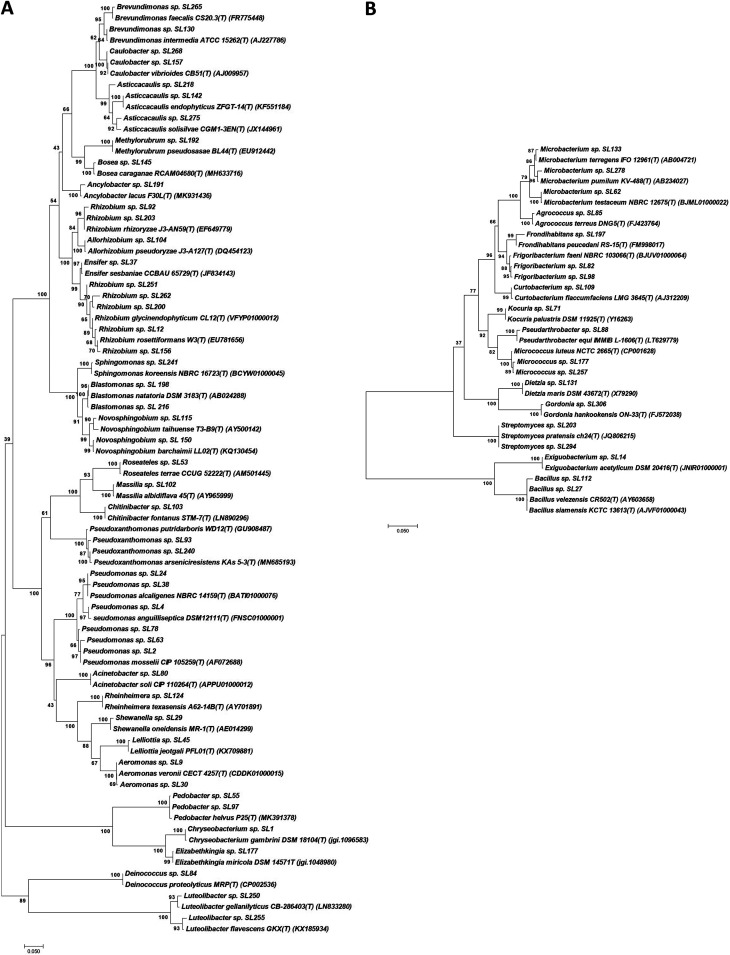
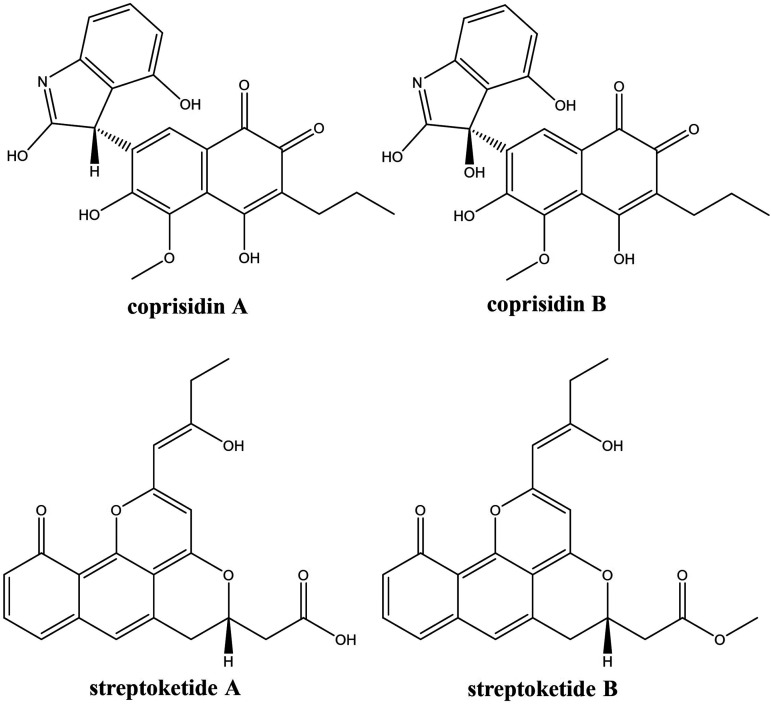
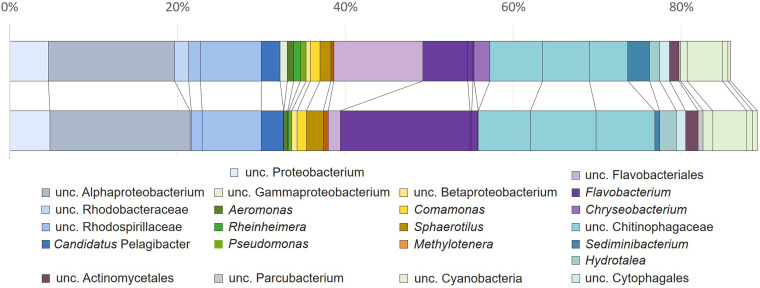
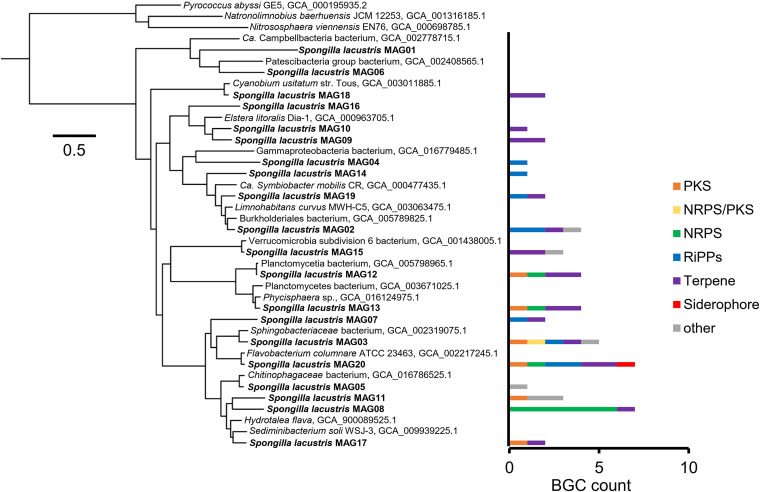
Marine and freshwater sponges harbor diverse communities of bacteria with vast potential to produce secondary metabolites that may play an important role in protecting the host from predators and infections. In this work, we initially used cultivation and metagenomics to investigate the microbial community of the freshwater sponge Spongilla lacustris collected in an Austrian lake. Representatives of 41 bacterial genera were isolated from the sponge sample and classified according to their 16S rRNA gene sequences. The genomes of 33 representative isolates and the 20 recovered metagenome-assembled genomes (MAGs) contained in total 306 secondary metabolite biosynthesis gene clusters (BGCs). Comparative 16S rRNA gene and genome analyses showed very little taxon overlap between the recovered isolates and the sponge community as revealed by cultivation-independent methods. Both culture-independent and -dependent analyses suggested high biosynthetic potential of the S. lacustris microbiome, which was confirmed experimentally even at the subspecies level for two isolates. To our knowledge, this is the most thorough description of the secondary metabolite production potential of a freshwater sponge microbiome to date. A large body of research is dedicated to marine sponges, filter-feeding animals harboring rich bacterial microbiomes believed to play an important role in protecting the host from predators and infections. Freshwater sponges have received so far much less attention with respect to their microbiomes, members of which may produce bioactive secondary metabolites with potential to be developed into drugs to treat a variety of diseases. In this work, we investigated the potential of bacteria associated with the freshwater sponge to biosynthesize diverse secondary metabolites. Using culture-dependent and -independent methods, we discovered over 300 biosynthetic gene clusters in sponge-associated bacteria and proved production of several compounds by selected isolates using genome mining. Our results illustrate the importance of a complex approach when dealing with microbiomes of multicellular organisms that may contain producers of medically important secondary metabolites.
海洋和淡水海绵体中栖息着多样的细菌群落,这些细菌具有产生次生代谢产物的巨大潜力,这些次生代谢产物可能在保护宿主免受捕食者侵害和感染方面发挥重要作用。在这项研究中,我们最初运用培养和宏基因组学方法,对采自奥地利一个湖泊的淡水海绵——湖海绵(Spongilla lacustris)的微生物群落进行了调查。从海绵样本中分离出了41个细菌属的代表菌株,并根据它们的16S rRNA基因序列进行了分类。33个代表性分离株的基因组以及20个宏基因组组装基因组(MAG)总共包含306个次生代谢产物生物合成基因簇(BGC)。16S rRNA基因和基因组的比较分析表明,与通过非培养方法揭示的海绵群落相比,回收的分离株之间的分类群重叠非常少。非培养和培养依赖性分析均表明湖海绵微生物组具有很高的生物合成潜力,这在实验中甚至在两个分离株的亚种水平上也得到了证实。据我们所知,这是迄今为止对淡水海绵微生物组次生代谢产物生产潜力最全面的描述。大量研究致力于海洋海绵,海洋海绵是滤食性动物,拥有丰富的细菌微生物组,据信这些微生物组在保护宿主免受捕食者侵害和感染方面发挥着重要作用。到目前为止,淡水海绵的微生物组受到的关注要少得多,其微生物组成员可能产生具有生物活性的次生代谢产物,这些次生代谢产物有潜力被开发成治疗多种疾病的药物。在这项研究中,我们研究了与淡水海绵相关的细菌生物合成多种次生代谢产物的潜力。我们使用培养依赖性和非依赖性方法,在与海绵相关的细菌中发现了超过三百个生物合成基因簇,并通过基因组挖掘证明了选定分离株产生了几种化合物。我们的结果说明了在处理可能含有医学上重要的次生代谢产物生产者的多细胞生物的微生物组时,采用综合方法的重要性。