Deparment of Medicine, Division of Infectious Diseases and Chronic Viral Illness Service, McGill University Health Centre, Montreal, QC, Canada.
Infectious Diseases and Immunity in Global Health Program, Research Institute of McGill University Health Centre, Montreal, QC, Canada.
AIDS Behav. 2023 Aug;27(8):2669-2680. doi: 10.1007/s10461-023-03991-8. Epub 2023 Feb 4.
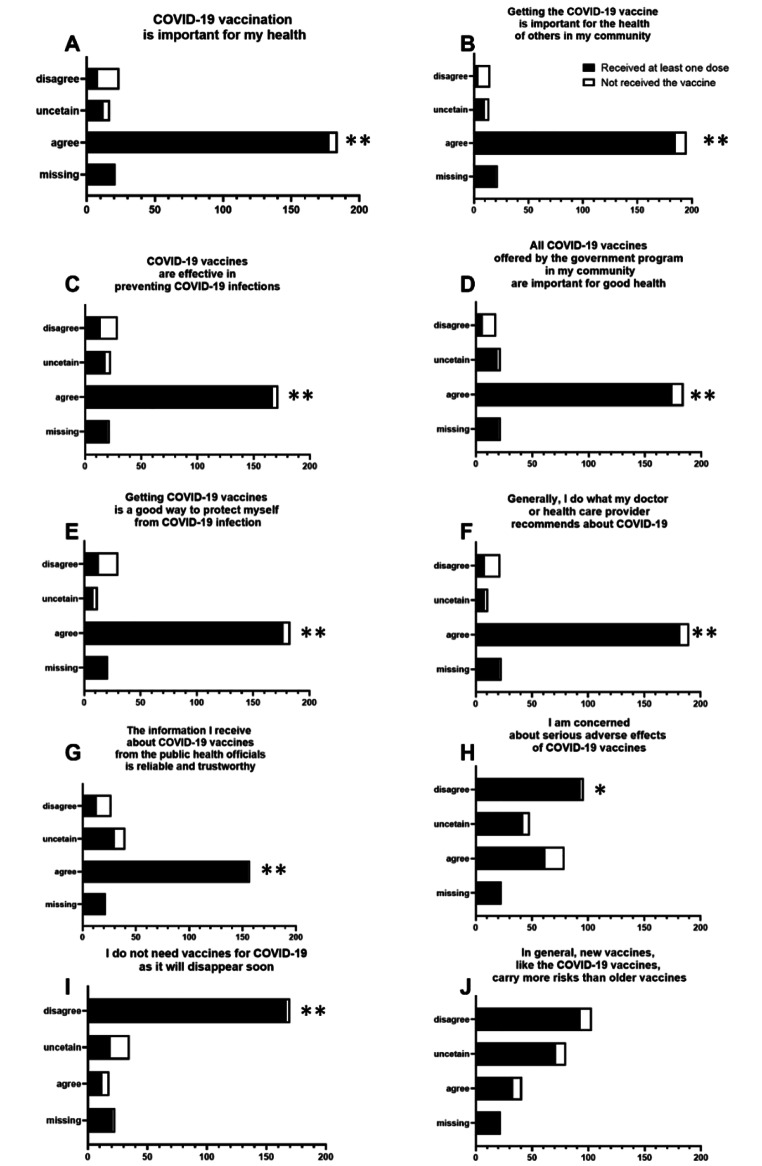
Understanding the roots of Covid-19 vaccine hesitancy in at-risk groups, such as persons living with HIV (PLWH), is of utmost importance. We developed a modified Vaccine Hesitancy Scale (VHS) questionnaire using items from the National Advisory Committee on Immunization Acceptability Matrix. To examine factors associated with receiving COVID-19 vaccine and the link between vaccine attitudes and beliefs with vaccine behavior, PLWH were recruited via social media and community-based organizations (February-May 2022). Descriptive statistics were used to summarize results. Total VHS score was generated by adding Likert scale scores and linear regression models used to compare results between participants who received or did not receive COVID-19 vaccines. Logistic regression models were used to identify factors associated with vaccine uptake. A total of 246 PLWH indicated whether they received a COVID-19 vaccine. 89% received ≥ 1 dose. Mean total VHS(SD) for persons having received ≥ 1 COVID-19 vaccine was 17.8(6.2) vs. 35.4(9.4) for participants not having received any COVID-19 vaccine. Persons who received ≥ 1 dose were significantly older than those who had not received any (48.4 ± 13.8 vs. 34.0 ± 7.7 years, p < 0.0001). The majority of participants considered COVID-19 vaccination important for their health(81.3%) and the health of others(84.4%). Multivariate logistic regression revealed the odds of taking ≥ 1dose were increased 2.4-fold [95% CI 1.6, 3.5] with each increase in age of 10 years (p < 0.0001). Sex and ethnicity were not different between groups. In conclusion, PLWH accept COVID-19 vaccines for both altruistic and individual reasons. With evolving recommendations and increasing numbers of booster vaccines, we must re-examine the needs of PLWH regularly.
了解包括艾滋病毒感染者(PLWH)在内的高危人群对新冠疫苗犹豫不决的根源至关重要。我们使用国家免疫咨询委员会可接受性矩阵中的项目开发了一个改良的疫苗犹豫量表(VHS)问卷。为了研究与接受 COVID-19 疫苗相关的因素以及疫苗态度和信念与疫苗行为之间的联系,我们通过社交媒体和社区组织招募了 PLWH(2022 年 2 月至 5 月)。使用描述性统计来总结结果。通过添加李克特量表得分来生成总 VHS 得分,并使用线性回归模型比较接受或未接受 COVID-19 疫苗的参与者之间的结果。使用逻辑回归模型确定与疫苗接种相关的因素。共有 246 名 PLWH 表示他们是否接种了 COVID-19 疫苗。89%的人接种了≥1 剂。接种了≥1 剂 COVID-19 疫苗的人的平均总 VHS(SD)为 17.8(6.2),而未接种任何 COVID-19 疫苗的参与者的平均总 VHS(SD)为 35.4(9.4)。接种了≥1 剂的人明显比未接种任何疫苗的人年龄更大(48.4±13.8 岁 vs. 34.0±7.7 岁,p<0.0001)。大多数参与者认为 COVID-19 疫苗接种对自己的健康(81.3%)和他人的健康(84.4%)很重要。多变量逻辑回归显示,每增加 10 岁,接种≥1 剂的几率增加 2.4 倍[95%CI 1.6, 3.5](p<0.0001)。组间的性别和种族没有差异。总之,PLWH 出于利他和个人原因接受 COVID-19 疫苗。随着推荐意见的不断发展和加强针疫苗数量的增加,我们必须定期重新评估 PLWH 的需求。