PhD Program in Health Policy, Harvard Graduate School of Arts & Sciences, Cambridge, MA, USA; Lurie Institute for Disability Policy, Brandeis University, Waltham, MA, USA.
Department of Health Care Policy, Harvard Medical School, Harvard University, Boston, MA, USA; National Bureau of Economic Research, Cambridge, MA, USA.
Disabil Health J. 2023 Apr;16(2):101429. doi: 10.1016/j.dhjo.2022.101429. Epub 2022 Dec 14.
While the COVID-19 public health emergency has had disastrous health impacts for people with disabilities, it remains unclear what impact the associated economic recession and subsequent recovery have had on disability employment.
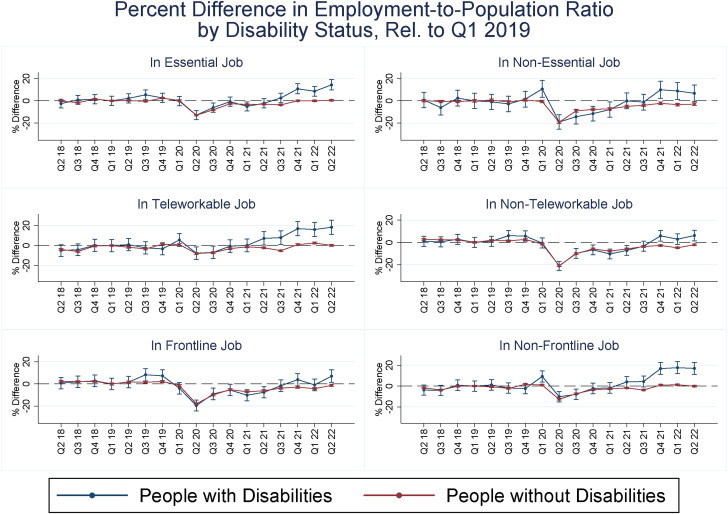
We evaluated employment trends for people with and without disabilities over the course of the COVID-19 recession and subsequent economic recovery, both overall and by occupational category (essential, non-essential, teleworkable, non-teleworkable, frontline, non-frontline).
We made use of data from the nationally representative Current Population Survey. Linear probability models were used to estimate percent changes in employment-to-population ratios and identify differences between disabled and non-disabled employment in each quarter broadly and within specific occupational categories.
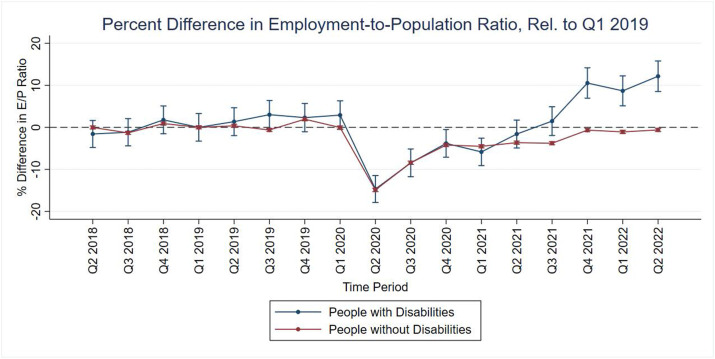
As the COVID-19 recession began in Q2 2020, people with disabilities experienced employment losses that were proportionately similar to those experienced by people without disabilities. However, during the subsequent economic recovery, the employment rate of people with disabilities grew more quickly in Q4 2021 through Q2 2022, driven by increased labor force participation. These employment gains have been concentrated in teleworkable, essential, and non-frontline occupations.
Our findings suggest that people with disabilities are disproportionately benefiting from the rapid recovery from the initial economic contraction at the start of the pandemic.
虽然 COVID-19 公共卫生紧急事件对残疾人士的健康造成了灾难性的影响,但仍不清楚相关的经济衰退及其后续复苏对残疾人士的就业产生了什么影响。
我们评估了 COVID-19 衰退期间和随后的经济复苏过程中,残疾人和非残疾人的总体就业趋势和职业类别(必要、非必要、可远程工作、不可远程工作、一线、非一线)的就业趋势。
我们利用了全国代表性的当前人口调查数据。线性概率模型用于估计就业与人口比率的百分比变化,并在每个季度以及特定职业类别中确定残疾人和非残疾人就业之间的差异。
随着 COVID-19 衰退在 2020 年第二季度开始,残疾人士经历了与非残疾人士相似比例的就业损失。然而,在随后的经济复苏中,残疾人士的就业率在 2021 年第四季度至 2022 年第二季度增长更快,这得益于劳动力参与率的提高。这些就业增长集中在可远程工作、必要和非一线职业。
我们的发现表明,在疫情初期经济收缩的快速复苏中,残疾人士不成比例地受益。