J Phys Chem B. 2023 Feb 16;127(6):1301-1311. doi: 10.1021/acs.jpcb.2c06475. Epub 2023 Feb 5.
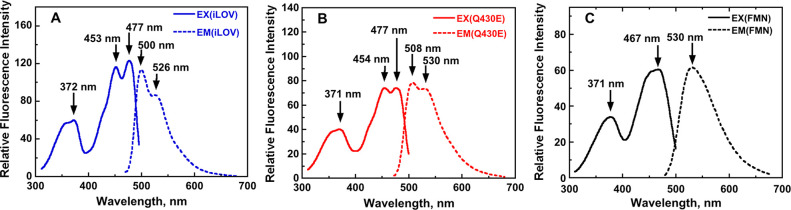
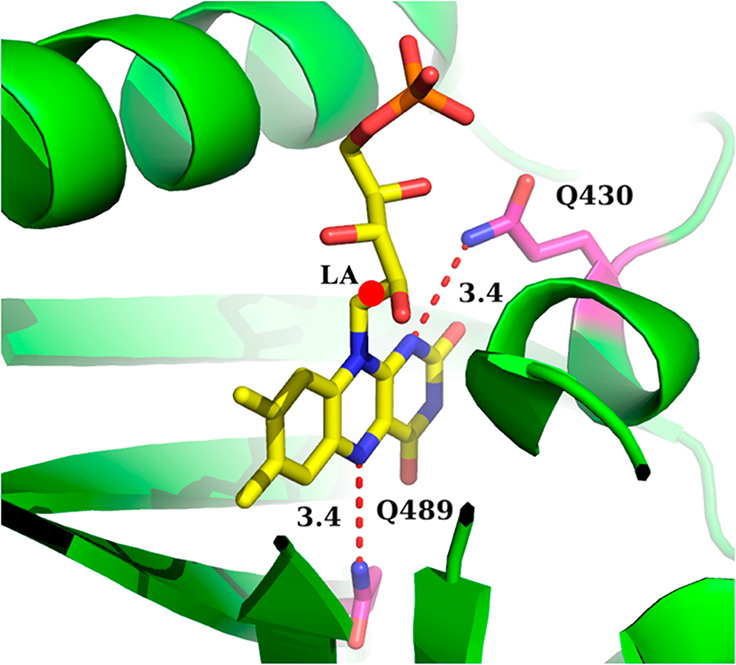
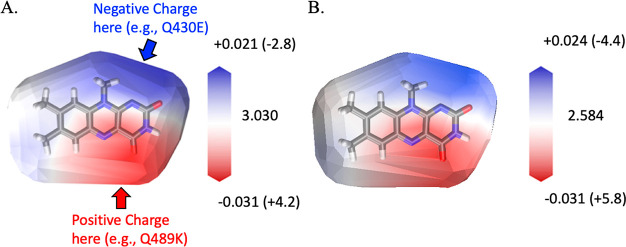
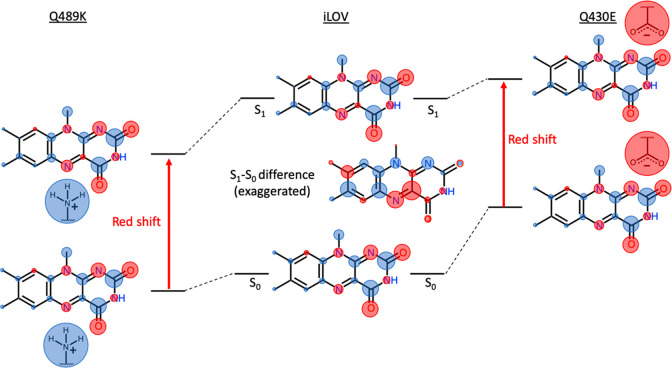
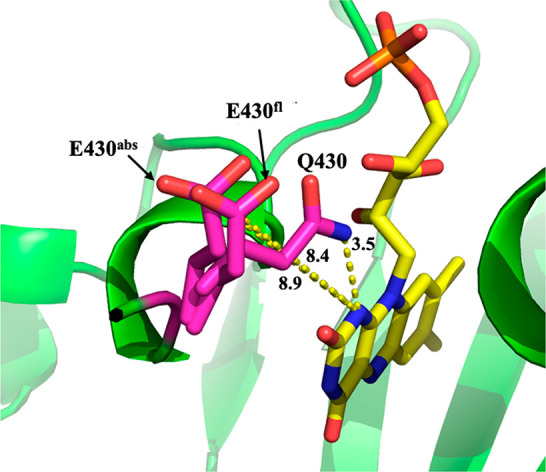
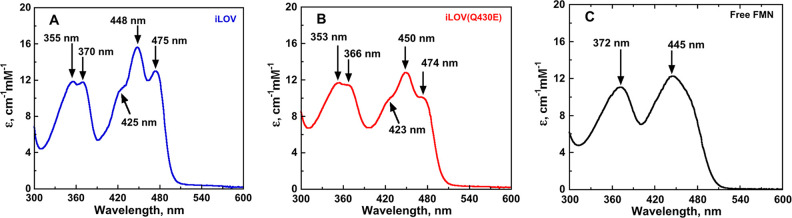
iLOV is an engineered flavin-binding fluorescent protein (FbFP) with applications for cellular imaging. To expand the range of applications of FbFPs for multicolor imaging and FRET-based biosensing, it is desirable to understand how to modify their absorption and emission wavelengths (i.e., through spectral tuning). There is particular interest in developing FbFPs that absorb and emit light at longer wavelengths, which has proven challenging thus far. Existing spectral tuning strategies that do not involve chemical modification of the flavin cofactor have focused on placing positively charged amino acids near flavin's C4a and N5 atoms. Guided by previously reported electrostatic spectral tunning maps (ESTMs) of the flavin cofactor and by quantum mechanical/molecular mechanical (QM/MM) calculations reported in this work, we suggest an alternative strategy: placing a negatively charged amino acid near flavin's N1 atom. We predict that a single-point mutant, iLOV-Q430E, has a slightly red-shifted absorption and fluorescence maximum wavelength relative to iLOV. To validate our theoretical prediction, we experimentally expressed and purified iLOV-Q430E and measured its spectral properties. We found that the Q430E mutation results in a slight change in absorption and a 4-8 nm red shift in the fluorescence relative to iLOV, in good agreement with the computational predictions. Molecular dynamics simulations showed that the carboxylate side chain of the glutamate in iLOV-Q430E points away from the flavin cofactor, which leads to a future expectation that further red shifting may be achieved by bringing the side chain closer to the cofactor.
iLOV 是一种经过工程改造的黄素结合荧光蛋白 (FbFP),可用于细胞成像。为了扩展 FbFP 在多色成像和基于 FRET 的生物传感中的应用范围,理想情况下需要了解如何修饰它们的吸收和发射波长(即通过光谱调谐)。人们特别感兴趣开发能吸收和发射更长波长光的 FbFPs,迄今为止这一直具有挑战性。迄今不涉及黄素辅因子化学修饰的现有光谱调谐策略集中在将带正电荷的氨基酸放置在黄素的 C4a 和 N5 原子附近。受先前报道的黄素辅因子静电光谱调谐图 (ESTM) 和本工作中报告的量子力学/分子力学 (QM/MM) 计算的指导,我们提出了一种替代策略:将带负电荷的氨基酸放置在黄素的 N1 原子附近。我们预测单点突变体 iLOV-Q430E 相对于 iLOV 具有略微红移的吸收和荧光最大波长。为了验证我们的理论预测,我们实验表达和纯化了 iLOV-Q430E 并测量了其光谱特性。我们发现 Q430E 突变导致吸收略有变化,荧光相对于 iLOV 红移 4-8nm,与计算预测非常吻合。分子动力学模拟表明 iLOV-Q430E 中谷氨酸的羧酸盐侧链指向远离黄素辅因子的方向,这使得未来有望通过使侧链更接近辅因子来实现进一步的红移。