Albrecht Simon L, Furlong Sarah, Leiter Michael P
School of Psychology, Deakin University, Geelong, VIC, Australia.
Positive Psychology Centers, Melbourne, VIC, Australia.
Front Psychol. 2023 Jan 20;14:1071924. doi: 10.3389/fpsyg.2023.1071924. eCollection 2023.
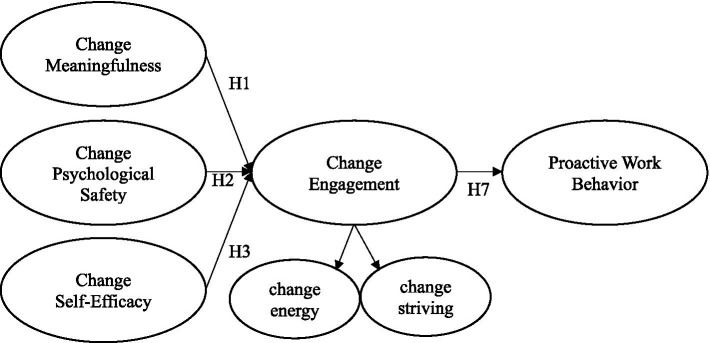
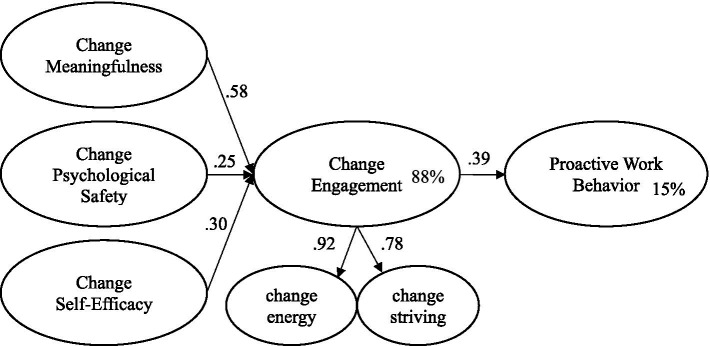
In the contemporary world of work, organizational change is a constant. For change to be successful, employees need to be positive about implementing organizational change. Change engagement reflects the extent to which employees are enthusiastic about change, and willing to actively involve themselves in promoting and supporting ongoing organizational change. Drawing from Kahn's engagement theory, the research aimed to assess the influence of change-related meaningful work, psychological safety, and self-efficacy as psychological preconditions for change engagement. The study also aimed to test the indirect associations of the change-related psychological preconditions with proactive work behavior through change engagement. Survey data from a Prolific sample ( = 297) were analyzed using confirmatory factor analysis and structural equations modeling. In support of the validity of the model, the results showed that change-related self-efficacy, psychological safety, and meaningfulness had significant direct effects on change engagement, explaining 88% of the variance. The change-related psychological conditions also had significant indirect effects on proactive work behavior through change engagement. The findings therefore suggest that employees who exhibit higher levels of change-related self-efficacy, psychological safety, and work meaningfulness are more likely to support and promote organizational change, and to proactively engage in innovative work behavior. In practical terms, organizations that create the psychological conditions for change could significantly improve employee motivation to change and to innovate, which in turn would increase the likelihood of successful organizational change, and improved organizational competitiveness. Study limitations and directions for future research are discussed.
在当代职场中,组织变革是常态。为使变革成功,员工需要对实施组织变革持积极态度。变革参与度反映了员工对变革的热情程度,以及他们愿意积极投身于推动和支持组织持续变革的程度。本研究借鉴卡恩的参与理论,旨在评估与变革相关的有意义工作、心理安全感和自我效能感作为变革参与度的心理前提条件所产生的影响。该研究还旨在通过变革参与度来检验与变革相关的心理前提条件与积极工作行为之间的间接关联。使用验证性因素分析和结构方程模型对来自Prolific样本(n = 297)的调查数据进行了分析。为支持该模型的有效性,结果表明与变革相关的自我效能感、心理安全感和意义对变革参与度有显著的直接影响,解释了88%的方差变异。与变革相关的心理条件通过变革参与度对积极工作行为也有显著的间接影响。因此,研究结果表明,表现出较高水平的与变革相关的自我效能感、心理安全感和工作意义的员工更有可能支持和推动组织变革,并积极参与创新工作行为。实际上,为变革创造心理条件的组织可以显著提高员工的变革和创新动力,这反过来又会增加组织变革成功的可能性,并提升组织竞争力。文中还讨论了研究的局限性以及未来研究的方向。