Department of Education Studies, University of Bologna, Bologna, Italy.
Research Unit Occupational & Organizational Psychology and Professional Learning, KU Leuven, Belgium.
PLoS One. 2022 Jun 29;17(6):e0269433. doi: 10.1371/journal.pone.0269433. eCollection 2022.
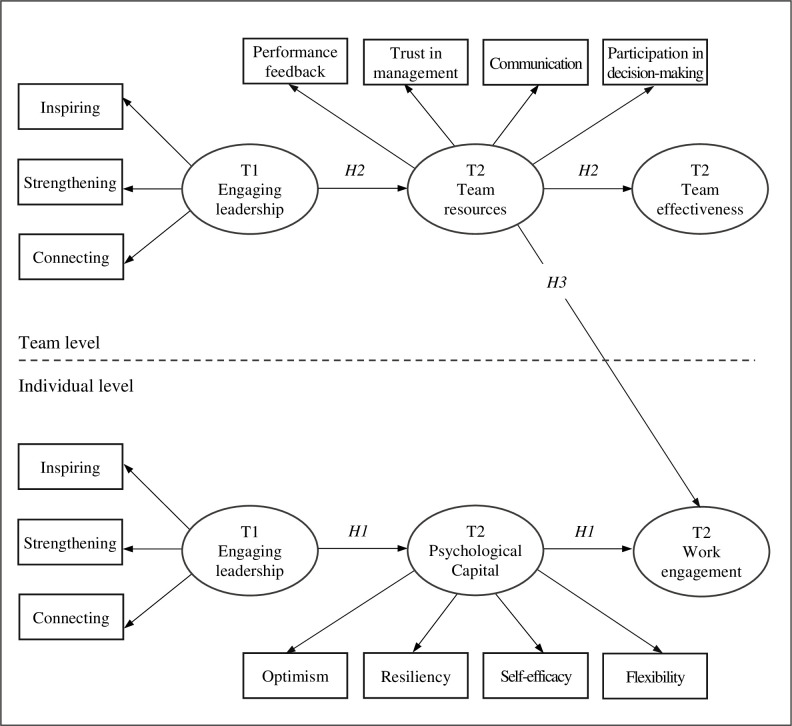
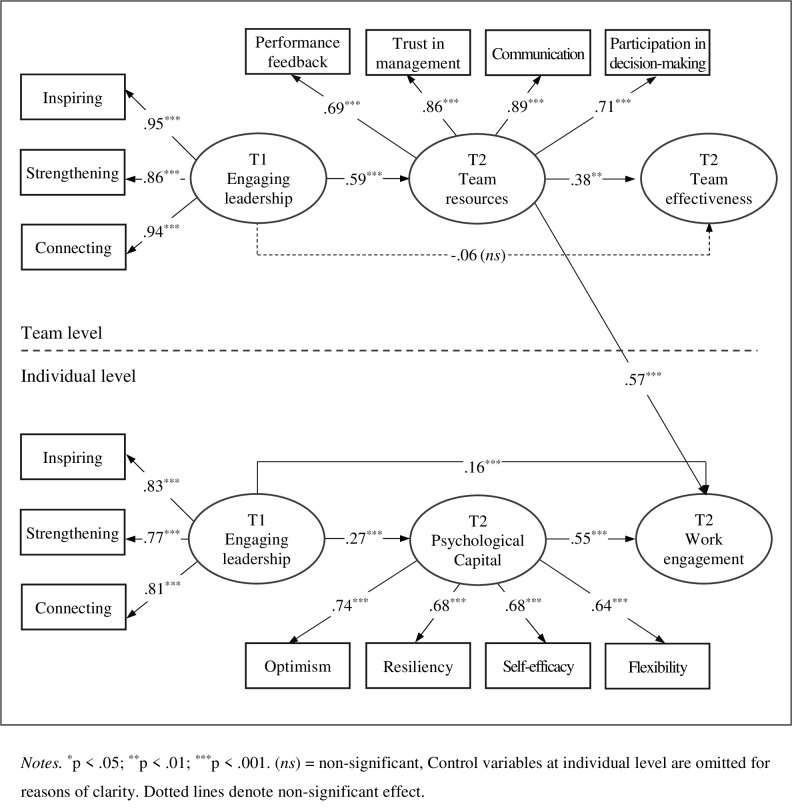
Most research on the effect of leadership behavior on employees' well-being and organizational outcomes is based on leadership frameworks that are not rooted in sound psychological theories of motivation and are limited to either an individual or organizational levels of analysis. The current paper investigates whether individual and team resources explain the impact of engaging leadership on work engagement and team effectiveness, respectively. Data were collected at two time points on N = 1,048 employees nested within 90 work teams. The Multilevel Structural Equation Modeling results revealed that personal resources (i.e., optimism, resiliency, self-efficacy, and flexibility) partially mediated the impact of T1 individual perceptions of engaging leadership on T2 work engagement. Furthermore, joint perceptions of engaging leadership among team members at T1 resulted in greater team effectiveness at T2. This association was fully mediated by team resources (i.e., performance feedback, trust in management, communication, and participation in decision-making). Moreover, team resources had a significant cross-level effect on individual levels of engagement. In practical terms, training and supporting leaders who inspire, strengthen, and connect their subordinates could significantly improve employees' motivation and involvement and enable teams to pursue their common goals successfully.
大多数关于领导行为对员工福祉和组织成果影响的研究都是基于那些没有扎根于可靠动机心理理论的领导框架,并且仅限于个体或组织层面的分析。本文研究了个人和团队资源是否分别解释了参与式领导对工作投入和团队有效性的影响。数据是在两个时间点上从 N=1048 名嵌套在 90 个工作团队中的员工中收集的。多层次结构方程模型的结果表明,个人资源(即乐观、适应力、自我效能和灵活性)部分中介了 T1 个体对参与式领导的感知对 T2 工作投入的影响。此外,T1 时团队成员对参与式领导的共同感知导致 T2 时团队更有效。这种关联完全由团队资源(即绩效反馈、对管理层的信任、沟通和参与决策)介导。此外,团队资源对个体参与水平有显著的跨层次影响。从实际意义上讲,培训和支持那些激励、加强和联系下属的领导者,可以显著提高员工的积极性和参与度,并使团队能够成功地追求共同目标。