Vu Minh Huy, Hyun Tae Kyung, Bahk Sungwha, Jo Yeonhwa, Kumar Ritesh, Thiruppathi Dhineshkumar, Iswanto Arya Bagus Boedi, Chung Woo Sik, Shelake Rahul Mahadev, Kim Jae-Yean
Division of Applied Life Science (BK21 Four Program), Plant Molecular Biology and Biotechnology Research Center, Gyeongsang National University, Jinju, Republic of Korea.
Department of Industrial Plant Science and Technology, College of Agricultural, Life and Environmental Sciences, Chungbuk National University, Cheongju, Republic of Korea.
Front Plant Sci. 2023 Jan 19;13:1107224. doi: 10.3389/fpls.2022.1107224. eCollection 2022.
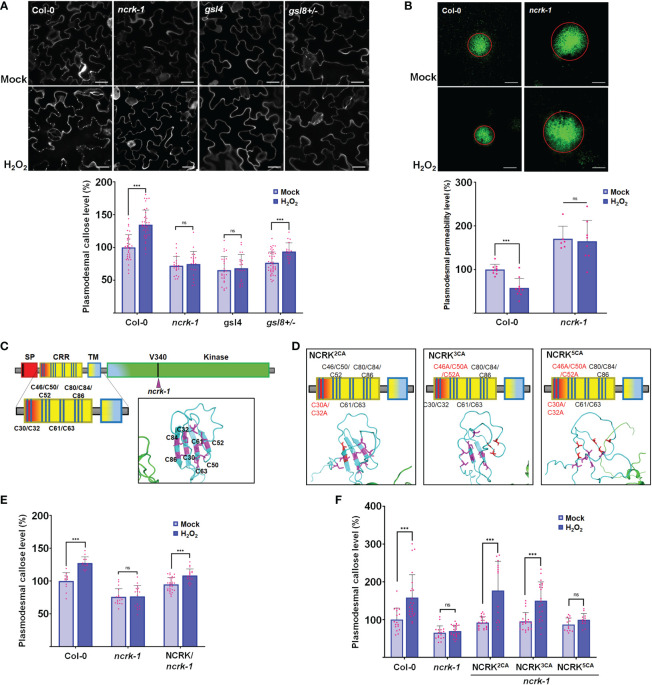
Plasmodesmata (PD) play a critical role in symplasmic communication, coordinating plant activities related to growth & development, and environmental stress responses. Most developmental and environmental stress signals induce reactive oxygen species (ROS)-mediated signaling in the apoplast that causes PD closure by callose deposition. Although the apoplastic ROS signals are primarily perceived at the plasma membrane (PM) by receptor-like kinases (RLKs), such components involved in PD regulation are not yet known. Here, we show that an Arabidopsis NOVEL CYS-RICH RECEPTOR KINASE (NCRK), a PD-localized protein, is required for plasmodesmal callose deposition in response to ROS stress. We identified the involvement of NCRK in callose accumulation at PD channels in either basal level or ROS-dependent manner. Loss-of-function mutant () of NCRK induces impaired callose accumulation at the PD under the ROS stress resembling a phenotype of the PD-regulating () knock-out plant. The overexpression of transgenic NCRK can complement the callose and the PD permeability phenotypes of mutants but not kinase-inactive NCRK variants or Cys-mutant NCRK, in which Cys residues were mutated in Cys-rich repeat ectodomain. Interestingly, NCRK mediates plasmodesmal permeability in mechanical injury-mediated signaling pathways regulated by GSL4. Furthermore, we show that NCRK interacts with calmodulin-like protein 41 (CML41) and GSL4 in response to ROS stress. Altogether, our data indicate that NCRK functions as an upstream regulator of PD callose accumulation in response to ROS-mediated stress signaling pathways.
胞间连丝(PD)在共质体通讯中起着关键作用,协调与植物生长发育以及环境胁迫响应相关的活动。大多数发育和环境胁迫信号会诱导质外体中活性氧(ROS)介导的信号传导,通过胼胝质沉积导致PD关闭。尽管质外体ROS信号主要由类受体激酶(RLK)在质膜(PM)上感知,但参与PD调节的此类组分尚不清楚。在这里,我们表明拟南芥新型富含半胱氨酸的受体激酶(NCRK)是一种定位于PD的蛋白质,是ROS胁迫下胞间连丝胼胝质沉积所必需的。我们确定NCRK以基础水平或ROS依赖的方式参与了PD通道处的胼胝质积累。NCRK功能缺失突变体()在ROS胁迫下诱导PD处胼胝质积累受损,类似于PD调节因子()敲除植物的表型。转基因NCRK的过表达可以补充突变体的胼胝质和PD通透性表型,但激酶失活的NCRK变体或半胱氨酸突变的NCRK则不能,其中半胱氨酸残基在富含半胱氨酸的重复胞外域中发生了突变。有趣的是,NCRK在由GSL4调节的机械损伤介导的信号通路中介导胞间连丝通透性。此外,我们表明NCRK在响应ROS胁迫时与类钙调蛋白41(CML41)和GSL4相互作用。总之我们的数据表明,NCRK作为PD胼胝质积累的上游调节因子,响应ROS介导的胁迫信号通路。