Cell and Developmental Biology, John Innes Centre, Norwich NR4 7UH, United Kingdom.
Proc Natl Acad Sci U S A. 2023 Apr 25;120(17):e2216397120. doi: 10.1073/pnas.2216397120. Epub 2023 Apr 17.
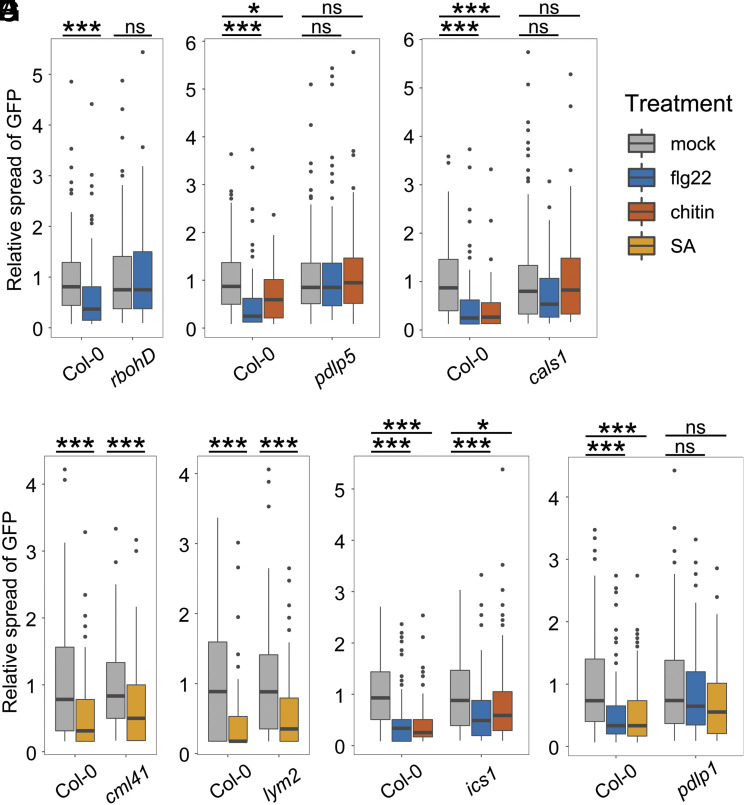
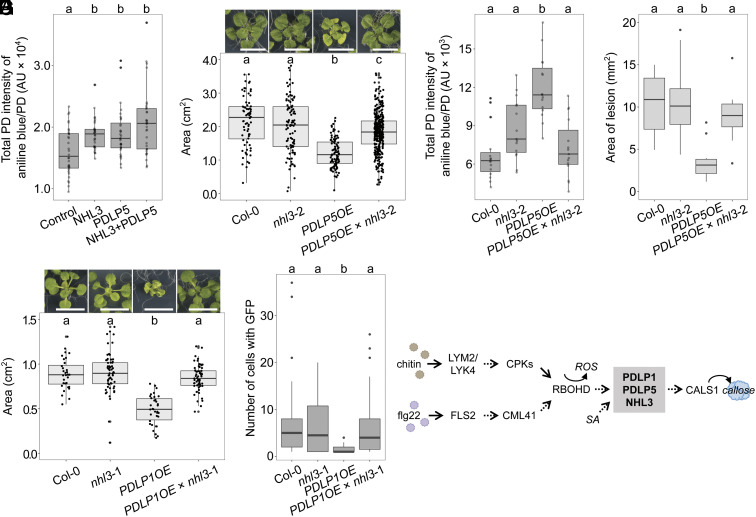
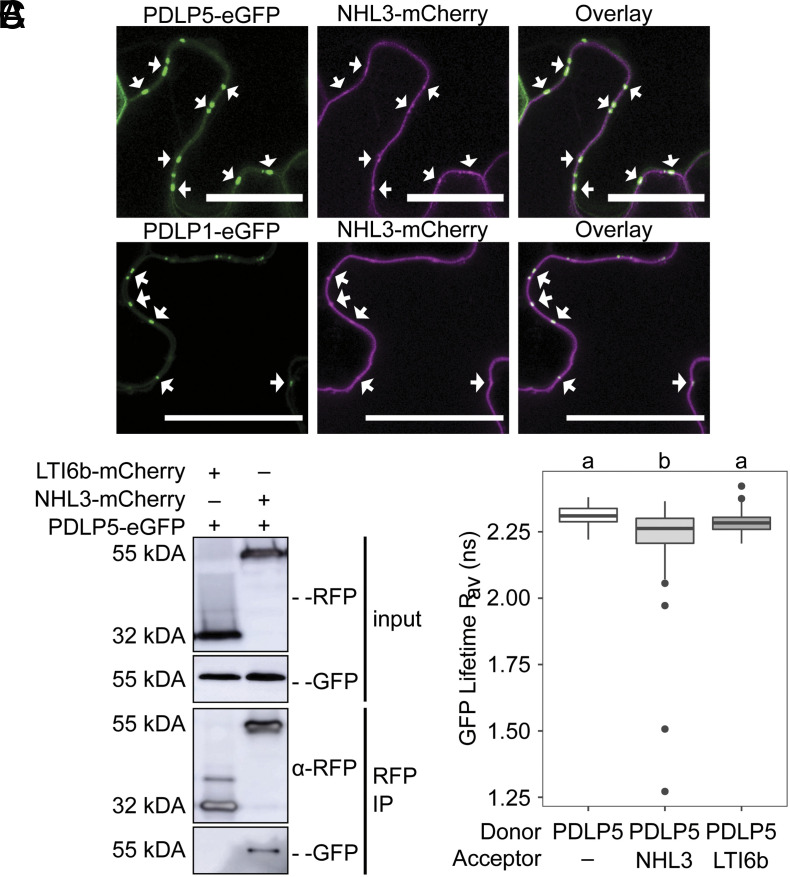
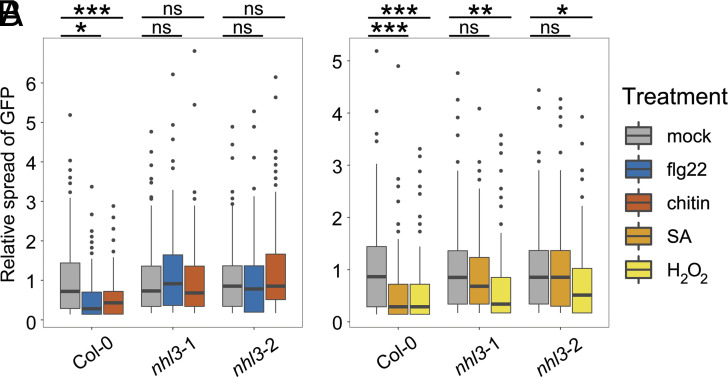
The plant immune system relies on the perception of molecules that signal the presence of a microbe threat. This triggers signal transduction that mediates a range of cellular responses via a collection of molecular machinery including receptors, small molecules, and enzymes. One response to pathogen perception is the restriction of cell-to-cell communication by plasmodesmal closure. We previously found that while chitin and flg22 trigger specialized immune signaling cascades in the plasmodesmal plasma membrane, both execute plasmodesmal closure via callose synthesis at the plasmodesmata. Therefore, the signaling pathways ultimately converge at or upstream of callose synthesis. To establish the hierarchy of signaling at plasmodesmata and characterize points of convergence in microbe elicitor-triggered signaling, we profiled the dependence of plasmodesmal responses triggered by different elicitors on a range of plasmodesmal signaling machinery. We identified that, like chitin, flg22 signals via RESPIRATORY BURST OXIDASE HOMOLOGUE D (RBOHD) to induce plasmodesmal closure. Further, we found that PLASMODESMATA-LOCATED PROTEIN 1 (PDLP1), PDLP5, and CALLOSE SYNTHASE 1 (CALS1) are common to microbe- and salicylic acid (SA)-triggered responses, identifying PDLPs as a candidate signaling nexus. To understand how PDLPs relay a signal to CALS1, we screened for PDLP5 interactors and found NON-RACE SPECIFIC DISEASE RESISTANCE/HIN1 HAIRPIN-INDUCED-LIKE protein 3 (NHL3), which is also required for chitin-, flg22- and SA-triggered plasmodesmal responses and PDLP-mediated activation of callose synthesis. We conclude that a PDLP-NHL3 complex acts as an integrating node of plasmodesmal signaling cascades, transmitting multiple immune signals to activate CALS1 and plasmodesmata closure.
植物免疫系统依赖于感知信号分子的能力,这些信号分子可以指示微生物威胁的存在。这会触发信号转导,通过一系列分子机制(包括受体、小分子和酶)来介导多种细胞反应。对病原体感知的一种反应是通过质膜泡的闭合来限制细胞间的通讯。我们之前发现,虽然几丁质和 flg22 在质膜泡的质膜中触发专门的免疫信号级联反应,但两者都通过质膜泡处的胼胝质合成来执行质膜泡的闭合。因此,信号通路最终在胼胝质合成处或其上游汇聚。为了确定质膜泡信号转导的层次结构,并表征微生物激发信号转导中的汇聚点,我们对不同激发子触发的质膜泡反应对一系列质膜泡信号机制的依赖性进行了分析。我们发现,与几丁质一样,flg22 通过呼吸爆发氧化酶同源物 D (RBOHD) 信号转导来诱导质膜泡的闭合。此外,我们发现质膜泡定位蛋白 1 (PDLP1)、PDLP5 和胼胝质合成酶 1 (CALS1) 是微生物和水杨酸 (SA) 触发反应所共有的,这表明 PDLPs 是一个候选信号枢纽。为了了解 PDLPs 如何将信号传递给 CALS1,我们筛选了 PDLP5 的相互作用蛋白,并发现非特异性疾病抗性/HIN1 发夹诱导样蛋白 3 (NHL3),它也是几丁质、flg22 和 SA 触发的质膜泡反应以及 PDLP 介导的胼胝质合成激活所必需的。我们的结论是,PDLP-NHL3 复合物作为质膜泡信号级联的整合节点,将多种免疫信号传递到激活 CALS1 和质膜泡闭合。