Zhao Depeng, Xie Rui, Li Xuemei
Department of Reproductive Medicine, Affiliated Shenzhen Maternity and Child Healthcare Hospital, Southern Medical University, Shenzhen, China.
Front Med (Lausanne). 2023 Jan 19;10:1071014. doi: 10.3389/fmed.2023.1071014. eCollection 2023.
To compare the pregnancy outcome after fresh embryo transfer between GnRH antagonist and GnRH agonist regimens in patients with thin endometrium.
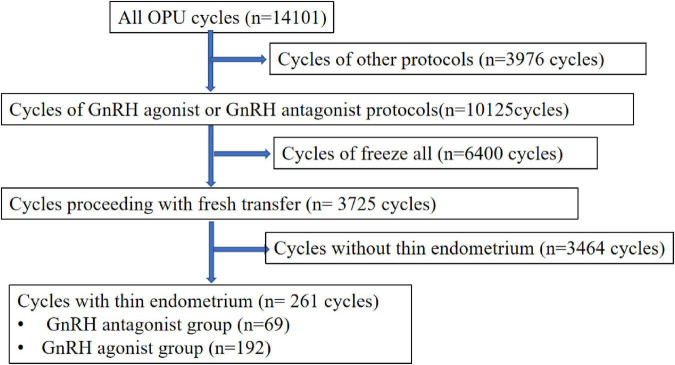
This retrospective study included all fresh embryo transfers following GnRH agonist or GnRH antagonist protocols in patients with thin endometrium from 2016 to 2021. The thin endometrium was defined as an endometrial thickness of 7.5 mm or less on the triggering day. Multivariant regression analysis was applied to assess the association of GnRH agonist or GnRH antagonist regimen with live birth following fresh embryo transfer in patients with thin endometrium.
A total of 69 and 192 cases were, respectively, included in the GnRH antagonist or GnRH agonist group. The stimulation duration was significantly longer by the GnRH agonist protocol than the GnRH antagonist protocol (11.2 ± 2.1 vs. 9.1 ± 1.9 days, = 0.002). The rates of clinical pregnancy or live birth were significantly lower in the GnRH antagonist group compared to the GnRH agonist group (26.1 vs. 47.9%, = 0.027; 17.4 vs. 40.1%, = 0.01, respectively). Multivariable regression analysis demonstrated that GnRH agonist regimen was related to higher live birth rate compared with GnRH agonist protocol [adjusted OR: 2.6, 95% confidence intervals (CI): 1.3-5.3]. No significant difference in miscarriage rate and the neonatal outcome was present between the two protocols.
Our findings suggest that GnRH agonist protocol results in a higher rate of live birth after fresh embryo transfer than GnRH antagonist protocol in patients with thin endometrium.
比较GnRH拮抗剂方案与GnRH激动剂方案在薄型子宫内膜患者新鲜胚胎移植后的妊娠结局。
这项回顾性研究纳入了2016年至2021年采用GnRH激动剂或GnRH拮抗剂方案进行新鲜胚胎移植的薄型子宫内膜患者。薄型子宫内膜定义为扳机日时子宫内膜厚度≤7.5mm。采用多变量回归分析评估GnRH激动剂或GnRH拮抗剂方案与薄型子宫内膜患者新鲜胚胎移植后活产的相关性。
GnRH拮抗剂组和GnRH激动剂组分别纳入69例和192例患者。GnRH激动剂方案的促排卵时间显著长于GnRH拮抗剂方案(11.2±2.1天 vs. 9.1±1.9天,P = 0.002)。GnRH拮抗剂组的临床妊娠率或活产率显著低于GnRH激动剂组(分别为26.1% vs. 47.9%,P = 0.027;17.4% vs. 40.1%,P = 0.01)。多变量回归分析表明,与GnRH拮抗剂方案相比,GnRH激动剂方案与更高的活产率相关[调整后比值比:2.6,95%置信区间(CI):1.3 - 5.3]。两种方案的流产率和新生儿结局无显著差异。
我们的研究结果表明,在薄型子宫内膜患者中,GnRH激动剂方案在新鲜胚胎移植后导致的活产率高于GnRH拮抗剂方案。