Department of Public Health and Clinical Medicine, Medicine, Umeå University, Umeå, Sweden.
Department of Surgical and Perioperative Sciences, Surgery, Umeå University, Umeå, Sweden.
Dis Esophagus. 2023 Sep 1;36(9). doi: 10.1093/dote/doad004.
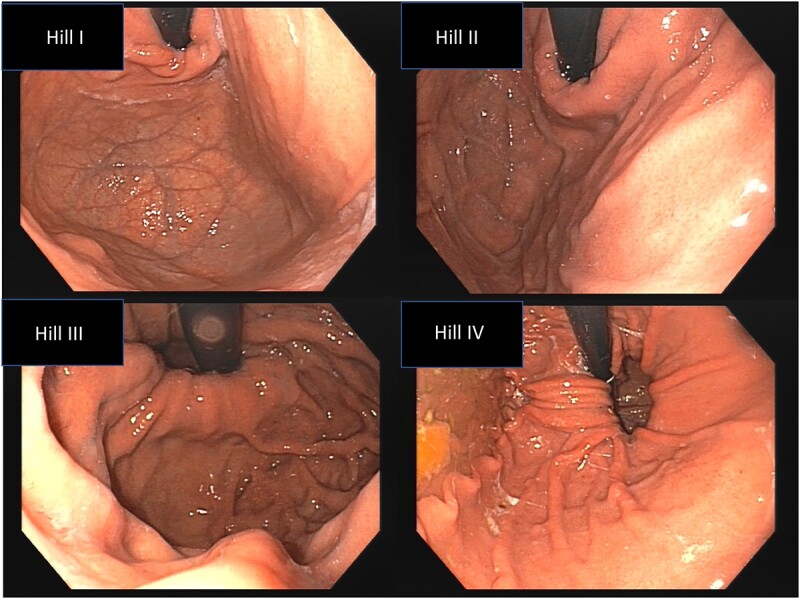
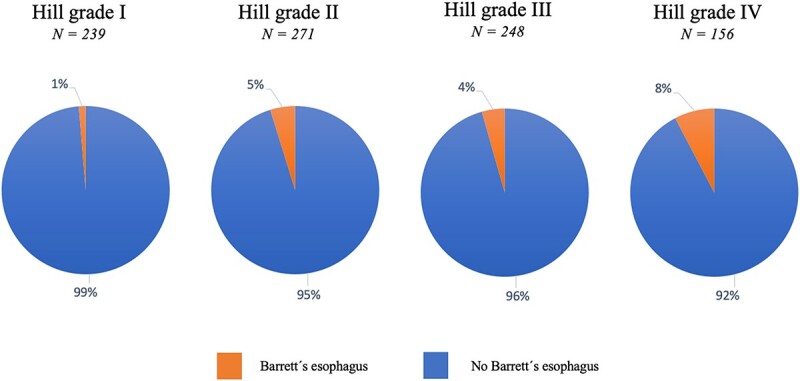
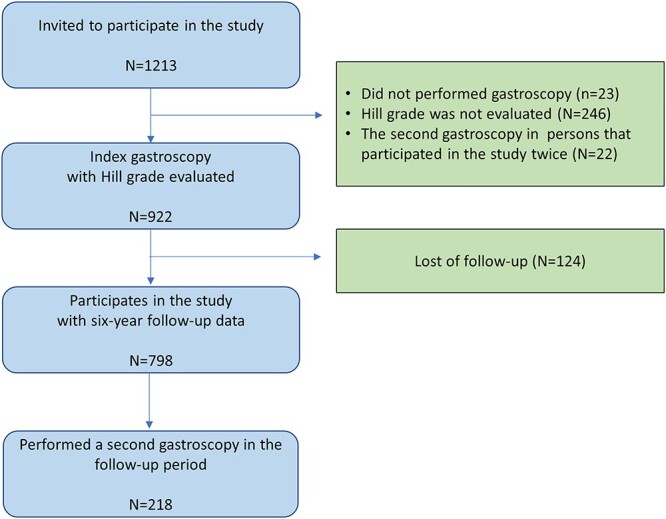
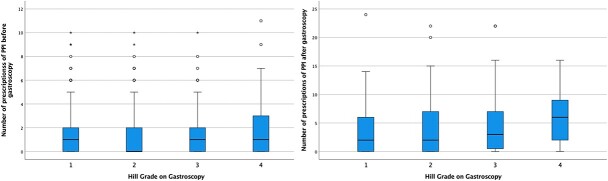
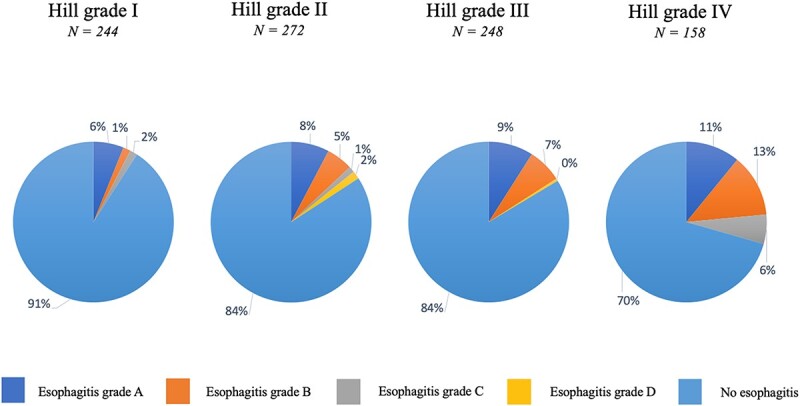
This study aimed to investigate the significance of Hill classification to predict esophagitis, Barrett's esophagus, gastroesophageal reflux disease (GERD) symptomatology, and future prescriptions of proton pump inhibitors in clinical practice. A total of 922 patients (546 women and 376 men; mean age 54.3 [SD 18.4] years) who underwent gastroscopy between 2012 and 2015 were analyzed. Patient questionnaire regarding symptoms were compared with endoscopy findings. A medical chart review was done that focused on the prescription of PPIs, additional gastroscopies, and GERD surgery in a 3-year period before the index gastroscopy and in a 6-year period afterward. In patients naïve to PPI prescriptions (n = 466), Hill grade III was significantly associated with esophagitis (AOR 2.20; 95% CI 1.00-4.84) and > 2 PPI prescriptions 6 year after the index gastroscopy (AOR 1.95; 95% CI 1.01-3.75), whereas Hill grade IV was significantly associated with esophagitis (AOR 4.41; 95% CI 1.92-10.1), with Barrett's esophagus (AOR 12.7; 95% CI 1.45-112), with reported heartburn (AOR 2.28; 95% CI 1.10-4.74), and with >2 PPI prescriptions (AOR 2.16; 95% CI 1.02-4.55). In patients 'non-naïve' to PPI prescription (n = 556), only Hill grade IV was significantly associated with esophagitis, reported heartburn, and with >2 PPI prescriptions. The gastroscopic classification in Hill grades III and IV is important in clinical practice because they are associated with esophagitis, Barrett's esophagus, symptoms of GERD, and prescriptions of PPIs, whereas a differentiation between Hill grades I and II is not.
本研究旨在探讨 Hill 分类对预测食管炎、巴雷特食管、胃食管反流病(GERD)症状和质子泵抑制剂(PPI)未来处方的意义。对 2012 年至 2015 年间接受胃镜检查的 922 名患者(546 名女性和 376 名男性;平均年龄 54.3 [18.4] 岁)进行了分析。比较了患者问卷中的症状与内镜检查结果。进行了病历回顾,重点关注索引胃镜检查前 3 年和之后 6 年内 PPI 处方、额外胃镜检查和 GERD 手术的情况。在未接受 PPI 处方的患者(n=466)中,Hill 分级 III 与食管炎(优势比 2.20;95%置信区间 1.00-4.84)和索引胃镜检查后 6 年内 > 2 次 PPI 处方(优势比 1.95;95%置信区间 1.01-3.75)显著相关,而 Hill 分级 IV 与食管炎(优势比 4.41;95%置信区间 1.92-10.1)、巴雷特食管(优势比 12.7;95%置信区间 1.45-112)、报告的烧心(优势比 2.28;95%置信区间 1.10-4.74)和 >2 次 PPI 处方(优势比 2.16;95%置信区间 1.02-4.55)显著相关。在接受 PPI 处方治疗的患者(n=556)中,只有 Hill 分级 IV 与食管炎、报告的烧心和 >2 次 PPI 处方显著相关。在临床实践中,Hill 分级 III 和 IV 的分类很重要,因为它们与食管炎、巴雷特食管、GERD 症状和 PPI 处方有关,而 Hill 分级 I 和 II 之间的区别则不然。