Department of Physics, Scottish Universities Physics Alliance (SUPA), University of Strathclyde, Glasgow G4 0NG, United Kingdom.
Department of Electrical & Electronic Engineering, University of Bath, Bath BA2 7AY, United Kingdom.
Nano Lett. 2023 Feb 22;23(4):1451-1458. doi: 10.1021/acs.nanolett.2c04826. Epub 2023 Feb 7.
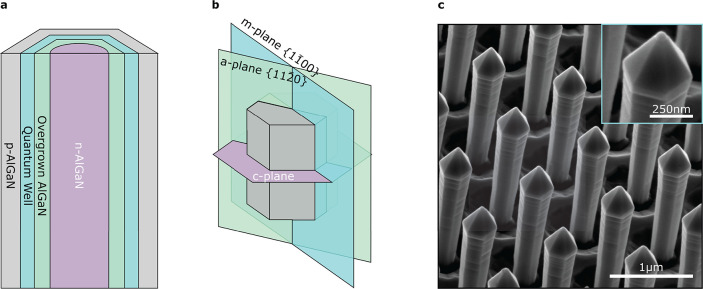
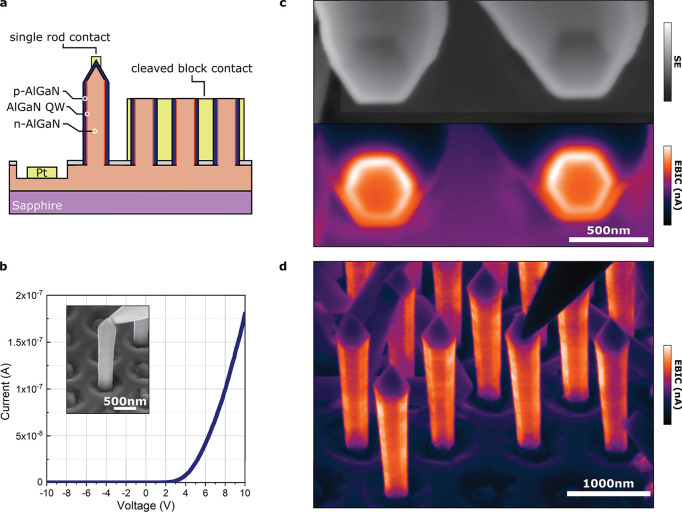
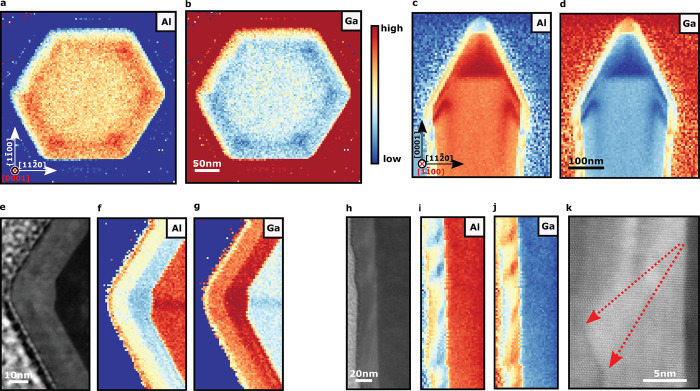
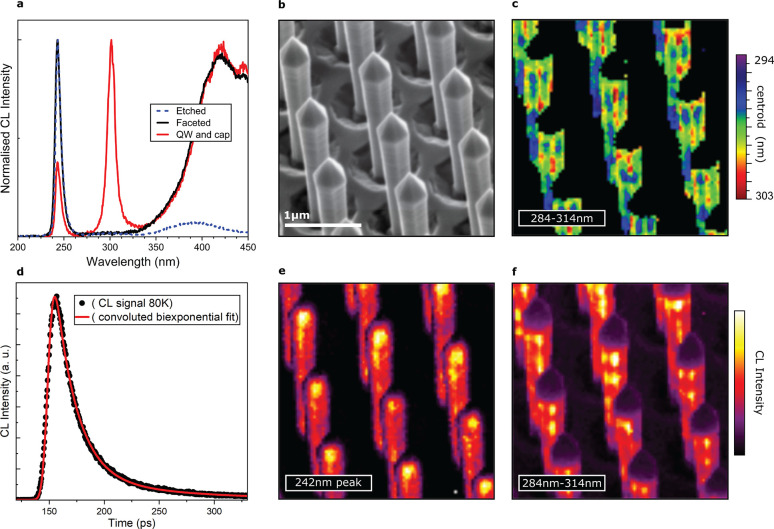
Existing barriers to efficient deep ultraviolet (UV) light-emitting diodes (LEDs) may be reduced or overcome by moving away from conventional planar growth and toward three-dimensional nanostructuring. Nanorods have the potential for enhanced doping, reduced dislocation densities, improved light extraction efficiency, and quantum wells free from the quantum-confined Stark effect. Here, we demonstrate a hybrid top-down/bottom-up approach to creating highly uniform AlGaN core-shell nanorods on sapphire repeatable on wafer scales. Our GaN-free design avoids self-absorption of the quantum well emission while preserving electrical functionality. The effective junctions formed by doping of both the n-type cores and p-type caps were studied using nanoprobing experiments, where we find low turn-on voltages, strongly rectifying behaviors and significant electron-beam-induced currents. Time-resolved cathodoluminescence measurements find short carrier liftetimes consistent with reduced polarization fields. Our results show nanostructuring to be a promising route to deep-UV-emitting LEDs, achievable using commercially compatible methods.
现有的高效深紫外 (UV) 发光二极管 (LED) 障碍可能通过从传统的平面生长转向三维纳米结构来减少或克服。纳米棒具有增强掺杂、降低位错密度、提高光提取效率以及没有量子限制斯塔克效应的量子阱的潜力。在这里,我们展示了一种混合自上而下/自下而上的方法,可在蓝宝石上重复制造高度均匀的 AlGaN 核壳纳米棒,其规模可达晶圆级。我们的无 GaN 设计避免了量子阱发射的自吸收,同时保留了电功能。使用纳米探针实验研究了掺杂 n 型核和 p 型帽形成的有效结,我们发现开启电压低、整流性能强且电子束诱导电流显著。时间分辨的阴极荧光测量发现载流子的短寿命与减少的极化场一致。我们的结果表明,纳米结构是实现深紫外发射 LED 的一种很有前途的途径,它可以使用商业兼容的方法实现。